He was tall once. You could tell. Now he stooped over a wooden cane, thin white hair, a cardigan buttoned wrong by one.
“Help you?” he said.
“Are you Walter Brennan?”
“I am.”
“My name is Margaret Lowe. I’m the librarian.” My voice wasn’t quite steady. “I think something of yours came back to me. Fifty-five years late.”
I held out the letter.
He looked at it the way you’d look at a face you buried. He took it with a hand that shook worse than mine, and he unfolded it on his own doorstep, and I watched a seventy-eight-year-old man read the words a nineteen-year-old boy had been too afraid to mail.
When he got to the bottom — I waited, you didn’t come — he had to sit down on the porch step.
“I waited at that bridge until dark,” he said. “Whole afternoon. I told myself if she didn’t come, that was my answer.” He pressed the heel of his hand to his eye. “Shipped out that Thursday. Came home two years later and she’d married a fella from Dubuque. So I married my Ruth. Fifty-one good years with Ruth. I’m not sorry for those. But I never did mail this. Couldn’t even look at it.”
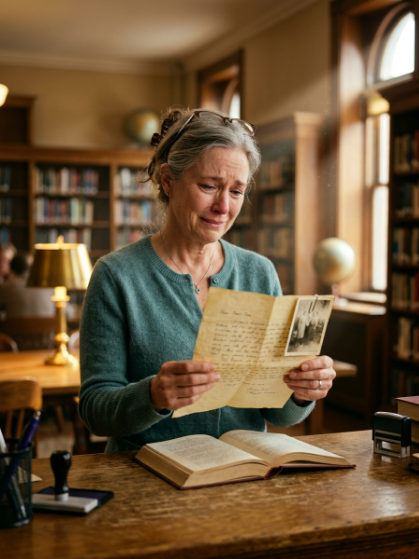
I made myself say the part I’d come to say.
“Mr. Brennan. Evelyn never married a man from Dubuque. She married late, lost him a few years back. She still lives here. Four blocks over, on Bench Street.”
He went very still.
“She’s been four blocks away,” he said.
“For fifty-five years.”
I should tell you there’s a cruelty folded into this story, the kind only time commits. Because I’d found Evelyn first, the day before. And Evelyn Carr is in the memory-care wing out on the county road now. Some mornings are clear. Most aren’t.
I told Walter that, gently, on the porch.
He didn’t crumble. He just nodded, the way old people do at news they’ve already half guessed about the world.
“Then we’d better not waste the afternoon,” he said, and reached for his cane.
I drove him myself.
A nurse walked us back. Evelyn was by the window in a pale blue sweater, white curls soft as dandelion, watching a bird feeder with the patient blankness of someone whose today won’t hold still.
“Evie,” Walter said.
She looked at him kindly. The way you’d look at a nice stranger.
He didn’t push. He didn’t say remember me. He just lowered himself into the chair beside her, unfolded the letter, and read it to her in a voice that found its way back to nineteen as it went.
She listened the way she might listen to anyone.
Until he reached the line about the river bridge.
And Evelyn Carr said, clear as a bell, to the window: “He waited at the wrong bridge. There were two.” A small frown. “I waited at the north one. Till dark. He never came.”
Walter stopped breathing.
Fifty-five years. Two bridges. A whole life each, spent four blocks apart, over an afternoon when they’d both waited until dark for someone standing half a mile away.
“Evie,” he whispered. “It was me. I was at the south bridge.”
She turned and looked at him. And for just a moment — I will swear to this for the rest of my life — something surfaced behind her eyes, something young, and she smiled the exact smile from the photograph paper-clipped to his letter.
Then he hummed a few bars of something old. And she hummed it back. All of it. Every note, when she couldn’t hold his name for ten seconds.
The body forgets a great deal. It seems a song is the last thing to go.
I left them by the window, two voices humming a tune I didn’t know.
In the car afterward, Walter held the letter flat on his knee and smoothed it the way you’d smooth a blanket over someone sleeping. “All those years,” he said, “I thought she read it and stayed away. Turns out she never got the chance to not love me.” He almost laughed. “I grieved the wrong story my whole life.”
I told him the truth, because librarians deal in truth: that he couldn’t have the lost years back, and no letter would buy them. He nodded. “I know. But I’ve got the afternoons now. A man my age learns to be rich on afternoons.”
He goes every day now. She doesn’t always know him. But she always knows the song.
Some loves don’t get the fifty-five years. They get an afternoon at the end, and one melody that memory refuses to surrender.
I’m a librarian. I return things to where they belong.
I never returned anything that mattered more than this.