I buttoned my jacket and walked to the podium, past Bill Hollis, close enough to touch.
He’d stopped clapping. His hands hung in the air, and you could watch my name climb up through twenty-two years and arrive on his face.
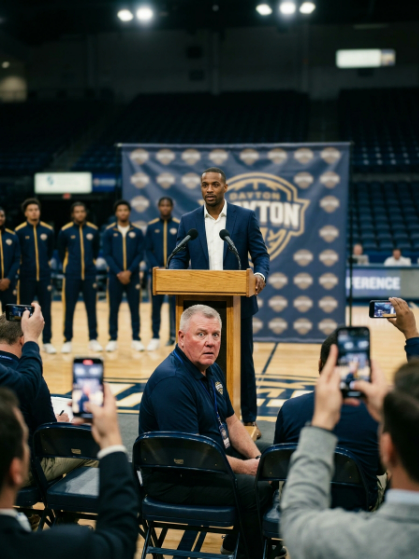
The team president stepped aside. “Mr. Coleman,” she said, and the cameras swung to me. I set my hands on the lectern and looked out at the players along the baseline and the gray old coach in the front row.
“Twenty-two years ago,” I said, “I got cut in this gym. The coach told me I was too small to ever matter on his court. He handed me my bag and told me to find a hobby.” I let that settle. “I believed him for about ten years. That’s the part I want to talk about. Not the cut. The ten years.”
The room was dead quiet.
“Because a kid will believe a coach. That’s the whole danger of the job. You can hand a sixteen-year-old a sentence he carries for a decade, and you’ll never know you did it, because by then he’s gone and you’re on to the next roster.”
I found Hollis’s eyes and held them, and I made myself keep my voice even, because this wasn’t a place for a score.
“I’m not here for revenge, Coach. If I’d bought this team to humiliate you, you’d still be running my life from a folding chair. I’m done letting you do that.”
Then I told them what the Foundry was going to become.
“We’re opening a youth academy. Free for the city’s kids. And it has one rule above all the others, printed on the door: no child is ever cut here for their size. Not their height, not their build, not how they look in a warmup line. We’ll measure skill. We’ll measure heart. We threw the tape measures out.”
The players started it, and then the whole room was clapping.
“There’s one more thing,” I said, when it quieted. “Most of you don’t know the name Earl Briggs. Twenty-two years ago he was the JV assistant nobody noticed. He’s the man who found a skinny kid crying in that stairwell, drove him home, and told him his handle was real and the world was wrong. He’s the only reason I picked a ball back up at all.”
I looked to the tunnel, where a heavyset man in his seventies stood gripping the rail, because I’d flown him in and not told him why.
“Earl. The academy is yours to run. If you’ll have it.”
Earl Briggs cried. So, I’m not ashamed to say, did I.
I talked to Hollis after, in the office that used to be his fortress, door closed.
He looked older up close. Smaller, somehow.
“You could’ve fired me on that stage,” he said. “In front of everybody. God knows I had it coming.”
“I thought about it for ten years,” I said. “Here’s where I landed. The Foundry believes every kid gets developed. Nobody gets told they’re too small. If you can coach like that — actually coach like that — there’s a chair for you. If you can’t, you retire Friday with a handshake and your banners, and we part clean.”
He was quiet a long time.
“When I started,” he finally said, “I thought hard was the same as good. Cut ’em, break ’em, see who’s left. I built thirty years on it.” He rubbed his face. “I don’t think I can unlearn it at sixty-two and not fake it. And those kids’ll know if I’m faking.”
“They will,” I agreed.
So Bill Hollis retired that Friday. Handshake. Banners. Dignity intact, which is more than he gave me, but I find I sleep better having given it anyway.
He did one thing before he left.
He pulled that year’s cut list off the board, found the smallest name on it — a guard the staff had flagged as “undersized” — and reinstated the kid himself. Walked out to the parking lot and told the boy’s father in person.
“Wrong call,” he said. “Saw it too late on another one once.”
That kid starts for our academy team now.
We named the youth program the Briggs Academy, and the first banner we hung in that gym wasn’t a championship. It was a photo — Earl at sixteen kids’ eye level, laughing, a clipboard under his arm. The kids touch it on their way out to the floor, the way ballplayers always touch something for luck. They have no idea who he is yet. They will.
The Foundry’s been mine for two seasons. We win some, we lose some, and not one child who walks through our doors gets told there’s a ceiling stamped on him at sixteen.
I keep my old gym bag in the office.
Some mornings I look at it and remember the kid in the stairwell who thought it was over.
Then I go unlock the gym.