Twenty-two years of training take over in a moment like that. The mind goes quiet. The hands already know.
I cleared the cord from the baby’s neck — one loop, careful, fast. I cleared the tiny mouth and nose. I laid that still little body along my forearm, head low, and I rubbed the small back hard with the heel of my hand, the way you do, the way that feels almost too rough for something so new.
“Come on,” I whispered. “Come on, sweetheart.”
Eli had stopped breathing. Sarah was begging from the bed. The lantern threw all our shadows huge against the wall.
I rubbed and I cleared and I bent and breathed two small breaths into a chest the size of my palm.
And the baby — a girl — shuddered, pulled in a furious, scraping breath, and screamed.
The most beautiful sound I have ever heard in my life.
Loud. Outraged. Alive.
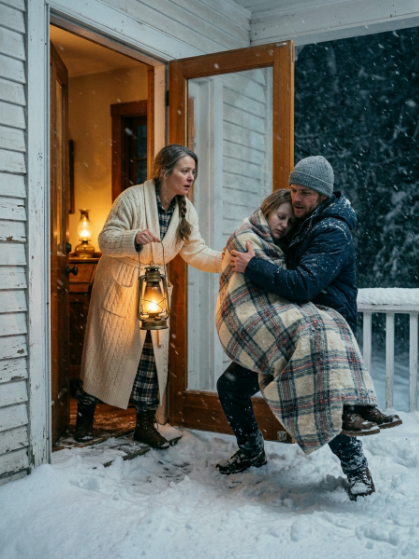
Eli dropped to his knees a second time that night, and this time it was relief that put him there.
We weren’t done. Sarah was bleeding more than I liked, and I worked on her by lantern light with the few supplies I keep at home and a calm I did not entirely feel. But the bleeding slowed. Her color came back. By four in the morning, mother and daughter were both asleep under every quilt I own, and Eli was sitting on my kitchen floor with his back against the cabinets, holding his wife’s hand through the bed rail, crying without making any sound at all.
“You saved them,” he kept saying. “You saved both of them.”
“You saved them,” I told him. “You carried her two miles through a whiteout. I just caught the part at the end.”
The storm broke a little after dawn.
I heard the plow before I saw it — that low diesel growl coming up the county road, the first sound from the outside world in twelve hours. It stopped at the end of my drive. A truck door slammed. Boots on the snow.
The man who came through my door was sixty, maybe, in a county Public Works coat, snow to his knees, panic all over his face.
“Eli,” he choked out. “Your truck’s in the ditch on Route 12, I’ve been driving since five, I thought—”
“Dad.” Eli stood up fast. “Dad, we’re okay. We’re okay. It’s a girl.”
And the older man stopped dead in the middle of my kitchen.
Because I knew his face. And, slowly, he placed mine.
Carl Marsh. Chair of the county board of supervisors. The man who, eleven days earlier, had read the budget aloud and called my clinic “redundant,” and voted, with four others, to shut it down.
He looked at the nurse he’d voted out of a job.
He looked at the bassinet I’d made out of a dresser drawer, and his granddaughter asleep in it.
He looked at his daughter-in-law, alive.
And Carl Marsh, who I had never once seen lost for words at a podium, covered his face with both hands and wept in my kitchen.
“She’d have died,” he said, when he could talk. “On that road. In this. If you hadn’t been here. If your light hadn’t been on.”
“My light’s always on,” I said. “That was rather the point of the clinic.”
He flinched like I’d struck him. Good.
I want to tell you Carl Marsh changed because he saw the light. Maybe he did. But I think mostly he saw a ledger line turn into a granddaughter, and he understood, in a way no public hearing had ever made him understand, what “redundant” actually buys.
The board met again two weeks later. Carl moved to reverse the vote himself. He read the names this time — every baby the clinic had caught in twenty-two years, all the way down to one delivered by lantern light in a blizzard, eleven days after he’d tried to close it. The funding was restored. They added a second nurse and a four-wheel-drive on permanent call for storm nights.
They named the call program after my late husband, when they learned he’d been the volunteer who used to drive it.
I went back to work.
Sarah and Eli named the baby Claire.
She comes by every birthday, that little girl, taller each time, and every year her grandfather Carl drives her himself.
He always parks where he can see the porch.
He says he just likes knowing the light still works.