The quiet man in the corduroy coat walked to the front of the room, and Mayor Dodd’s gavel never came down.
“My name is Harold Whitman,” he said. “I’ve lived in Cedar Falls for six years. I check out two books a week from Ms. Alvarez’s library. And I’ve sat in the back of these meetings for most of those six years, because you learn the most about a town by watching how it treats the people who don’t think anyone important is watching.”
He set a worn leather folder on the lectern.
“Before I retired here, I spent twenty-six years on the federal bench. A fair number of those years, I heard cases brought under the Americans with Disabilities Act.”
The room changed temperature.
“Mr. Mayor, you’ve told this woman ‘maybe next year’ for two years. You’ve called the building grandfathered. I’d gently point out that a public building which has had three renovations since 1990 — new HVAC, a new roof, a remodeled circulation desk — is not as grandfathered as you’d like. Each of those was a chance to bring the entrance into compliance. The town passed on every one.”
Mayor Dodd’s jaw worked. “We are not going to be threatened in our own—”
“It isn’t a threat,” Whitman said, mildly. “If it were a threat, I’d have brought a lawyer instead of a checkbook.”
He opened the folder.
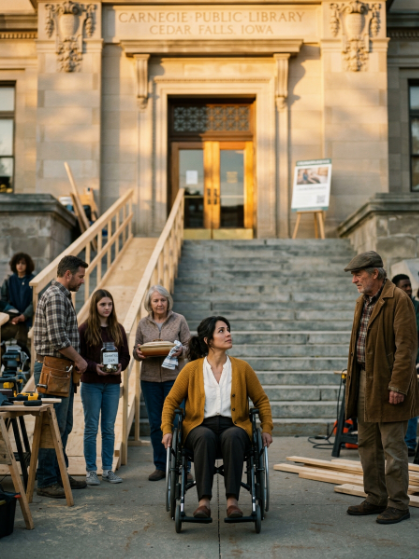
“I also chair a small family foundation. For two years I’ve watched Ms. Alvarez enter her own library through the alley, past the dumpsters. I watched her put a jar on her desk and letter a poster by hand. I watched this town answer her with bake sales and mowing money and a stack of donated lumber and a Saturday of volunteers.”
He looked around the room, and his weathered face softened.
“I wanted to see if Cedar Falls would do the right thing before anyone made it. You did. Quietly. Out of your own pockets. So here is mine.”
He slid a piece of paper to the clerk.
“The foundation will match every dollar this town has raised for that ramp, and cover whatever is left to build it right — proper grade, handrails, heated against the ice. On one condition.” A small smile. “It is finished before the first snow.”
For a second, nobody moved.
Then the room came apart into applause — the carpenter, the teenager with the donation jar, the mom with the stroller, the man still learning to walk after his stroke. Denise from the bake sale was crying. So, I realized, was I.
Mayor Dodd sat very still while the town clapped around him.
He is, whatever else, a man who can read a room.
“The chair,” he said finally, into the microphone, “withdraws its objection. The ramp is approved tonight. Unanimously.”
The ramp went in over the next five weeks.
Blond wood and gray steel, a clean rise to the tall front doors, handrails worn smooth already by every hand that uses them now. They built the grade exactly to code, the way Whitman asked. The way it should have been built decades ago.
Half the volunteers from that first Saturday came back to help finish it. The carpenter donated his labor. The hardware store on Main knocked the price off the railings and didn’t make a fuss about it. A girl from the high school painted a little sign for the landing — not the building’s name, just two words: “Everyone Welcome.” Nobody asked her to. Nobody took it down.
The council did one more thing that month. They voted to establish a standing accessibility fund — a line in the budget, every year, so the next person who needs a ramp, an interpreter, a lowered counter, doesn’t have to put a jar on a desk and beg.
They asked me to help write the policy. I said yes before they finished the sentence.
And there was a ribbon.
Of course there was a ribbon.
They held it on a cold bright Saturday, the whole town crowded onto the sidewalk. And the man who cut it — gold scissors, big smile for the local paper — was Mayor Roy Dodd, who had told me “maybe next year” for two years running.
I let him have the photo. Politicians need their photos, and grace is cheaper than spite.
But when the ribbon fell, it was me who went up that ramp first.
Harold Whitman held the door, the way he’d held a hundred library doors before I ever knew his name.
“After you, Ms. Alvarez,” he said.
I rolled through the front entrance of my own library, in the daylight, where everyone else goes in.
It only took eleven steps to fix.
It just took the whole town to climb them.