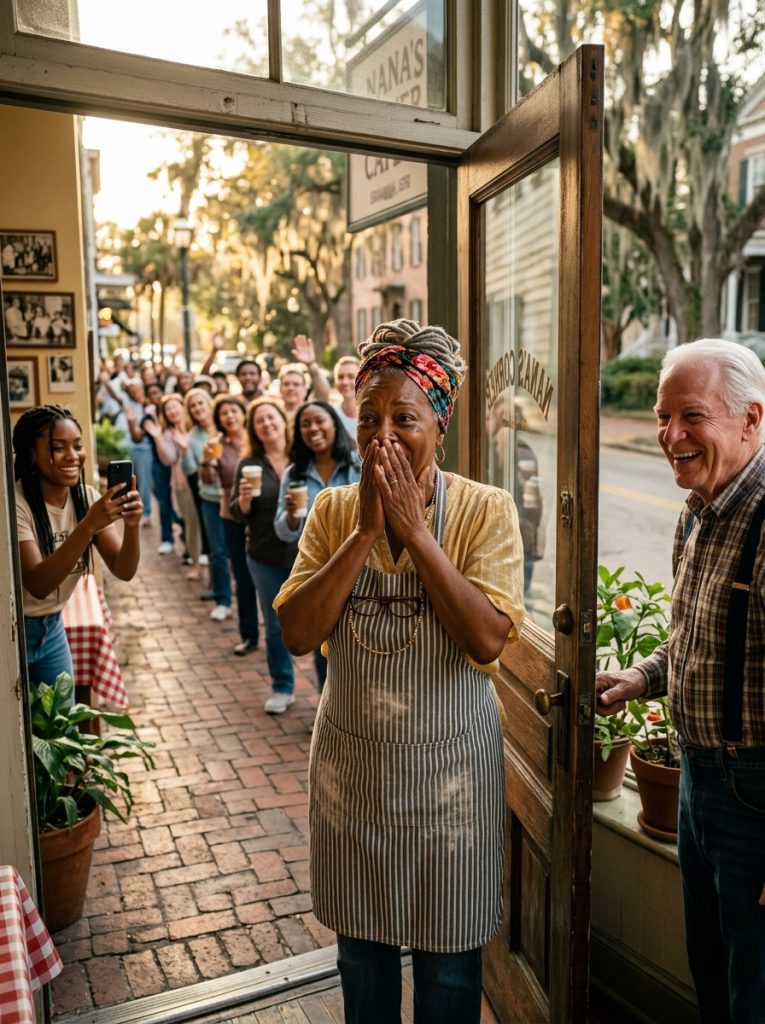
Nana came out of the kitchen wiping her hands on her apron.
She saw the line and stopped moving.
I watched her face from behind the register. Thirty years I’d known this woman — my whole life — and I’d never seen that expression before. Her mouth opened. Closed. Opened again. Her hand went to her chest like she was checking her own heartbeat.
“Keisha,” she whispered. “What — how — “
“They came, Nana. They all came.”
The line stretched past the barbershop. Past the laundromat. Around the corner onto Delancey Street. Forty people. Maybe fifty. Regulars. People who’d been eating her cooking since before I was born. People whose kids had grown up on her mac and cheese. People who’d had first dates in these booths and brought their grandchildren back to the same tables.
Earl was already inside. His booth. The one by the window with the cracked vinyl he refused to let us replace because he’d “broken it in perfect.” He’d been there since six a.m., first one at the door. He caught my eye through the window and grinned so wide his gold tooth caught the morning light.
Nana’s eyes filled up. She pressed both hands to her mouth and the tears came. Not sad tears. Not the ones I’d seen over the past three months when the reviews kept piling up and the customers stopped coming. These were the other kind. The kind that come when you’ve been fighting so long you forgot what winning looked like.
“They came back,” she said through her fingers.
“They never left, Nana. They were just waiting for you to let them show up.”
She stood there another moment. Small. Seventy-three years old and barely five-foot-two, but she’d always seemed giant to me. Still did. Even crying in her apron at seven in the morning with flour on her cheek.
Then she straightened up. Wiped her face with the apron. Smoothed her hair back. Lifted her chin.
“Well.” Her voice was steady again. “They came for food. Better give them some.”
She turned and walked back into the kitchen. I heard every burner fire up. Heard the cast iron hit the stove. Heard her humming — first time in months.
I unlocked the front door at seven sharp.
They flooded in. Mr. Patterson with his walker, moving slow but determined. The Davis twins who’d been coming every Saturday since high school. Lorraine from the church choir with her big purse and bigger voice. Teachers from the elementary school two blocks over. The mechanic from Broad Street who never remembered anyone’s name but had his order memorized since 1998.
They filled every table. Every booth. People stood along the wall waiting and nobody complained. They talked to each other like old friends at a reunion. Which, in a way, they were. The bad reviews had scattered everyone. Made them second-guess a place they’d loved for decades because some stranger on the internet said it wasn’t worth the trip.
The kitchen sang. Smothered pork chops. Collards with the ham hock cooked low and slow since yesterday. Mac and cheese with the burnt edges everyone fought over. Cornbread in the cast iron. Sweet tea so strong it could wake the dead.
I worked the register until my fingers hurt. Nana worked the kitchen until the sweat soaked through her shirt. We didn’t stop. Didn’t slow down. Didn’t want to.
By nine a.m., a news van pulled up outside.
Channel 7. A reporter named Danielle with perfect hair and a microphone and a cameraman who kept bumping into chairs.
“We’re hearing about an incredible community response here in Germantown,” she said, facing the camera outside the restaurant. “Nana’s Kitchen, a beloved thirty-year neighborhood institution, was recently targeted by a devastating online review. But this morning, the community is answering back.”
She interviewed Earl first. Of course she did. Earl had never met a camera he didn’t love.
“I’ve been eating here since 1994,” he said, leaning back in his booth like a king surveying his kingdom. “Some blogger with a laptop and an agenda ain’t gonna change that. This food is truth. You can taste thirty years of love in every bite. You can’t fake that and you can’t kill it with a keyboard.”
Danielle interviewed Mr. Patterson. The Davis twins. Lorraine, who cried on camera and didn’t apologize for it.
Then she turned to me.
“Keisha, you organized this?”
“I made some phone calls. Put something on Facebook last night. But I want to be clear — these people didn’t come because I asked. They came because they love this place. Because it belongs to them as much as it belongs to us.”
The segment aired at noon. Shared four thousand times by dinner.
By afternoon, the internet did what the internet does. Someone dug into the blogger’s history. His name was Derek Vine. Food critic. Influencer. Twenty-two thousand followers built on restaurant reviews and “hidden gem” content.
What they found: six restaurants had paid him for positive reviews. Screenshots of DMs offering coverage for cash. Venmo receipts. A pattern going back three years. Pay Derek, get five stars. Refuse Derek, get destroyed.
He’d given Nana’s Kitchen one star because she’d refused to pay for placement on his “Best Hidden Gems” list. She hadn’t even understood it was a shakedown. She’d just said, “Baby, I don’t pay for compliments. The food speaks for itself.”
And he’d buried her for it. One review. One star. Three months of empty tables.
By evening, his own page was flooded. His reviews dropped to one star across every platform. He deleted his Instagram by midnight. His Twitter went dark an hour later.
I didn’t feel sorry for him. Not even a little bit.
Thursday morning, the landlord called. Mr. Kovacs. He’d been circling for months, talking about “market rates” and “viable tenants.” The empty tables had given him leverage. “Maybe this location isn’t sustainable anymore,” he’d said last month. Code for: I can get twice the rent from a juice bar.
But now Channel 7 had run the story. Now the line was out the door every morning. Now Nana’s Kitchen was the feel-good segment of the week, shared by people who’d never even been to Germantown.
“I’d like to offer a ten-year lease renewal,” he said. “Same terms as your current agreement.”
Nana was right next to me when the call came. I put it on speaker so she could hear.
“Ten years?” she said, looking at me.
“Yes ma’am. With an option to extend after.”
She held my gaze. I nodded. She nodded back.
“I’ll have my granddaughter review the paperwork,” she said, calm as Sunday morning. “But yes. We’re staying.”
She hung up and walked back to the stove. Like it was nothing. Like she hadn’t just secured another decade in the building that held her life’s work.
But I saw her shoulders drop two inches. Saw the tension leave her neck. I heard her start humming again — Smokey Robinson this time.
Saturday morning. Early. The light just coming through the windows.
I stood in the kitchen doorway and watched. Nana behind the counter, apron tied tight, cracking eggs into a bowl with one hand. Radio playing low — Motown, always Motown. The smell of butter and coffee and cornbread already filling every corner.
Earl was in his booth. Paper spread out. Coffee black, two sugars. Same as every morning for twenty-nine years. He looked up, caught me watching, and raised his mug in a little salute.
The cafe that couldn’t be killed.
Not by a blogger with a grudge. Not by a landlord with dollar signs. Not by an algorithm that rewards cruelty and buries truth.
Here it stands. Nana behind the counter. Earl in his booth. Regulars filing in one by one. Same hooks for their coats. Same chairs. Same orders they’ve been placing for decades.
Some things can’t be killed by a one-star review.
Some things survive because they’re built on something the internet can’t touch.
They’re built on showing up. On thirty years of the same hands making the same food for the same people.
Not because an algorithm said to.
Because it’s home.