The video hit two million views before I finished my coffee.
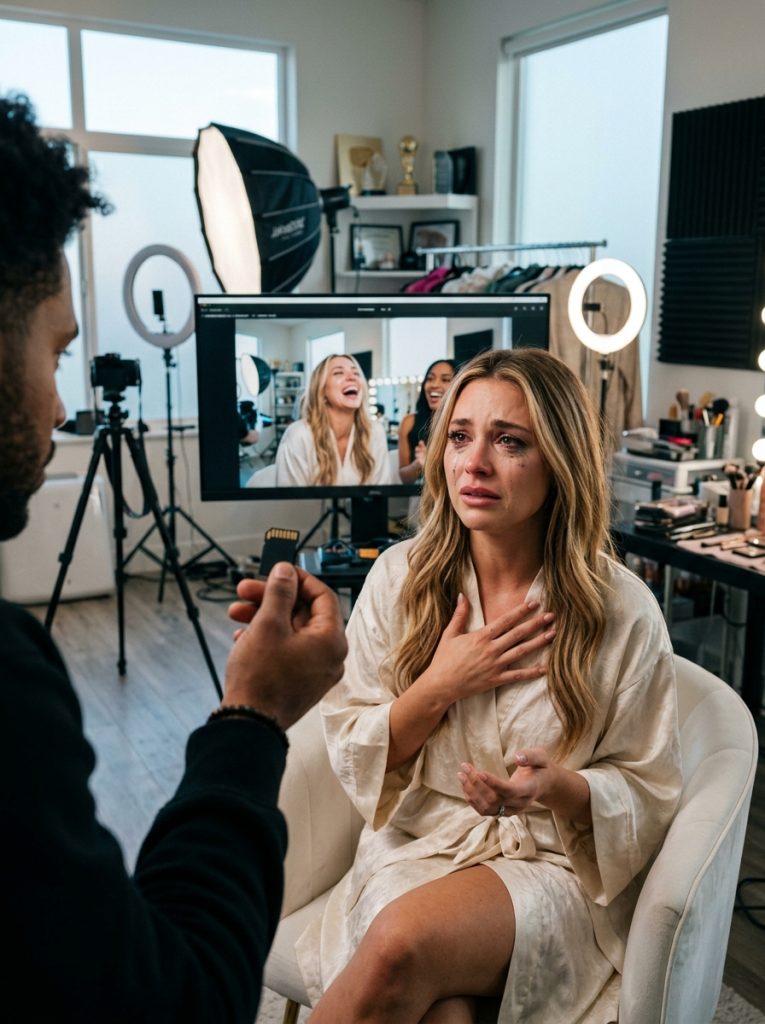
I sat in my apartment in Koreatown, laptop open on the kitchen counter, watching the numbers climb. The outtakes I’d uploaded — Chloe Ashford dabbing glycerin under her eyes, practicing her quiver in a compact mirror, laughing between takes of her “raw vulnerability” series — were everywhere.
My phone buzzed. Then buzzed again. Then didn’t stop.
I poured another cup and let it ring. Let the notifications pile up. I didn’t owe anyone a response yet.
By noon, three brands had issued statements. Luminara Skincare went first. “We are deeply troubled by the footage and are terminating our partnership with Chloe Ashford effective immediately.”
I read it twice. Luminara was her biggest deal. Six figures a year. I knew because I’d edited the announcement video. I’d color-corrected her skin while she held their serum up to the ring light and pretended it changed her life.
FreshThread dropped her by two o’clock. Then Aura Wellness. Then the protein powder company whose name I could never remember. Then the meditation app.
Each statement was more corporate than the last. Each one was a nail in a coffin she’d built herself.
I didn’t feel joy. I thought I would, but I didn’t. I felt something quieter. Something like exhaling after holding your breath too long. Something like setting down a bag you didn’t realize was crushing your shoulders.
Priya called me that evening.
“Marcus.” Her voice was shaking. “FreshThread just emailed me. They want to discuss a collaboration.”
“That’s because your content is actually good, Priya.”
“She stole my entire format. My transitions. My scripting style. The way I frame my morning routines. And they gave her the deal over me two years ago because she had more followers.”
“I know.”
“And now they’re calling me.”
“Take the meeting,” I said. “You earned this before she ever copied you. The numbers just finally caught up to the quality.”
She was quiet for a moment. I could hear traffic on her end. She was probably on her balcony in Echo Park, looking at the hills. “Thank you. For uploading it. I know it wasn’t easy.”
It wasn’t. I’d edited Chloe’s videos for fourteen months. I’d watched her build an empire on choreographed emotion. I’d seen the glycerin bottle in her kit and said nothing because the paycheck was good and rent in LA doesn’t care about your ethics.
I’d watched Priya’s original concepts show up in Chloe’s feed three days after Priya posted them, repackaged with better lighting and a bigger budget.
The SD card sat in my desk drawer for two months before I did anything with it. Sixty days of looking at that drawer and thinking about what was inside.
Two days after the upload, Chloe posted a response video. Tears — real ones this time, I could tell the difference now. She called it a “violation of trust.” She called me “a disgruntled former employee.” She said the outtakes were “taken out of context.”
The comments were brutal.
“Girl, the context is you faking crying for brand deals.”
“What context makes glycerin drops okay?”
“So the tears for your ‘miscarriage scare’ video were fake too?”
That last one hit different. I remembered editing that video. The way she’d nailed it in one take. The way she’d checked her phone immediately after and said “that’s gonna do numbers.” I remembered her laughing about the engagement metrics afterward while I sat at my editing bay feeling sick.
By Friday, her subscriber count had dropped by four hundred thousand. Her comment sections were graveyards of betrayal. People who’d sent her money during that miscarriage video. People who’d shared their own losses in her comments, thinking they were connecting with someone real.
Those people were the reason I uploaded it. Not revenge. Not Priya. Them.
The following Monday, I got a call from a production company in Burbank. Redline Media. They’d seen the footage and — more importantly — they’d seen how cleanly it was cut. How the narrative built without commentary.
“We’re not interested in drama,” the creative director told me. “We’re interested in editors who understand story structure. That footage was devastating because of how you sequenced it. The mirror check before the fake cry. The laughing followed by the performance. That’s editorial instinct.”
They offered me a staff position. Full benefits. A desk with my name on it.
I said yes before he finished the salary number.
Three weeks later, I met Priya for coffee at a place in Silver Lake. She looked different. Lighter. She’d signed with FreshThread and two other brands. Her subscriber count had tripled. People were discovering her back catalog, realizing she’d been making this content for years.
“How does it feel?” I asked.
She wrapped both hands around her latte. “Complicated. I’m glad. But I’m also angry it took exposing a fraud for people to notice my work existed. I’ve been posting for five years, Marcus.”
“Your work always existed. The algorithm just rewarded the louder version.”
“The faker version.”
“Yeah.”
We sat with that for a moment. Outside, a woman walked by wearing a FreshThread hoodie. Priya noticed and smiled, just barely.
“What happened to Chloe?” she asked.
“Lost her management. Agency dropped her. Last I saw, she’s pivoting to a podcast about ‘authenticity in the creator economy.'”
Priya laughed. Sharp and real. “Of course she is.”
“Some people can’t stop performing. Even when the stage collapses, they look for a smaller one.”
She set her mug down. “You know what gets me? That SD card was tiny. Like, physically tiny. And it just — “
“Changed everything.”
“Changed everything,” she repeated. “Her career. My career. Your career. All on that tiny chip.”
I thought about that a lot on the drive home. The 101 was packed, bumper to bumper past Hollywood, and I had nothing but time and thoughts. Fourteen months of footage on a chip smaller than my thumbnail. Fourteen months of watching someone build a castle out of lies and getting paid to polish every brick.
One upload. One decision made at two in the morning when I couldn’t sleep. And the whole thing crumbled.
Not because the truth was loud. But because it was undeniable. You can argue with words. You can spin a narrative. You can hire a crisis PR team and cry on camera and post a notes-app apology.
But you can’t argue with footage of yourself laughing while you apply fake tears. You can’t contextualize glycerin.
The truth doesn’t need a marketing budget. It doesn’t need brand deals or a content calendar. It just needs to exist somewhere people can see it.
And once they see it, it travels faster than any lie ever could.
My desk at Redline has a small frame on it now. Not a photo. Just the SD card, mounted on black velvet like a museum piece.
My coworkers think it’s a joke.
It’s not.
It’s a reminder that the smallest thing in the room can be the most powerful. That fourteen months of silence can end in fourteen seconds of footage. That the truth doesn’t expire, doesn’t lose potency, doesn’t get less true with time.
It just waits. Patient. Quiet. Ready.
Priya texted me last night. A screenshot of her latest video — two million views. Organic. No glycerin required. Just her face, her voice, her ideas.
I smiled and set my phone down.
Some stories don’t need fake tears to make people feel something.
Advertisement
They just need to be real.