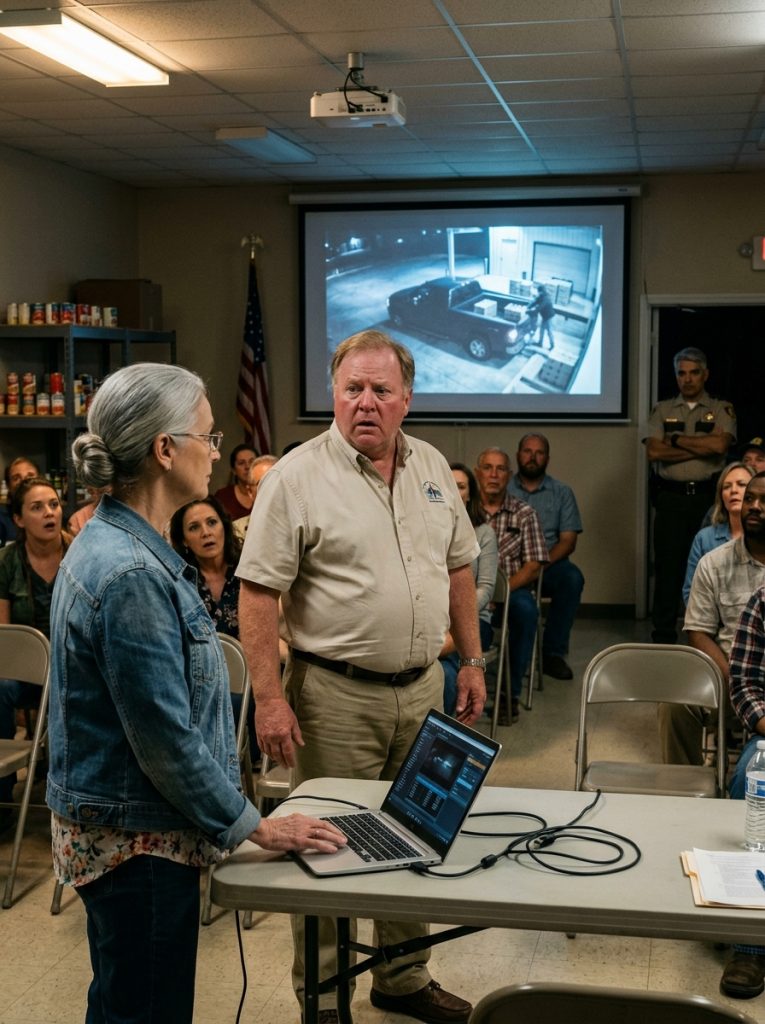
The footage ran for two minutes and fourteen seconds.
Nobody moved.
Nobody breathed.
On that screen, clear as a confession written in light, Dale Crenshaw carried crate after crate from the food bank’s loading dock into the bed of his silver pickup truck. The timestamp ticked forward. Friday. 9:47 p.m. Then 9:51. Then 9:58. Then 10:06.
Seventeen crates.
The same man who stood at the front of this room three minutes ago thanking the community for “trusting him with their generosity” was now watching himself steal from them in real time.
Dale turned away from the screen.
His face had gone the color of raw dough.
“That’s–” he started.
“Four weeks of footage,” I said calmly. I didn’t stand. I didn’t need to. “Four consecutive Friday nights. Same time. Same truck. Same loading dock. Same key you told us was for emergencies only.”
A murmur swept through the folding chairs.
Dale’s hand went to his collar. He touched the church pin like it might save him.
“Now hold on,” he said. His voice was too loud. Too fast. “There’s context here. I was moving supplies to the overflow storage–“
“What overflow storage?” Earl Tucker, seated in the third row, stood up slowly. Earl ran the hardware store on Main. He’d served on the food bank board for twelve years before Dale pushed him out. “Dale, there is no overflow storage. There never was.”
Dale’s eyes darted. Left. Right. To the door.
Sheriff Ruiz uncrossed his arms.
That was enough.
Dale stopped looking at the door.
“I can explain–“
“Then explain.” A young mother in the second row stood now too. Maria Orozco. I recognized her from Tuesday distributions. “Explain why you told me there was no formula left three weeks ago. My daughter was two months old. I had to drive to Conway to find some.”
Another voice from the back: “You told my husband the cereal was donated to the school.”
Another: “I asked about the canned soup. You said it never arrived.”
And another, quieter but harder: “My boy waited in line for an hour last Saturday. You looked him in the face and said the shipment was short.”
The room was turning.
Not loud. Not violent.
Just the slow, terrible sound of a community realizing it had been lied to by the man they put in charge of feeding them.
Dale gripped the edges of the podium.
“Sheriff,” he said, trying to sound dignified. “I’d like to file a complaint. This woman recorded me without my consent. That footage is–“
“Taken on property you don’t own,” I said. “The loading dock belongs to the county. I checked with the clerk’s office three weeks ago. There’s no expectation of privacy in a public facility after hours.”
I’d prepared for that argument. I’d prepared for all of them.
Thirty-one years as a librarian teaches you one thing above all else: research wins.
Sheriff Ruiz stepped forward.
“Dale.” His voice was quiet. The dangerous kind of quiet. “I’m going to need you to step away from the podium.”
“On what grounds?”
“On the grounds that I’ve been reviewing those camera files since six this morning, and what I’ve seen is enough to open a formal investigation. Theft of donated goods. Misuse of nonprofit resources. Potential fraud in the grant applications you filed last year listing inventory you didn’t have.”
Dale’s face collapsed.
Not the confident grin. Not the practiced charm.
Just a man caught.
He looked around the room one more time — at the families, the volunteers, the single moms who drove thirty minutes for powdered milk — and found nothing.
No ally. No sympathy. Not a single person willing to meet his eye.
“I want a lawyer,” he said.
“That’s your right,” Sheriff Ruiz replied. “Let’s go.”
He walked Dale out through the side door. Not in handcuffs. Not yet. But everyone understood.
The door closed behind them.
Silence held for three seconds.
Then Maria Orozco turned to me.
“How long have you known?”
“Three months.”
“Why didn’t you say something sooner?”
“Because I needed it to be undeniable,” I said. “One week — he’d call it a misunderstanding. Two weeks — he’d say I edited it. Four weeks, same time, same truck, same man? That’s a pattern. And a pattern is a prosecution.”
Maria nodded slowly.
Earl Tucker walked to the front of the room.
“I’d like to make a motion,” he said. “Effective immediately, the board chair position is vacant. I nominate Marge Ellison as interim director of the Pinewood Community Food Bank.”
I blinked.
“Earl, I’m a volunteer–“
“You’re the reason these families know the truth tonight. You watched that man steal food from hungry people, and you didn’t just get angry. You got evidence. You got the law involved. You waited until the moment would count.” He turned to face the crowd. “I’ve lived in this town forty-six years. I’ve never seen a quieter act of courage.”
A hand went up. Then another. Then half the room.
I didn’t ask for a vote.
They gave me one anyway.
After the meeting, people came up one by one. Some shook my hand. Some hugged me. A teenage boy stopped and said, “My little sister went to school hungry last month because of him.” His voice cracked. “Thank you.”
Advertisement
I held his hand for a moment. Let him walk away.
That night I drove home on the same two-lane road. Past the feed store. Past the church where Dale preached generosity every Sunday. Past the school where kids brought crayon-decorated bags on Saturdays.
The flash drive was still in my jacket pocket.
I pulled into my driveway. Turned off the engine. Sat in the dark. Pecan tree shadows on the windshield. Crickets thick and endless, the way they always are in Arkansas.
My phone buzzed.
Maria: “My daughter had formula tonight. First time in three weeks. Thank you, Ms. Marge.”
I set the phone down.
And for the first time in three months, I didn’t feel like I was carrying a secret that might crush me.
The next morning, the parking lot of the sheriff’s office was full by eight.
Families I recognized from the food bank. The hardware store owner. Two county board members. The pastor from First Baptist — the one who’d shared a pew with Dale for fifteen years.
They came with stories. With receipts. With questions they’d been too polite to ask for too long.
“How much did he take?” Maria asked the deputy at the front desk.
“We’re still counting,” he said.
She nodded. Held her daughter a little tighter. And waited.
By the end of that week, seventeen families had filed statements. Seventeen. Each one a story of being told there wasn’t enough — while Dale loaded his truck in the dark.
The investigation took six weeks. Dale was charged with felony theft and nonprofit fraud. The audit revealed forty-three thousand dollars diverted over two years — resold under his nephew’s name, given to unqualified family, hoarded in a storage unit rented with food bank petty cash.
He pled guilty. Eighteen months. Full restitution.
The food bank reopened Monday. We restructured the board. Added Maria. Installed cameras. Created a transparent inventory system.
The shelves stayed full on Fridays now.
And every Tuesday and Thursday, I still showed up at seven to sort cans, bag rice, and stack powdered milk.
Simple work. Quiet work.
But this time, there was nothing left to hide from.
And the families of Pinewood finally got what they’d been promised all along.
Someone who showed up for them.
Not for applause. Not for a church pin.
Just because it was right.