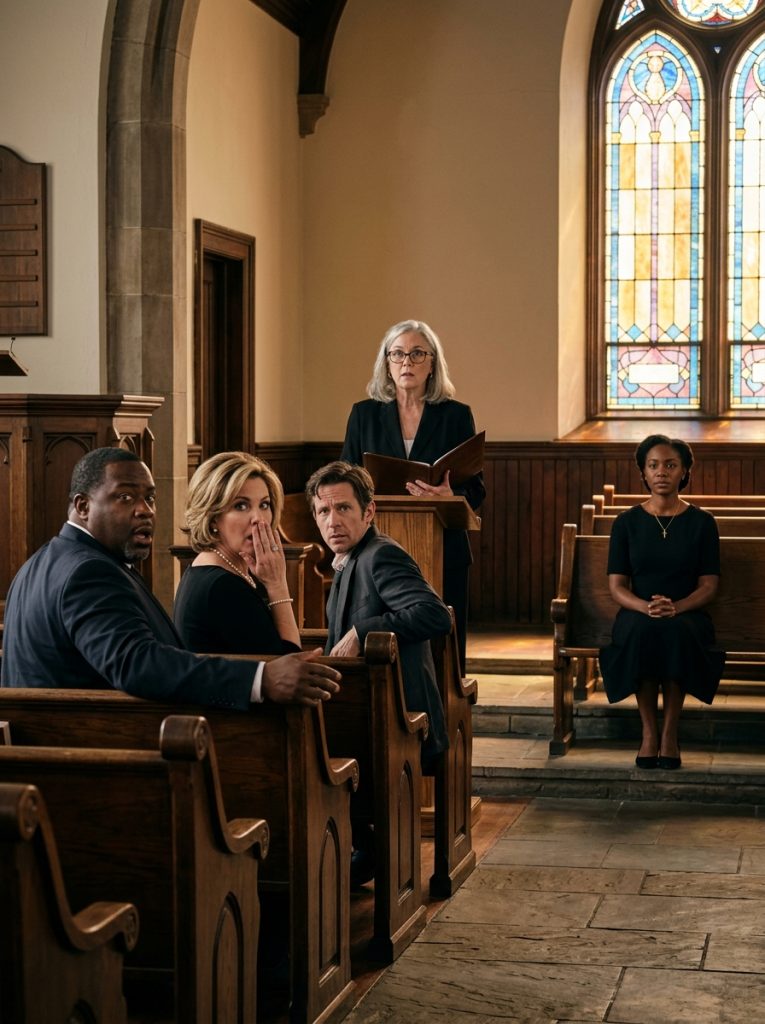
Naomi walked out of that church into the Savannah sun and didn’t look back.
She could feel their eyes on her — Richard, Diane, Craig — boring into her back from the front pew they’d claimed like territory. The pew they’d sat in like it entitled them to something. Like proximity to a casket was the same thing as proximity to a father.
It wasn’t.
Naomi knew that better than anyone.
She walked across the gravel parking lot to her car — a ten-year-old Honda she’d paid for in cash. The same car that had taken her to the pharmacy at midnight. To the emergency room at 3 a.m. To the medical supply store that knew her by name.
She sat in the driver’s seat and pressed her forehead to the steering wheel.
And finally, alone, she cried.
Not because of what her siblings said.
Because of what her father wrote.
“My youngest gave me her time, her money, and her silence while the others gave me nothing but accusations.”
He saw her.
The whole time.
He knew.
Three days later, Gerald Voss’s office called again.
“Naomi, there’s more to the estate reading. Your father’s full will. Can you come in Thursday?”
She could.
The reading took place in a small conference room in Gerald’s downtown office. Richard, Diane, and Craig were already seated when Naomi arrived — on one side of the table, like a tribunal. Gerald sat at the head.
Naomi took the chair closest to the door.
Nobody greeted her.
That was fine.
Gerald opened the file.
“Harold’s full estate consists of the following: the family home on Whitaker Street, valued at approximately $480,000. A retirement account with a current balance of $112,000. A life insurance policy of $250,000. And the memorial scholarship fund, currently endowed at $85,000.”
Richard leaned forward. “And the distribution?”
Gerald adjusted his glasses.
“The house is left to Naomi. Sole ownership. No conditions.”
Richard’s face reddened.
“The retirement account is divided three ways — between Richard, Diane, and Craig.”
Diane exhaled. “That seems—”
“Minus deductions.”
“Deductions?”
Gerald produced a ledger.
“Harold kept a record of every dollar his children borrowed and never repaid over the past fifteen years. Richard: $34,000. Diane: $28,000. Craig: $41,000. These amounts are deducted from your shares before distribution.”
The room went very quiet.
“What’s left?” Craig asked.
Gerald did the math aloud. “$112,000 divided by three is approximately $37,333 each. After deductions: Richard receives $3,333. Diane receives $9,333. Craig — your borrowing exceeds your share. You receive nothing from this account.”
Craig stood. “This is—”
“Documented,” Gerald said. “Every loan. Every date. Every broken promise to repay. Your father kept meticulous records.”
Craig sat back down.
“The life insurance policy,” Gerald continued, “is payable to Naomi Bennett. In full.”
$250,000.
Richard exploded. “She manipulated him. She isolated him from us. She—”
“She was the only person in this room who was present during his illness,” Gerald said. Not sharply. Just factually. “The medical records show daily care from Naomi for five consecutive years. Physical therapy appointments attended by Naomi. Medication managed by Naomi. Emergency room visits — eleven over five years — all accompanied by Naomi.”
He paused.
“Your father’s medical expenses totaled approximately $180,000 over that period. Insurance covered roughly half. Naomi paid the remaining balance from her personal income. She never billed the estate. She never requested reimbursement.”
The room absorbed this.
Diane’s hand moved to her pearls.
“She also endowed the memorial fund,” Gerald added. “From her salary as a public school teacher. Approximately $85,000 over three years.”
“That’s impossible,” Richard said. “A teacher’s salary—”
“She lives in a studio apartment,” Gerald said simply. “She drives a 2016 Honda. She has no debt. She chose to spend everything on your father’s comfort and his legacy.”
Richard sat back.
The fight went out of him like air from a tire.
Gerald closed the file.
“There’s one final provision. Your father recorded a video message. He asked that it be played after the financial reading.”
He opened his laptop. Turned it toward the table.
Harold Bennett appeared on screen. Thin. Gray. Sitting in the recliner Naomi had bought him. Wearing the cardigan she’d given him for his last birthday. Lucid. Clear-eyed. And firm.
“If you’re watching this,” Harold said, “it means I’m gone and Gerald is doing what I asked. So here’s what I want to say.”
He looked directly into the camera.
“Richard. Diane. Craig. I love you. I’ve always loved you. But love isn’t enough when the people you love only show up to take.”
He paused.
“Naomi never took. Not once. She gave. Every day. Every night. While you called to ask about my accounts, she was changing my sheets. While you argued about the house, she was holding my hand in the dark.”
Advertisement
His voice wavered.
“I’m not punishing you. I’m recognizing her. Because somebody has to.”
The video ended.
Nobody spoke.
Naomi stood.
She walked to the door.
“Naomi—” Diane started.
Naomi paused. Turned.
“I don’t need an apology,” she said. “I just needed him to know. And he did.”
She left.
The Savannah sun hit her face as she stepped outside.
Warm. Bright. The same sun that had lit her father’s porch every morning of the five years she’d spent beside him.
She drove to his house — her house now — and sat on that porch.
And for the first time in five years, she rested.
Because the work was done.
And the truth had finally spoken for itself.
Naomi moved into her father’s house on Whitaker Street the following week.
It wasn’t large. Two bedrooms. A small kitchen with yellow tile Harold had installed himself thirty years ago. A porch with a rocking chair that still smelled faintly of his aftershave.
She didn’t redecorate.
She didn’t renovate.
She sat on that porch the first evening with a glass of water and let five years of exhaustion finally settle into her bones.
No midnight pharmacy runs. No emergency room drives. No medication schedules. No fighting with insurance companies at 6 a.m. No siblings calling to accuse her of theft while she was changing her father’s sheets.
Just quiet.
Just the Georgia evening settling around her like a warm hand on a tired shoulder.
The memorial fund continued to grow. Harold’s obituary — the one that named Naomi as the endower — was shared thousands of times. People she’d never met sent letters. Teachers, nurses, caregivers who’d experienced the same accusation from family members who did nothing and then demanded everything.
“You’re not alone,” the letters said. “Thank you for showing us someone else went through this too.”
Naomi read every one.
She wrote back to some.
And on Saturdays, she volunteered at the senior center downtown — the one Harold used to visit before the dementia made it impossible. She helped serve lunch. Played cards with the residents. Read aloud to the ones whose eyes couldn’t focus on print anymore.
Not because the will required it.
Because that’s what Harold would have done.
Because that’s what Harold taught her — not in words, but in decades of quiet, consistent, unremarkable kindness that added up to a life worth honoring.
Richard called once. Three months after the funeral.
The conversation lasted four minutes.
“I’m sorry,” he said. “For all of it.”
“Okay,” Naomi said.
“I want to do better.”
“Then do better.”
She didn’t invite him to the house.
Not yet.
Maybe someday.
But for now, the porch was hers. The quiet was hers. The rocking chair and the yellow tile kitchen and the knowledge that her father had seen everything and chosen her — that was hers.
Nobody could accuse her of stealing it.
Nobody could diminish it.
Nobody could make it smaller than it was.
And on warm evenings, when the Savannah light turned gold, Naomi sat exactly where Harold used to sit.
And rested.
Finally at peace.