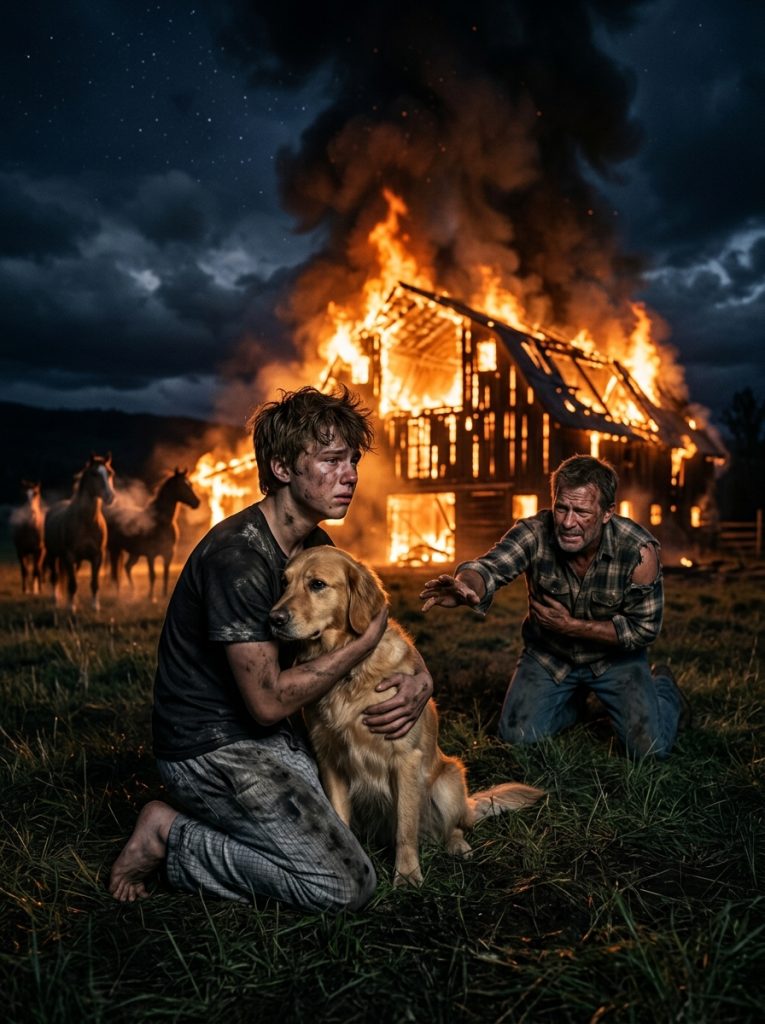
Dale’s hand trembled on Jesse’s shoulder.
The fire still consumed what remained of the barn behind them — a hundred-year-old skeleton of beams glowing orange against the Montana stars. Embers drifted upward like sparks from a campfire built by giants.
Jesse couldn’t stop shaking.
Not from cold — though the night air cut through his thin, soot-blackened T-shirt. From adrenaline that had nowhere left to go. From the slow realization of what his body had just done. And from the words he’d finally said out loud.
“I don’t hate it here, Dad. I just didn’t think you wanted me here.”
Dale’s weathered face crumpled.
Fifty-two years of ranching had taught this man to hold everything inside. Weather. Drought. Financial ruin. Loneliness after Jesse’s mother died of cancer when the boy was eleven. The grinding silence that grew between a father who didn’t know how to talk about feelings and a son who eventually stopped trying to reach him.
But he couldn’t hold this.
“I always wanted you here,” Dale whispered. “Every single day. I just didn’t know how to tell you. Not without her.”
Jesse looked at his father. Really looked. Not with the reflexive distance of a teenager. But with the clear eyes of someone who’d just run into a burning building eight times and come out understanding something about himself he didn’t have words for yet.
“Mom was the translator,” Jesse said quietly. “Between us.”
Dale nodded. “She was. She always knew what I meant even when I couldn’t say it right.”
“And when she died—”
“I stopped talking. I know. I watched myself do it and I couldn’t figure out how to stop.”
Biscuit shifted between them. The old golden retriever pressed his gray muzzle into Jesse’s chest, as if to say: I heard everything. I always hear everything. I’m still here.
Neighbors had gathered in the driveway. Pickup trucks with their headlights cutting through lingering smoke. The volunteer fire department from fourteen miles away — too late to save the barn, but here for the people. Someone brought quilts. Someone brought water. Someone had already started calling others.
That’s how it works in rural Montana. You don’t wait to be asked.
Mrs. Patterson from the neighboring ranch wrapped a heavy quilt around Jesse’s shoulders and turned to the fire chief.
“That boy went in eight times. Barefoot. Got every single animal out.”
The chief looked at Jesse’s feet.
Blistered. Bloody. Black with soot and the burns of concrete that had radiated heat like a griddle.
“Son, you need an ambulance.”
“I’m okay.”
“You’re not okay. You’re possibly the bravest person I’ve seen in thirty years of this job, but you are not okay.”
The paramedics arrived twenty minutes later. They cleaned and wrapped Jesse’s feet. Treated the burns on his arms and shoulders where embers had landed and he hadn’t paused to brush them away because there were still animals inside. Checked his lungs — smoke inhalation, mild but present.
Dale sat beside him in the grass the entire time. Cracked ribs wrapped in an ACE bandage from a neighbor’s kit. Arm in a makeshift sling fashioned from a dish towel.
They didn’t say much more that night.
But they didn’t need to.
Because the silence between them had fundamentally changed. It was no longer the cold, hollow silence of two people who’d forgotten how to reach each other across a kitchen table. It was the warm, exhausted, honest silence of two people who had finally said the thing that needed saying.
The sun rose at 5:47 a.m.
In daylight, the damage was complete. The barn was gone. Nothing remained but a concrete foundation, twisted metal roofing, and ash so thick it would take weeks to clear. A hundred years of Whitfield history — the loft where Dale’s father proposed to his mother, the stall where Jesse’s first horse was born, the workbench where three generations built and repaired — gone in ninety minutes of flame.
But in the meadow beyond the wreckage: ten animals. All alive. Some singed. Some limping. All breathing.
Because a sixteen-year-old boy who told everyone he hated this place had loved it enough to run into fire for every living thing inside it.
The community response began before noon.
A GoFundMe page went live at 9 a.m. By noon it held fourteen thousand dollars. By evening — after the local paper ran the story with a photo of Jesse, soot-covered and holding Biscuit — it crossed sixty thousand.
By the end of the week: two hundred twelve thousand dollars.
More than enough for a new barn.
Ranchers from three counties donated lumber and hardware. A construction crew from Billings volunteered their weekends. The Future Farmers chapter from Jesse’s high school organized rotating work shifts — kids showing up at dawn with toolbelts and thermoses.
The new barn went up in five weeks.
Better than the old one. Stronger timber frame. Proper electrical wiring. Fire suppression system. Metal roof rated for lightning. Modern stalls with easy-release latches the horses could trigger themselves.
And above the main door — a plaque. Donated by the fire department. Brass letters on dark wood:
WHITFIELD BARN — REBUILT BY COMMUNITY
“Every time, he came back.” — Dale Whitfield
Jesse was there every single day of the build. Not because anyone required it. Not because he felt obligated. Because he wanted to be.
He still talked about music school. Still played guitar in his room at night until his burned fingertips toughened up. Still downloaded catalogs from universities in Nashville and Austin and Los Angeles.
But something had shifted in how he talked about it.
He no longer spoke about leaving like it was an escape from something unbearable.
He spoke about it like a plan — one that included a return trip.
“I want to go see what’s out there,” he told Dale one evening, sitting on the new barn’s porch, watching the sun drop behind the Bitterroot Mountains. “But I want this to be what I come home to.”
Dale nodded slowly. “Then it will be. Long as I’m breathing, this place waits for you.”
Jesse leaned into his father’s good shoulder.
Biscuit lay at their feet, nose twitching at the smell of new lumber.
The horses grazed peacefully in the meadow where they’d stood terrified and free just five weeks before.
And the Montana sky stretched above them — wide enough for a boy to leave and come back as many times as he needed.
Because home isn’t a place you’re trapped in.
It’s a place that waits.
Even when you forget to say you’re coming back.
The following autumn, Jesse started his senior year at Flathead Valley High School.
He applied to three music programs — Nashville, Austin, and Bozeman.
The Bozeman application surprised Dale.
“Montana State?” Dale asked one evening at the kitchen table.
Advertisement
“They have a good music education program,” Jesse said. “And it’s close enough to come home on weekends. If you need help with anything.”
Dale looked at his son for a long moment.
“I don’t need you to stay close for me, Jess.”
“I know. I’m not staying close for you.” Jesse paused. “I’m staying close for me.”
He got into all three programs.
He chose Bozeman.
Not because he was afraid to leave. Not because he felt obligated. Because the fire had shown him something he’d been too angry to see before: that loving a place and leaving a place aren’t mutually exclusive. That you can carry Montana in your chest while learning new things in a new building with new people.
That home doesn’t disappear when you walk away from it.
It just waits.
On his first weekend back from college — a Friday in late September — Jesse drove down the gravel road toward the ranch at sunset.
The new barn stood solid against the darkening sky. The plaque above the door caught the last light.
Dale was on the porch. Coffee in hand. Biscuit at his feet.
He raised a hand when he saw the truck.
Jesse raised one back.
And it was enough.
It was always going to be enough.