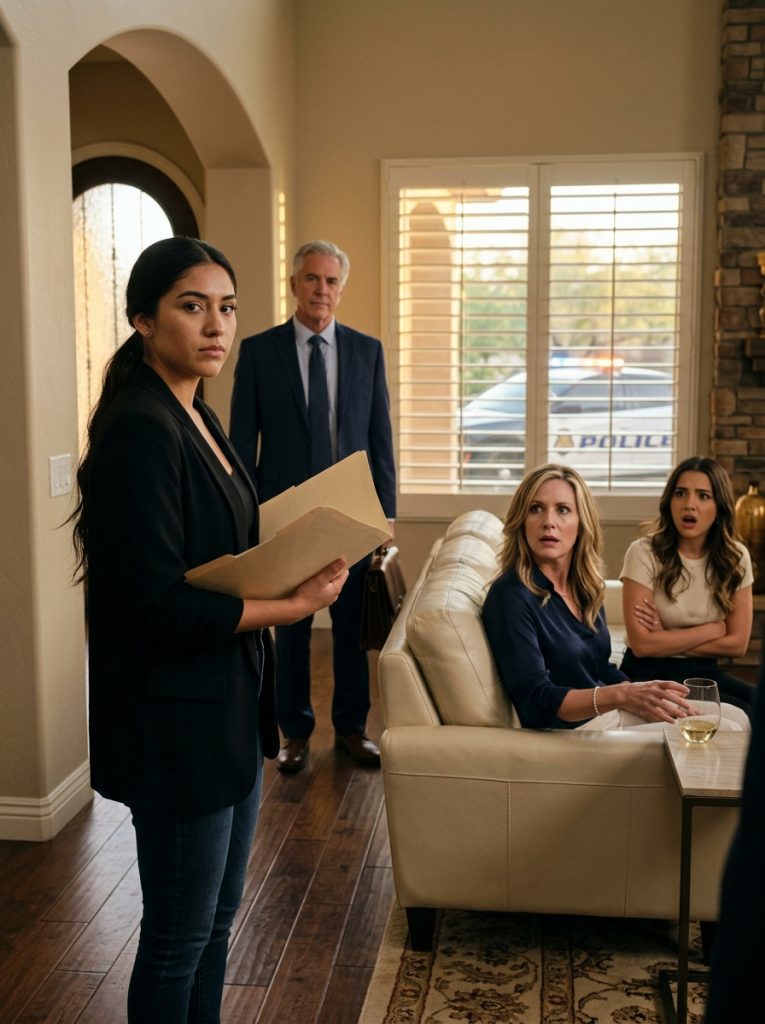
Gerald Voss stood on Karen Harding’s porch holding a leather briefcase and a court order.
Behind him, a marked police cruiser sat in the curved driveway with its lights off but its presence completely unmistakable.
Inside the house, Mia Castillo hadn’t moved from her seat at the dining table. The manila folder lay open in front of her — pages fanned across Karen’s expensive cream tablecloth like a hand of cards that had just ended a very long, very crooked game.
Karen was frozen on the leather sofa. Wine glass raised halfway. Diamond tennis bracelet catching the last afternoon light through plantation shutters. Her face was the color of raw dough.
Brooke stood beside her mother. Arms crossed. Jaw clenched tight. The defensive posture of someone who still believed she could bluff her way out of what was happening.
“What is this?” Brooke demanded for the third time.
“Sit down,” Mia said quietly.
“You don’t tell me what to do in my own—”
“Sit. Down.”
Something in Mia’s voice — a steadiness that had been building for six years beneath the surface of a girl everyone underestimated — made Brooke sit.
Gerald entered the house. He set his briefcase on the sideboard, opened it with the precise movements of a man who had prepared for this meeting extensively, and removed a bound stack of documents clipped in blue legal binding.
“Mrs. Harding,” he said. “My name is Gerald Voss. I was Antonio Castillo’s estate attorney and the trustee of Mia’s inheritance fund.”
Karen didn’t respond.
“I’ve been attempting to reach Mia for two years. My letters were returned. My emails bounced from an address that isn’t hers. My phone messages went to a number registered to this residence.”
“I don’t know anything about—”
“The contact information in the trust file was changed using a power of attorney that expired on Mia’s twenty-first birthday. Changed to your personal email. Your phone number. Your mailing address.”
Karen’s mouth opened and closed without producing words.
“The trust Antonio established was valued at three hundred twenty thousand dollars. It was meant to transfer to Mia in full on her twenty-first birthday. Instead, one hundred twenty thousand was withdrawn between her eighteenth and twenty-first birthdays — during the period you served as interim custodian.”
“Those withdrawals were for household expenses. For raising—”
“Mia was living independently at eighteen. She was paying her own rent. Working two jobs. She received nothing from this household after the age of seventeen.” Gerald’s voice remained perfectly even. Professional. Devastating. “The withdrawals were routed through three secondary accounts in your name. Funds from those accounts were used for consumer spending, vehicle leases, and credit applications — all documented and traceable.”
He turned to Brooke.
“Four credit cards were opened using Mia’s Social Security number over a three-year period. Security footage from three department stores shows you, Ms. Harding, signing Mia’s name at point-of-sale terminals. Twelve incidents. All provided to the Phoenix Police Department.”
Brooke’s face went from defiant to white in approximately two seconds.
“I didn’t—”
“You are on camera. At three separate locations. On twelve separate dates. The forensic handwriting analysis confirms the signature is yours, not Mia’s.”
The doorbell rang.
Detective Sandra Reeves. Professional. Polite. She asked Brooke to step outside for a conversation.
Brooke looked at Karen.
Karen looked at the tablecloth.
Neither said “lawyer” yet. That would come later — in the following hours, when the reality solidified and the performance of innocence became impossible to sustain.
Mia sat through all of it in complete silence.
She didn’t gloat. Didn’t cry. Didn’t deliver a victory speech. Didn’t slam her hands on the table.
She’d spent six years being invisible in this family. Being told she had nothing. Being made to feel grateful for emotional scraps from people who were literally living off her stolen inheritance while she worked doubles at a coffee shop and skipped meals to make tuition payments.
Now she had her name back. Her credit cleared. Her trust restored — Gerald had frozen the remaining two hundred thousand before Karen could access it again. And the fraud charges would ensure that every dollar spent under Mia’s identity would be legally accounted for.
The trial took place four months later.
It lasted four days.
The evidence was overwhelming. Security footage. Bank records. The altered trust documents. The fake contact information. The paper trail connecting every spending pattern to Karen and Brooke’s lifestyle.
Both pled guilty to reduced charges in exchange for full restitution agreements.
Karen: three counts of felony fraud, identity theft, and breach of fiduciary duty. Two years probation. Full financial restitution. Loss of the Scottsdale house to satisfy the judgment.
Brooke: two counts of identity theft and one count of forgery. Eighteen months probation. Surrender of the leased BMW. Permanent criminal record.
Karen moved into a rental apartment in Mesa.
Brooke got a job at a retail store — the kind she used to shop at with stolen money.
Mia used her restored inheritance to finish her bachelor’s degree in finance.
Then she did something nobody expected.
She opened a nonprofit. Specifically designed for young women aging out of foster care, family displacement, or situations where their financial identities had been compromised by the people who were supposed to protect them.
She called it The Folder Project.
Because everything Mia needed to save herself — the bank records, the security stills, the trust documents, the forensic analysis — had fit in a single manila folder.
And because no twenty-two-year-old should ever have to become her own investigator just to prove she exists.
At the sentencing hearing, the judge offered Mia the opportunity to make a victim impact statement.
She stood.
“For six years,” she said, “I was told my father left me nothing. That he was careless. That he didn’t plan ahead. That was a lie.”
She paused.
“He left me everything he could. And the people who stole it never once considered that I might be the kind of person who would find out. Who would document. Who would fight.”
She looked at Karen and Brooke without hatred. Without tears. Without performance.
“I am.”
She sat down.
The courtroom was completely silent.
Gerald Voss, seated in the gallery, smiled.
And somewhere — in whatever space the dead occupy when their children carry their legacy forward — Antonio Castillo’s daughter proved that invisibility is not the same thing as absence.
It never was.
Advertisement
Two years after the trial, The Folder Project had helped forty-seven young women recover stolen identities and access financial resources that had been hidden from them.
Mia spoke at conferences. Appeared on podcasts. Trained social workers and family court advocates on how to recognize the signs of financial abuse against young adults.
She never mentioned Karen or Brooke by name in public.
Not out of forgiveness.
Out of irrelevance.
They simply didn’t matter anymore.
What mattered was the twenty-three-year-old in Houston who’d discovered her grandmother had been cashing her disability checks for a decade. The nineteen-year-old in Philadelphia whose foster parent had opened credit cards in her name at sixteen. The twenty-one-year-old in Phoenix — not unlike Mia herself — whose stepfather had drained a college fund before she knew it existed.
For each of them, Mia’s organization provided what she’d had to find alone: an attorney, a forensic accountant, and the steadfast belief that being young doesn’t mean being powerless.
And every time Mia looked at the work they were doing — the identities restored, the futures reclaimed — she felt something steady and warm.
Gratitude. For a father who planned ahead. And for the truth that surfaced because someone was patient enough to dig.