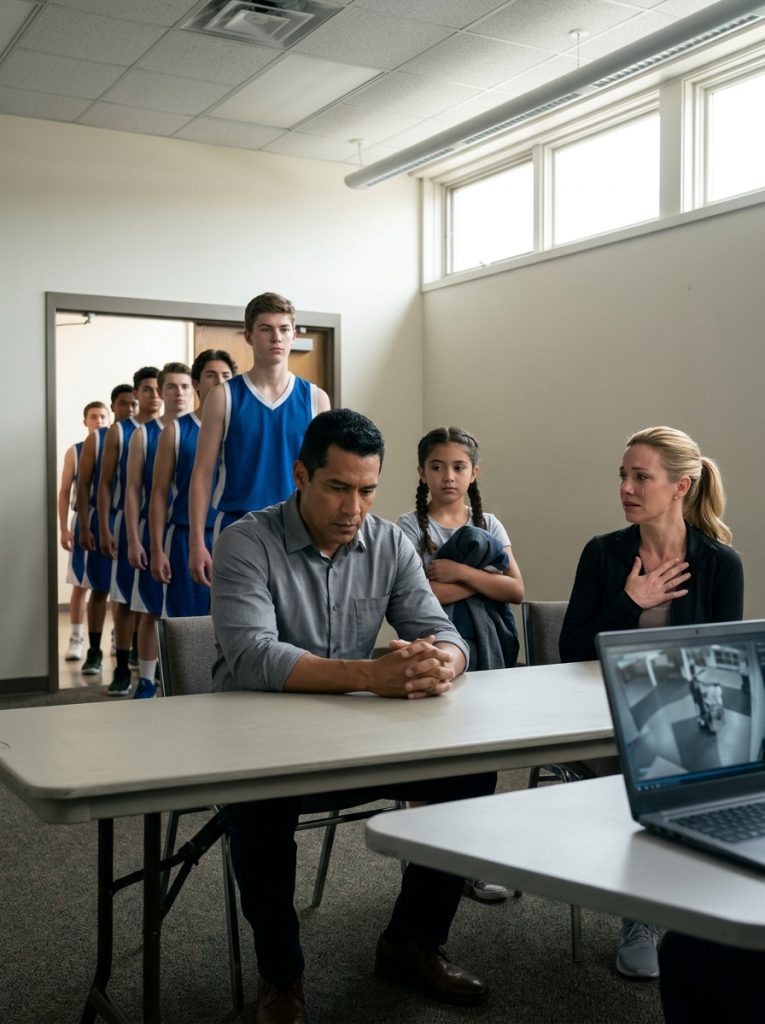
The board chair’s decision took less than ninety seconds.
“The suspension is reversed immediately. Coach Rivera is reinstated effective today. All records of the complaint will be expunged.”
Marcus didn’t move.
He sat at that folding table with his hands still clasped — the same position he’d held for ninety minutes of accusation, evidence presentation, and the systematic dismantling of a lie — and he simply didn’t move. Like his body hadn’t caught up to the words yet.
Behind him, twelve boys in blue-and-white jerseys exhaled as one. His daughter Sofia gripped his jacket tighter against her chest.
Diane Holt stood abruptly.
“This is absolutely ridiculous. My son—”
“Mrs. Holt.” The board chair, a retired principal named Walter Gibbs, removed his glasses and set them on the table with deliberate calm. “Your son is currently seated behind the man you accused. I believe that tells this board everything it needs to know about the veracity of your complaint.”
Kyle Holt — Diane’s fourteen-year-old son — hadn’t looked at his mother since crossing the room and sitting on Marcus’s side. His head was down. His blue-and-white jersey wrinkled. He looked like a boy who had been carrying a crushing weight for six weeks and had finally set it down.
“Kyle,” Diane said sharply. “We’re leaving.”
Kyle didn’t stand.
“Kyle. Now.”
“No, Mom.”
The word landed in the fluorescent conference room like a stone dropped into still water.
Diane’s face went through three expressions in rapid succession — shock, fury, and something that might have been genuine fear.
“Coach Rivera never did anything wrong,” Kyle said. His voice was quiet but absolutely steady. “You know it. I know it. You made me write that statement because you were angry about playing time. Because I got benched and you thought it was unfair.”
Marcus turned in his chair. His expression wasn’t triumph. It wasn’t vindication. It was concern — for a fourteen-year-old boy who had just publicly contradicted his mother in a room full of adults.
“Kyle,” Marcus said gently. “You don’t have to—”
“I want to, Coach.” Kyle looked up for the first time. His eyes were red. “I should’ve said something sooner. Way sooner. I’m sorry.”
The team captain — a fifteen-year-old named Jaylen — put a hand on Kyle’s shoulder.
Walter Gibbs cleared his throat.
“Mrs. Holt. This board will be referring the matter to the district attorney’s office for possible criminal charges including filing a false report and defamation. I strongly recommend you retain legal counsel before speaking publicly about this matter again.”
Diane grabbed her designer gym bag from the back of her chair.
She walked out without looking at anyone.
The door closed behind her with a flat institutional click that somehow felt entirely final.
And then the room exhaled.
Marcus’s attorney gathered his documents. The three board members stood one by one and shook Marcus’s hand — each with the particular firmness of people who know they just witnessed an injustice being corrected.
But the real moment — the one Marcus would carry with him for years — happened next.
Sofia stood from her chair. Twelve years old. Dark braids hanging past her shoulders. Her father’s folded jacket still clutched against her chest like a lifeline.
She walked around the table and stood directly in front of him.
“Can we go home now, Dad?”
Marcus’s composure — the composure he’d held for six weeks of hell — finally broke completely.
He pulled his daughter into a hug so tight and so raw that every other person in that room looked away to give them privacy.
“Yeah, mija,” he whispered. “We can go home.”
The team filed out behind them through the recreation center lobby. Twelve boys in jerseys walking in formation. The front desk receptionist — who’d watched Marcus get escorted out six weeks earlier with his head down — stood from her chair and started clapping.
Then the janitor.
Then two parents who’d been waiting in the hall.
By the time Marcus reached the parking lot, the sound followed him out the doors.
Not because he’d won something.
Because he’d endured something. And survived it. And come out the other side still being exactly the kind of man who volunteers his time for other people’s children without asking for a single thing in return.
The legal aftermath was swift and decisive.
Diane Holt was charged with filing a false police report and civil defamation. Her own text messages — recovered from three parents’ phones — were the prosecution’s primary evidence. She pled no contest.
Community service. Two years probation. A permanent restraining order barring her from Westside Recreation Center property.
The newspaper that published the original accusation ran a front-page retraction with Marcus’s photo. Above the fold. Full apology.
It helped.
But it wasn’t enough.
Nothing could give back six weeks. Nothing could erase what Sofia heard at school. Nothing could undo the spray-painted word on his garage door or the 3 a.m. insomnia or the feeling of being presumed guilty by a community he’d served for four years without compensation.
But something else happened that mattered more.
The day Marcus returned to the gym for the first practice back, every single player showed up.
Plus four new ones.
Parents who’d pulled their kids brought them back with casseroles and awkward apologies and the particular shame of people who followed a crowd instead of waiting for truth.
Marcus accepted every apology without bitterness. That wasn’t who he was. Had never been.
He made one change to the program.
A sign above the gym door — hand-painted by Sofia in blue and white:
“CHARACTER FIRST. TROPHIES SECOND.”
And below it, smaller:
“This gym protected by cameras, truth, and twelve kids who showed up when it mattered.”
Kyle Holt rejoined the team the following season.
Marcus never once treated him differently than any other player.
Because that was always the entire point.
Advertisement
That had always been the entire point.
The following spring, the Westside Recreation Center held its annual awards banquet.
Marcus was asked to give the keynote speech.
He stood at the podium in front of a hundred families — parents and kids and coaches from every program the center offered — and spoke for twelve minutes about what volunteering had taught him.
Not about basketball.
About trust.
“The hardest thing about what happened to me,” he said, “wasn’t the accusation. It was watching the people I’d served for four years decide I was guilty before anyone asked a single question.”
The room was very quiet.
“But the second hardest thing — and the most healing thing — was watching twelve kids walk into that hearing room in their jerseys. They didn’t have to do that. Nobody asked them to. They just showed up.”
He looked out at the audience.
“That’s what character looks like. Not when it’s convenient. Not when there’s a trophy at the end. When it costs something and you do it anyway.”
The ovation lasted longer than any basketball game he’d ever coached.
Afterward, a father approached him in the parking lot. The man had been one of the parents who pulled his son during the accusation.
“I owe you an apology,” the man said.
Marcus shook his hand. “You owe your son a conversation about what happened. That’s more important.”
The man nodded.
Marcus climbed into his truck. Sofia was in the passenger seat, scrolling her phone.
“Good speech, Dad.”
“Thanks, mija.”
“You didn’t cry this time.”
He smiled. “Progress.”
She smiled back.
And they drove home through suburban Denver streets that no longer felt hostile — just familiar. The way home is supposed to feel when you’ve earned your place in it.