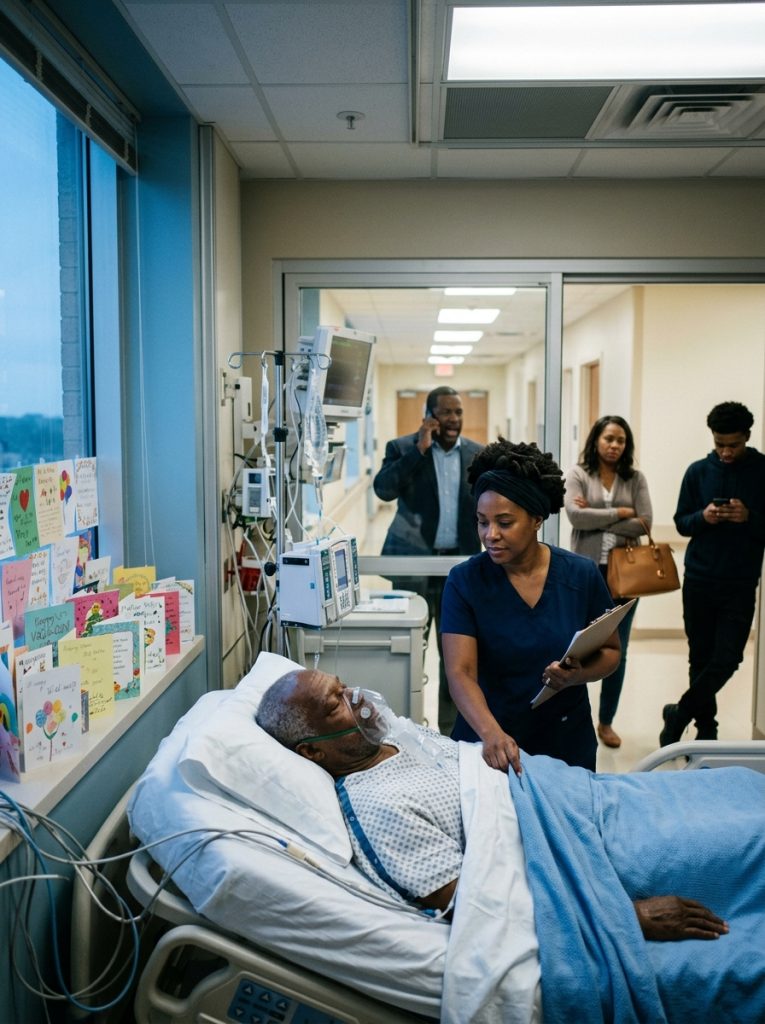
The sentence Martin wrote on the hospital notepad said seven words:
“The ones who came are the ones who get it.”
Written in a hand so trembling that Grace had to hold the pad under the fluorescent light and trace each letter twice before the meaning became clear.
Then Martin’s eyes closed.
He didn’t open them again.
Grace stood beside his bed for a long moment, holding the notepad. Twenty-two years of nursing. Hundreds of patients. And still — every time — the weight of a final moment pressed against her chest like something physical.
She followed protocol. Called the attending. Alerted the charge nurse. Updated the chart.
Then she did the other thing Martin had asked.
Three days earlier — during a brief window of lucidity nobody else witnessed — he had gripped her wrist with surprising strength and whispered a name and a phone number.
“Gerald Voss. He’s my attorney. When it’s time — call him.”
At 5:47 a.m., Grace made the call.
At 6:17 a.m., Martin Cole’s heart stopped.
The monitors flatlined with a long steady tone. Grace stood in the blue morning light with the notepad still on the bedside table and the wall of get-well cards glowing softly in the early sun.
Dozens of cards. From coworkers. Neighbors. The church group. The barber. The hardware store volunteers. The mail carrier who’d found him. The animal shelter woman. The teenager he’d taught to change a tire.
Not one from his children.
Derek arrived at 7:45 a.m.
He came from a breakfast meeting. Laptop bag over one shoulder. Phone in hand.
“Where is he?” he demanded at the nurses’ station.
“Room 411. Mr. Cole, I’m sorry — he passed at—”
“I need to speak to someone about the estate immediately.”
Grace set down her coffee cup.
Not a question about suffering. Not a question about the final moments. The estate.
Vanessa arrived at 8:30. From her hotel. Hair styled. Makeup perfect. Black dress already on, as if she’d planned the funeral outfit the night before.
“Did he say anything at the end?”
“He wrote something,” Grace said.
“What did he write?”
“That’s for the attorney.”
Paul arrived at noon. Hoodie. Unshaven. Fast-food bag crinkling in one hand.
The three of them gathered in the hallway — the same hallway where they’d spent eight days discussing money while their father lay dying fifteen feet away.
Gerald Voss called the next afternoon.
The reading was held in his downtown Houston office. Small room. Leather chairs. Skyline through the windows. Derek, Vanessa, and Paul on one side of the table. Gerald behind his desk with a file that had been updated seventy-two hours before Martin died.
“Your father made changes to his estate plan,” Gerald began, “during a verified period of lucidity. Witnessed by two nurses. Confirmed by Dr. Rahim’s capacity assessment.”
Derek leaned forward. “What kind of changes?”
Gerald opened the file.
“The house on Maple Street is placed in a trust. The trustee is Mrs. Patricia Delmont.”
“Who?”
“His next-door neighbor. She checked on him every morning for three years. Brought groceries. Mowed his lawn when he couldn’t. Drove him to appointments after Naomi at the church stopped being able to.”
Vanessa’s fingers tightened on her purse strap.
“The investment account — approximately three hundred forty thousand dollars — is divided equally among seven individuals.”
Gerald read the names.
The barber. The mail carrier. The woman from the animal shelter. The coworker who stayed four hours at his bedside. The hardware store manager. The teenager. And Grace Okafor — the night nurse who held the notepad.
Not one name was Derek, Vanessa, or Paul.
Derek stood. “He wasn’t competent. We’ll contest—”
“He passed every capacity test administered that evening,” Gerald said calmly. “Documentation is thorough. Witnessed and notarized.”
“He didn’t know what he was doing.”
“On the contrary. He knew exactly what he was doing.” Gerald unfolded a single page. “He also left a letter.”
Martin’s handwriting. Steadier than the notepad — written during an earlier lucid morning.
Gerald read it aloud.
“To my children: I spent seventy-one years being the kind of man who helped without asking for credit. I fixed fences. I drove in ice storms. I walked dogs nobody else wanted. I showed up. You were my children and I loved you. But love is not a ledger. For the last five years, while I needed you, strangers held my hand. While I forgot my own name on bad nights, people I hadn’t seen in years drove across the city to sit with me. And you called about the house. I don’t write this in anger. I write it in clarity. The people who show up are the people who matter. That is the only inheritance worth leaving. — Dad.”
The room was silent for a very long time.
Vanessa’s hand covered her mouth.
Paul stared at the floor.
Derek sank back into his chair like the air had left his body.
Gerald closed the letter and returned it to the file.
“There is one additional provision.”
The three siblings looked up.
“If, within one calendar year, any of you complete forty hours of documented volunteer service at the organizations your father supported — the hardware store mentoring program, the animal shelter, the church food bank — a secondary trust will release fifty thousand dollars per person.”
“He’s bribing us from beyond the grave?” Derek said.
“He’s teaching you,” Gerald said quietly. “The way he taught everyone else. By showing up.”
Nobody contested the will.
Advertisement
Not because they couldn’t have tried.
Because the letter was forwarded to a local reporter by one of the seven beneficiaries. The story ran the following week. Sixty thousand shares in forty-eight hours.
A hundred thousand comments.
Every one saying the same thing: “Show up while they’re still here.”
Paul completed his forty hours first. At the food bank. Saturday mornings. He didn’t talk about it much, but his wife said he came home different after those shifts — quieter, but calmer.
Vanessa finished second. At the animal shelter. Walking the dogs nobody wanted. The same ones Martin had walked for years.
Derek took eleven months. He chose the hardware store program — teaching kids to build birdhouses. The same program Martin had run every Saturday for a decade.
On his last shift, Derek found one of his father’s hand-labeled tool drawers in the workshop. Still organized perfectly. Still smelling faintly of sawdust and WD-40.
He sat on the workshop stool and cried for twenty minutes.
Then he finished the birdhouse he was building with a twelve-year-old named Marcus.
And drove home.
All three received their fifty thousand.
None of them spent it on anything Martin wouldn’t have approved of.
And the wall of cards — every single one — was preserved in a shadow box that now hangs in Patricia Delmont’s living room.
Right beside the front door Martin used to knock on every morning.
Just to check.
Grace Okafor used her portion of the inheritance to establish a patient advocacy fund at Houston Methodist — specifically for ICU patients whose families fail to appear.
She called it The Card Wall Fund.
Because she never forgot the image of dozens of handwritten cards from strangers surrounding a man whose own children couldn’t be bothered to visit.
And because sometimes the most important thing a nurse can do is notice who shows up.
And who doesn’t.
And make sure it matters.