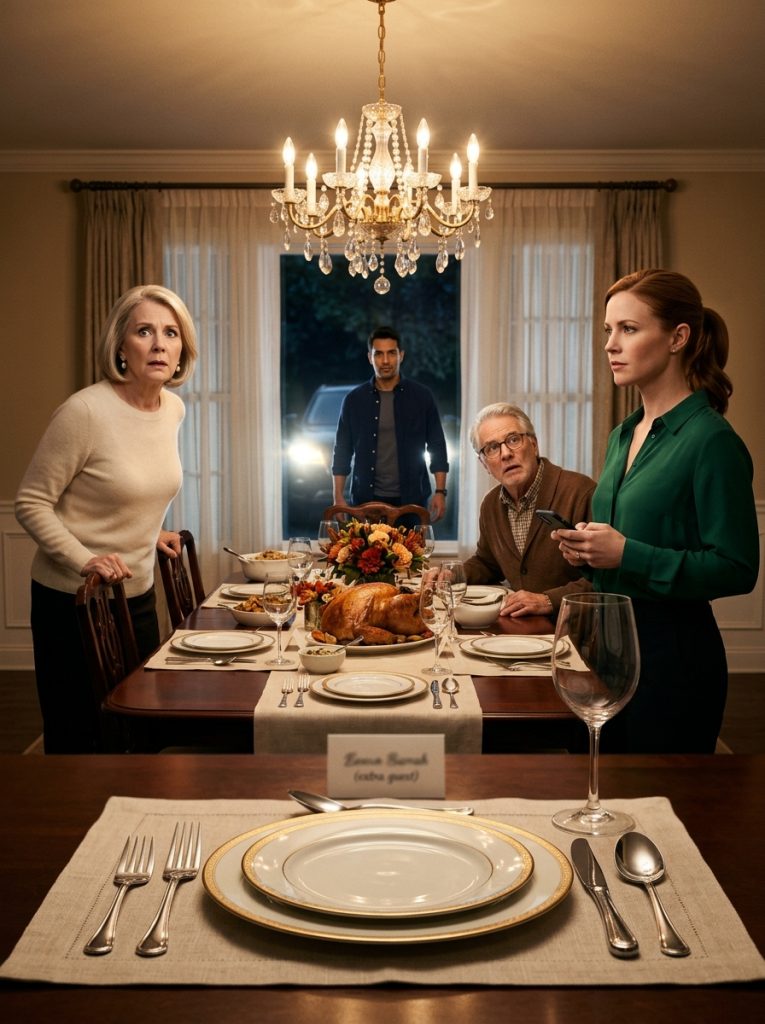
David didn’t shout.
He didn’t need to.
He stood in the dining room doorway of the Morrison family home — the house where he’d taken his first steps, learned to ride a bike in the backyard, eaten a thousand Sunday dinners — and looked at his mother with something far worse than anger.
Understanding.
“I’m not here to fight, Mom,” he said quietly.
Helen gripped the back of her dining chair. Her pearl earrings caught the chandelier light. Her cream cashmere sweater, which had looked elegant ten minutes ago, now seemed like armor that no longer fit properly.
Frank still had his arms around David — the kind of embrace that tries to compress five years of regret and absence into a single desperate moment. His reading glasses were fogged. His shoulders shook.
Jenna stood beside the table with her phone still in hand. The text messages were still on the screen — the threats, the slurs, the five-year campaign Helen had waged against David’s wife. Evidence glowing in the warm chandelier light like an indictment.
“You don’t understand,” Helen said. Her voice was thin. Fragile in a way none of them had ever heard before. “I did what I thought was right for this family.”
“For this family?” David said. “Or for your control over it?”
Helen’s mouth opened.
Nothing came out.
David stepped fully into the room. He didn’t raise his voice — didn’t need to. He moved the photo album from where Jenna had opened it and placed it at the exact center of the table, where the chandelier light fell directly on the faces of his children.
“Ellie asked about you last month,” he said. “She found an old photo in a box. She pointed at you and said, ‘Who’s the lady with Daddy?’ I told her it was her grandmother.”
Helen’s breath caught audibly.
“She said, ‘How come she never visits?'”
The silence that followed was heavier than any holiday argument that room had ever contained.
Frank released David and turned toward his wife.
“I asked you,” Frank said, his voice breaking on the words. “Three years ago. I asked why David stopped calling. You told me he wanted nothing to do with us.”
Helen studied the tablecloth.
“You said his wife turned him against the family. You said she was poisonous.”
Nothing.
“You lied, Helen. For five years, you lied to my face.”
Helen’s chin rose. The old defiance flickering. “She wasn’t right for him. That woman—”
“That woman,” Jenna interrupted clearly, “is named Sarah. She’s a kindergarten teacher. She bakes bread on Sundays. And she’s raising your grandchildren — children you have never held, never called, never sent a single birthday card.”
Helen turned on Jenna with fury. “You had no right to do this. This is my house. My family. My—”
“It’s everyone’s family,” David said. “That’s what you never understood, Mom. It was never just yours to control.”
He pulled out the seventh chair.
The one with the extra place setting Jenna had arranged.
And he sat down.
Frank sat beside his son without hesitation.
Jenna poured David a glass of water and placed it gently at his setting.
And then Frank Morrison said something that fundamentally altered the architecture of his forty-year marriage.
“Helen. Sit down or leave. Those are your only choices.”
Helen stared at her husband.
In four decades, Frank had never once spoken to her this way. He’d always been the quiet one. The agreeable one. The peacekeeper. The man who chose harmony over honesty every single time because the alternative felt too explosive.
“You heard me,” Frank said.
Helen looked around the table. At Jenna — who would never fear her again. At Frank — who would never ignore her again. At David — who had stopped needing anything from her the moment he built a life she wasn’t part of.
Two choices.
Sit at a table she no longer controlled.
Or walk away from the only family she had left.
She sat.
It took thirty seconds for her body to lower into the chair — like the act of joining a table as an equal instead of presiding over it as a queen was physically painful.
Nobody spoke for a full minute.
Then David opened the photo album to the first page.
“This is Ellie on her fourth birthday,” he said. “She loves butterflies. Collects rocks from every park. Lines them up on her windowsill by color.”
He turned the page.
“This is James. He’s two. Doesn’t say much yet, but he laughs at everything — especially when his sister chases him around the backyard.”
Frank leaned forward. Tears streaming. Studying each photo like a man who’d been shown water after years in a desert.
Helen watched.
She didn’t touch the album.
But she watched.
And when David turned to the last page — a family portrait taken in a park, all four of them together, Sarah smiling radiantly at the center — Helen made a sound.
Small. Strangled.
Not anger.
Grief.
The kind that comes only when you finally see the damage you caused and realize the people you hurt built something beautiful without you. Not to punish you. Just because they had to.
“If you want to meet them,” David said, closing the album carefully, “there’s one condition. You apologize. Not to me — to Sarah. In person. In writing. And it has to be real. Not performance. Real.”
Helen’s chin trembled. “I don’t know if I—”
“Then you won’t meet them,” David said simply. “That’s the boundary. Sarah sets it. I honor it.”
Advertisement
He stood. Buttoned his coat. Tucked the album under his arm.
“Happy Thanksgiving, Dad.” He embraced Frank again — longer this time, tighter. “Jenna — thank you. For doing what nobody else in this family had the courage to do.”
He looked at Helen one last time.
“The door is open, Mom. But you have to be the one who walks through it. Nobody will carry you.”
He left.
The front door closed softly behind him.
The seventh plate sat untouched at the table.
Frank wouldn’t let Helen clear it that night.
Or the next morning.
Or for two full weeks.
It sat there — gleaming and empty — a reminder, an invitation, and a test all at once.
Two months later, a letter arrived at David’s home.
Three handwritten pages in Helen’s careful script. Not perfect — sentences crossed out and rewritten. Paragraphs that circled before finding honest ground. Some words smudged where tears had fallen before the ink dried.
But it was the first genuinely honest thing Helen Morrison had written in five years. Maybe longer.
And taped inside the envelope — a small butterfly sticker.
“For Ellie,” the note said. “If she’ll have it from a grandmother she’s never met.”
David showed it to Sarah.
Sarah read it three times. Slowly. Carefully.
Then she looked up.
“It’s not enough yet,” she said. “But it’s a beginning.”
It was.
A slow, fragile, imperfect beginning.
Which is how all real things start.
Three months after the letter, Helen drove to David’s house alone.
She sat in the driveway for twenty minutes before finding the courage to knock.
Sarah opened the door.
The two women looked at each other for a long moment.
Then Helen said — quietly, imperfectly, but genuinely — “I’m sorry. For everything. For all of it.”
Sarah didn’t invite her in that day.
But she didn’t close the door either.
And six weeks later, on a Saturday morning in spring, Helen Morrison met her grandchildren for the first time.
Ellie showed her the rock collection.
James laughed at her earrings.
And Helen — sitting on a living room floor she had no right to sit on, holding a butterfly sticker she’d brought for a granddaughter she didn’t deserve — finally understood what family actually means.
It means showing up.
Even when you’re late.
Even when you’re the one who needs to apologize.
Especially then.