The story broke on a Wednesday morning.
Carmen was on her way to work — 6 a.m. shift, same route she’d driven four years straight — when her phone started buzzing. Not with hate this time.
With apologies.
The first one came from a woman named Sarah who’d called Carmen “a jealous monster” three weeks earlier. Her comment had gotten 1,400 likes.
“I’m sorry. I believed her. I should have listened to you.”
The second came from a local news anchor who’d aired a sympathetic segment about Danielle’s campaign.
“We should have fact-checked before we amplified. You were right.”
The third came from the platform itself — an official statement posted publicly.
“After investigation, this campaign has been determined to be fraudulent. All funds are being returned to donors. We thank the healthcare professional who brought evidence to our attention.”
Carmen read them in the hospital parking lot.
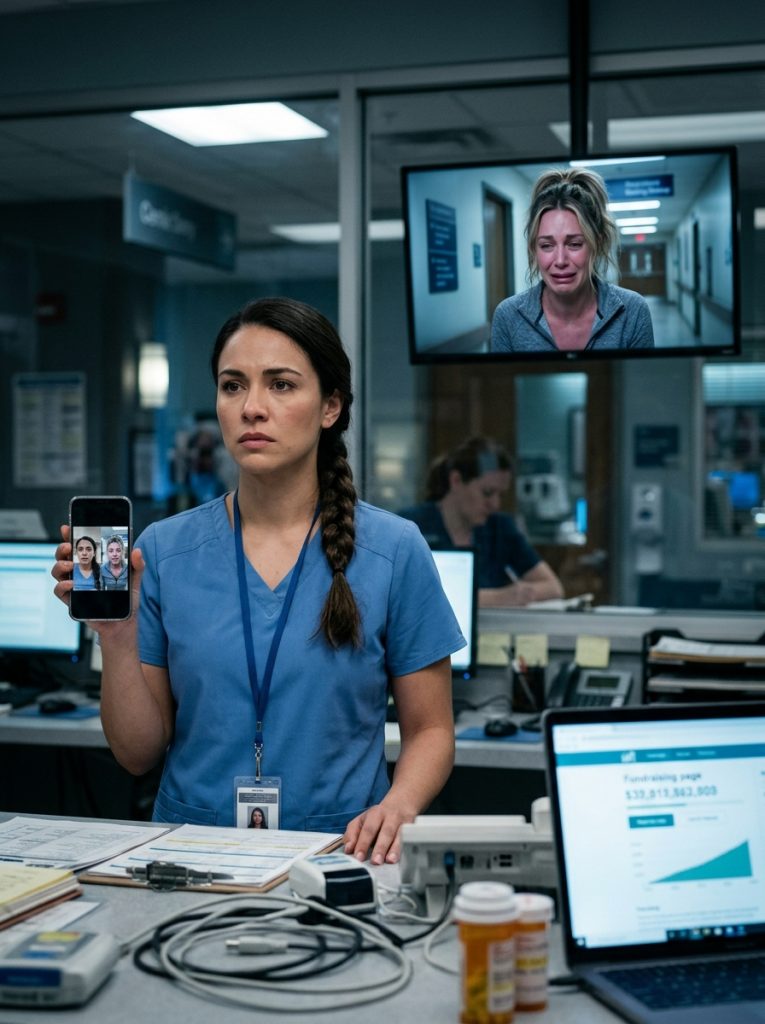
Sitting in her car. Engine off. Scrubs on. Badge clipped.
She didn’t feel vindicated.
She felt tired.
Eight weeks of being called a monster. Eight weeks of people at the grocery store recognizing her from the comment section and looking away. Eight weeks of colleagues whispering. Of her mother calling every night asking “are you okay, mija?” Of lying and saying yes.
She was not okay.
But she’d been right.
And right had won. Slowly. Painfully. The way it usually does.
The journalist — Maria Costello from the Austin Tribune — had published a full investigation the night before. Timestamps. Source comparisons. Prop receipts. Stock photo licensing records. Phone interviews with hospital staff who confirmed no child named Lily had been treated there.
Danielle Voss’s social media had been deleted overnight. All of it. Instagram. Facebook. TikTok. The GoFundMe page showed “Under Investigation” in red letters where the donate button used to be.
$380,000 frozen.
Return process initiated.
No criminal charges filed yet — but the district attorney’s office had opened a preliminary inquiry.
Carmen walked into St. Luke’s that morning expecting things to feel different.
They didn’t.
The fluorescent lights still hummed. The pediatric ward still smelled like hand sanitizer and apple juice. Room 4B still had a boy named Marcus who needed his IV changed. Room 6A still had a girl named Priya whose parents hadn’t left her side in nine days.
Real children.
Real families.
Real fear.
That was the part that made Carmen’s blood burn from the very beginning. Not the fraud itself — fraud happened everywhere. But the way Danielle’s fake campaign had sucked the oxygen out of every real one.
When Carmen reported for shift change, the charge nurse pulled her aside.
“There’s someone in the family room asking to see you.”
“A reporter?”
“A mom.”
Carmen walked to the family room. Small space. Two couches. A coffee maker that never worked. Faded magazines from 2022.
A woman sat on the far couch. Mid-thirties. Dark circles under her eyes. Hair unwashed. Wearing the same sweatshirt she’d worn for days — Carmen recognized it from the hallway.
Mrs. Gutierrez.
Mother of Ana. Room 3C. Leukemia. Diagnosed four months ago.
Mrs. Gutierrez had been running her own fundraiser for Ana’s treatment since the diagnosis. A real one. With real medical records. Real hospital verification. Real photos of a real little girl with a real feeding tube and a real bald head from chemotherapy.
Her campaign had raised $8,000.
Danielle’s fake one raised $380,000.
The algorithm buried Mrs. Gutierrez’s story because people only had so much compassion bandwidth, and Danielle had consumed all of it.
Mrs. Gutierrez stood when Carmen entered.
“Nurse Diaz?”
“Yes.”
“I wanted to say something to you.”
Carmen waited.
Mrs. Gutierrez took a breath. Her eyes were wet but her voice was steady.
“When you posted that comment — the one where everyone attacked you — I saw it. And I knew you were right. Because I’m in this hospital every day. I know what’s real. And I knew that woman was lying.”
“Why didn’t you—”
“Because I was afraid. Because I didn’t have energy for a fight. Because my daughter was in surgery that week and I couldn’t think about anything else.”
She stepped forward.
“But you did it anyway. You stood there and took all of that hate. For people like me. For people like Ana. And I want you to know — since that story broke last night, my daughter’s campaign has received $47,000 in new donations.”
Carmen’s vision blurred.
“Forty-seven thousand?”
“People are angry. They gave to the wrong thing. Now they want to give to the right one. And you made that possible.”
Mrs. Gutierrez hugged her.
Not a polite hug. A fierce, desperate, grateful embrace from a mother who’d been invisible for months and was finally being seen.
Carmen held on.
Because this — this right here — was why she’d posted that comment. Not for credit. Not for vindication. For Ana in Room 3C. For Marcus in 4B. For every real family whose real story got buried under one perfect performance.
After Mrs. Gutierrez left, Carmen sat alone in the family room for five minutes.
Advertisement
Staring at the broken coffee maker.
Thinking about the cost.
Eight weeks of her life consumed by hatred. Eight weeks of being the villain in a story where she was the only one telling the truth.
Was it worth it?
She looked at her phone. Scrolled past the apologies. Found the message she’d saved — the one Mrs. Gutierrez had sent three weeks ago, when Carmen’s world was burning:
“Keep going. We see you. — Room 3C’s mom.”
One message.
From one mother.
In the middle of the worst eight weeks of Carmen’s life.
Yes.
It was worth it.
The investigation continued through the spring. Danielle Voss was eventually charged with wire fraud. The case was ongoing.
The $380,000 was returned to donors. Most of them redirected their money — to Ana’s campaign, to two others at St. Luke’s, to a hospital fund Carmen’s colleague started for families who couldn’t afford to stay near their children during treatment.
The internet moved on. It always does.
New outrages. New villains. New cycles.
But at St. Luke’s Children’s Hospital, something stayed.
A small plaque in the nurses’ station. Installed by the staff. Not the administration.
It read: “The truth doesn’t always make you popular. Sometimes it just makes you right.”
Carmen passed it every shift.
Touched it once. At the start.
Then went back to work.
Because the children in those rooms didn’t need a hero.
They just needed someone who showed up.
Every shift.
Every day.
Whether anyone was watching or not.
Three months later, Ana Gutierrez went into remission.
Mrs. Gutierrez sent Carmen a photo. Ana — seven years old, hair growing back in soft dark fuzz — holding a handmade card that said “Thank you Nurse Carmen” in wobbly crayon letters.
Carmen put it on her refrigerator.
Right next to her hospital badge.
And every morning, before her shift, she looked at both.
The badge reminded her what she did.
The card reminded her why.