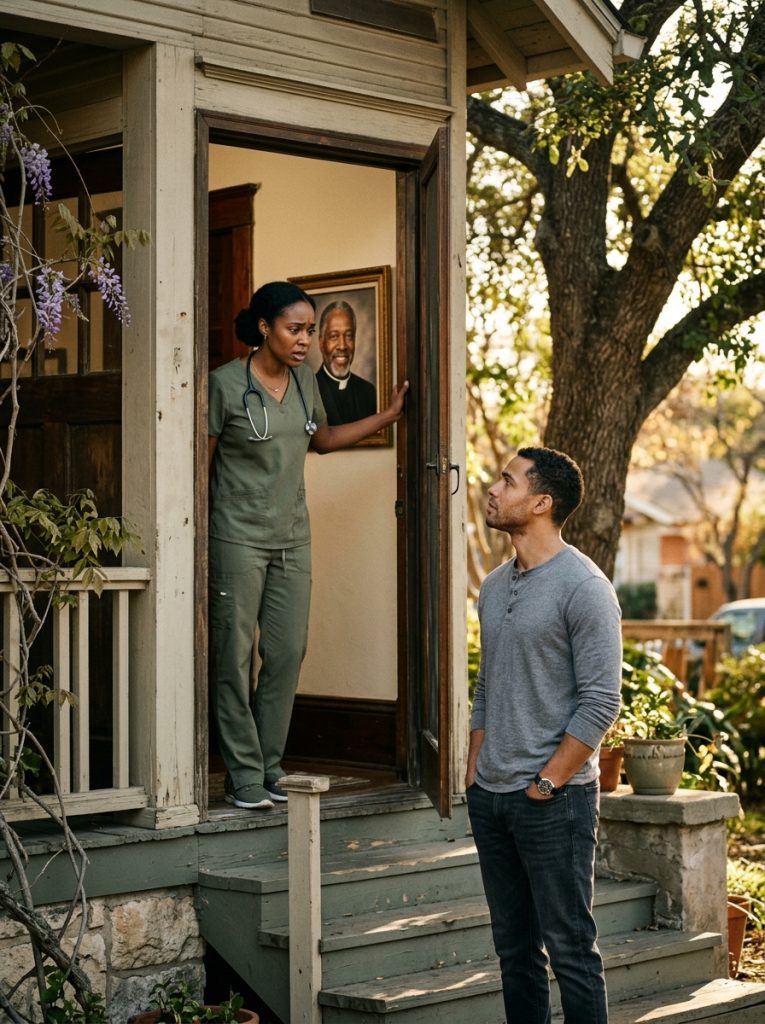
Nadia stepped backward into the hallway.
Not to close the door. Not to run.
To make room.
“Come in,” she said.
Elijah hesitated. One hand came out of his pocket — slowly, like a man who’d spent his life being careful about which spaces he entered.
“You sure?”
Nadia nodded.
She wasn’t sure. Not about anything. But she knew that leaving him on the porch wasn’t an option her conscience could survive.
He stepped inside.
The hallway was narrow. Warm. A row of framed photographs on the left wall — family portraits, church events, holidays.
And there. Third frame from the door.
Pastor David Brooks. Age thirty-two. Sunday-morning portrait. White collar. Deep-set brown eyes looking directly into the camera with the kind of steady confidence that made congregations trust him.
Elijah saw it.
Stopped.
His hand lifted — just slightly — toward the frame. Then dropped.
“That’s him,” he said quietly. Not a question.
“That’s him.”
Elijah stared at the photograph for a long time.
“I look like him.”
“You do.”
“My grandfather — Gerald — he told me. But seeing it is…”
He didn’t finish.
Nadia led him to the kitchen. Put on coffee. Set two mugs on the table. Moved on autopilot because her brain was still trying to process the fact that her father — the man whose funeral she’d planned, whose legacy she’d protected, whose sermons she’d transcribed into a memorial book — had a son she never knew about.
A son who grew up without a name.
A son who sat across from her now with gentle hands wrapped around a coffee mug and their father’s exact posture — shoulders slightly forward, chin level, present.
“Tell me about your life,” Nadia said.
Because she didn’t know where else to start.
Elijah told her.
Foster care from three to seven. Four placements. Some okay. Some not. Then Gerald and Helen — his adoptive grandparents — took him in when he was seven. They were older, retired, living in a small Ohio town. They gave him stability. A bedroom that stayed his. A school he didn’t have to leave.
He became a carpenter. Worked with his hands. Built things — porches, bookshelves, additions. Moved to San Antonio three years ago for a bigger market.
“I’m not angry,” Elijah said. “I want you to know that. I’m not here for money or a claim or — anything like that. I just wanted to see someone who shared something with me.”
Nadia’s eyes burned.
“Did you ever try to find him?”
“Gerald looked. For years. But the records from my birth were sealed. My mother — Denise — she passed when I was fifteen. Gerald said she never told anyone who the father was. It wasn’t until the DNA site matched me to your family tree that anything clicked.”
“And Gerald contacted me.”
“He asked me first. I said yes. Then I waited for you to decide.”
Nadia set her mug down.
“He was a good man,” she said. “Our father. In most ways. He was patient and kind and he gave everything to his congregation. But this—”
She gestured between them.
“This is the one thing he got wrong.”
Elijah nodded.
“Gerald said something when I told him I wanted to reach out. He said, ‘The man made a mistake. But the children don’t inherit the shame. They inherit each other.'”
Nadia’s throat closed.
Because that was exactly the kind of thing her father would have preached on a Sunday morning.
Except he never practiced it for his own son.
They talked for three hours.
About small things and large things. About Elijah’s work — the porch he was building for a family in Helotes. About Nadia’s clinic — the golden retriever with hip dysplasia she’d been treating for six months. About the weather in Austin versus Ohio. About coffee preferences and whether cornbread should have sugar in it.
Normal things.
Sibling things.
Things they were learning how to do for the first time at thirty and thirty-two.
When Elijah stood to leave, he pulled something from his back pocket.
A folded piece of paper. Old. Yellowed at the creases.
“Gerald found this in my mother’s things after she passed. He didn’t show me until last year.”
Nadia unfolded it.
A letter. In her father’s handwriting.
Dated thirty years ago.
“Dear Denise,
I know I have no right to write this. I know you asked me not to contact you again. But I need you to know that I think about him every day.
I’m a coward. I know that. I have a wife. A congregation. A reputation I’ve built my entire life around.
And I have a son I’ve never held.
Advertisement
I’ve tried three times to drive to Columbus. Each time I turn around. Each time I tell myself ‘next month.’ Each time next month becomes next year.
I don’t expect you to understand. Or forgive.
But if he ever asks about me — tell him I wasn’t brave enough. Not that I didn’t love him.
Because I do.
Even from here.
Even in silence.
David.”
Nadia read it twice.
Her hands were trembling.
“He tried,” she whispered.
“He didn’t try hard enough,” Elijah said. Gently. Not with anger. With the kind of acceptance that comes from a man who made peace with his story long before this moment.
“But he thought about me. That’s something.”
Nadia handed the letter back.
“Keep it,” Elijah said. “I have a copy. Gerald made one for me. But the original — it should be with his family.”
“You are his family.”
The words came out before Nadia could stop them.
Elijah looked at her.
That same expression she’d seen at the door — cautious, hopeful, waiting.
“Yeah?” he said.
“Yeah.”
She hugged him.
Not a polished, rehearsed embrace. An awkward, fierce, arms-around-a-stranger-who-isn’t-a-stranger hug that lasted too long and not long enough.
When they pulled apart, Elijah’s eyes were red.
“I’ll drive back to San Antonio tonight,” he said. “But — can I call you?”
“You better.”
He smiled.
Their father’s smile.
And walked down the porch steps into the golden Austin evening.
Nadia watched until his truck disappeared around the corner.
Then she went back inside.
Stood in front of the hallway portrait.
Looked at her father’s face.
The same eyes Elijah had. The same jaw. The same quiet steadiness.
“You should have been braver,” she said to the photograph.
It didn’t answer.
But she imagined — maybe foolishly, maybe not — that somewhere, in whatever comes after, David Brooks was watching his two children finally meet.
And feeling the weight of the silence he’d chosen.
Two weeks later, Nadia drove to San Antonio.
Elijah showed her the porch he was building. Introduced her to Gerald — eighty-one now, sharp as a tack, still building family trees on his computer.
“You look like your father,” Gerald told her.
“So does Elijah.”
“I know. That’s how I found you.”
They had dinner together. The four of them. Like family.
Because that’s what they were.
Not because David Brooks earned it.
But because his children chose it anyway.
And sometimes grace doesn’t require permission from the dead.
It only requires the living to open the door.
And keep it open.
The way Nadia did.
The way Elijah always hoped someone would.
The way David Brooks never quite managed — but his children finished for him.