The letter was twelve pages.
Handwritten. Blue ink. The same careful print their father had used on birthday cards and tax forms and the labels on his filing cabinet.
Noah sat on the old desk chair in Storage Unit 7C and read every word.
“Dear Noah,
If you’re here, you did what I hoped you would — you didn’t accept the surface answer. You dug deeper. You cared enough to wonder why.
That’s why you’re here and they’re not.
Let me tell you what this unit contains and why.”
The letter laid everything out.
Not in anger. Not in bitterness. In the measured, factual tone of a man who’d spent thirty years building a consulting firm and knew how to present evidence.
Victoria had been withdrawing from their father’s personal account since 2019. Small amounts at first — $2,000, $5,000 — escalating to $15,000 a month by the time he was too ill to check the statements himself. Total: $340,000.
James had used the family business as collateral for personal loans their father never authorized. He’d forged signatures on three separate occasions. The loans were still outstanding — and technically owed by the estate.
Cameron — the middle child, the quiet one — had sold two of their father’s properties without his knowledge. Used a power of attorney their father had signed during a hospital stay, thinking it was for medical decisions only.
All of this was documented in Box One.
Box Two held the real estate.
Four properties. A beach condo in Rehoboth. A cabin in the Poconos. A rental duplex in West Philadelphia. A commercial lot in Cherry Hill.
All purchased under a trust their father had created eight years ago — long before he was sick. Long before he suspected what his older children were doing.
The trust was named “The Noah Carter Irrevocable Trust.”
Noah read that line three times.
His father had known.
For years. He’d known what they were doing. Known they were draining him. Known they thought he was too old, too sick, too distracted to notice.
And instead of confronting them — instead of blowing it up — he’d quietly moved everything real to a place only the honest son would find.
“I could have fought them,” the letter read. “I could have hired lawyers and made it public and torn this family apart while I was still alive. But I was tired, Noah. And I didn’t want my last years to be a war.
So I built you a fortress instead.
Everything in this unit is yours. The properties. The accounts. The truth. My attorney, Margaret Webb, has the full documentation. She knows to expect your call.
The key was the test. Not a cruel one — just an honest one. They’ll laugh at it. They’ll post about it. They’ll think you got nothing.
Let them.
Because the will they heard today is real — but incomplete. The properties, the separate trust, the accounts I opened in your name five years ago — none of that goes through probate. None of it appears in the document they received.
It’s already yours.
It’s been yours since the day I realized you were the only one who called on Sundays because you wanted to. Not because you needed something.”
Noah set the letter down.
Stared at the unit around him.
His childhood desk. His mother’s journals — the ones Victoria had claimed were “lost in the move.” His grandmother’s ring — the one James said was “stolen during the estate sale.”
All here.
All saved.
By a man who couldn’t protect them in the open.
So he hid them where only love would find them.
Noah called Margaret Webb the next morning.
She answered on the first ring.
“I’ve been waiting for this call,” she said. “Your father told me you’d come within a week. He was right.”
“How long have you known?”
“Eight years. He set this up the year Victoria started the withdrawals. I told him to confront her. He said, ‘Margaret, I’d rather build something for the one who deserves it than destroy what’s left of the family over the ones who don’t.'”
Noah’s chest tightened.
“What’s the total value of the trust?”
“Including properties, liquid accounts, and the investment portfolio I’ve been managing quietly for five years — just over four point two million dollars.”
Noah sat down.
The will the siblings celebrated over — the house, the business portfolio, the investment accounts — totaled roughly two point eight million. Split three ways.
The key had opened four point two.
All his.
“What about their claims against the estate?” Noah asked. “The loans James took. The properties Cameron sold.”
“All documented. Your father wanted you to have the choice — pursue recovery or let it go. But the documentation exists if you ever need it. And honestly? Once their attorneys see what your father recorded, most of this resolves itself.”
Noah thanked her. Hung up.
Sat in his Fishtown apartment staring at the brass key on his kitchen table.
He didn’t call his siblings.
Not that day.
Not the next.
But three days later, Victoria called him.
Her voice was different. The smugness was gone. Replaced by something tight and controlled.
“Noah. I got a letter from Dad’s attorney. About an — an amendment to the estate.”
“Mmm.”
“It says there are additional assets. Under a separate trust. And that the executor is—” She paused. “You. It says the executor is you.”
Advertisement
“That’s correct.”
Long silence.
“Noah, what is this?”
“It’s what Dad wanted.”
“But—”
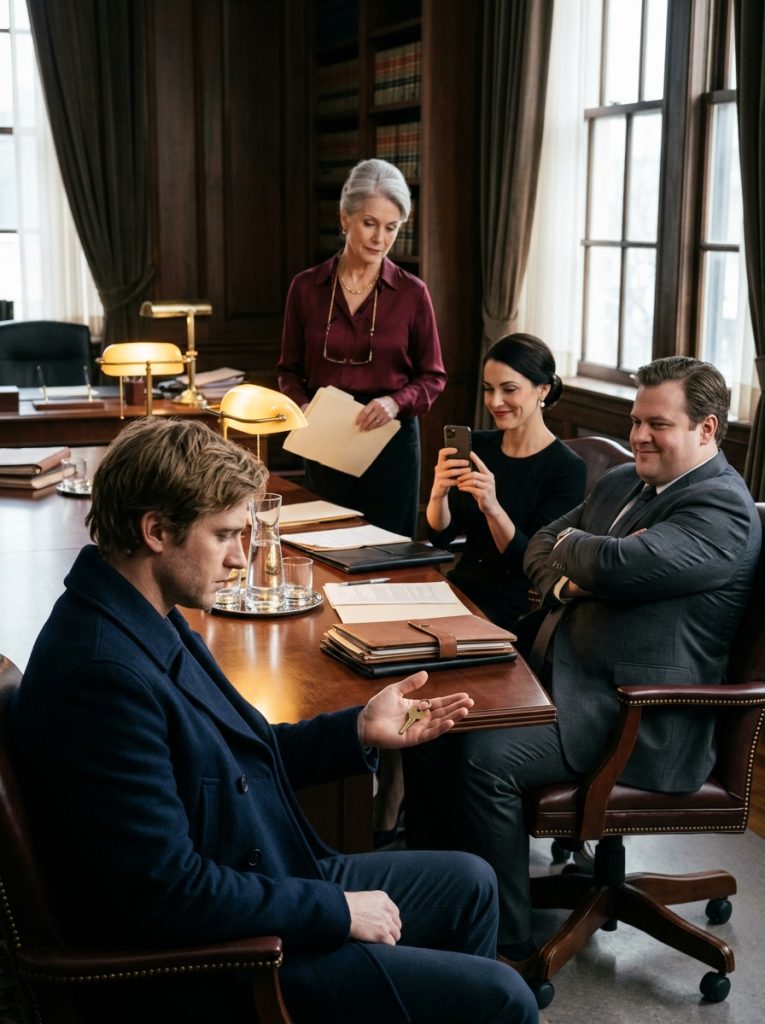
“Victoria. You photographed a key and sent it to the group chat. You laughed at me in a room full of people. You posted about it online.”
Silence.
“I’m not angry,” Noah said. “But I’m also not sharing. Dad made his decision. He made it years ago. And he made it because he watched.”
“Watched what?”
“Everything. Every withdrawal. Every forged signature. Every property sold behind his back. He knew. He always knew.”
The line went quiet for a very long time.
Then Victoria said something Noah didn’t expect.
“He never said anything.”
“No. He just moved everything somewhere safe.”
“And the key—”
“Was for the person he trusted to find it.”
Victoria didn’t cry. Victoria never cried.
But the silence that followed sounded exactly like what crying would sound like for someone who’d spent thirty-eight years believing they were smarter than everyone in the room.
Noah hung up.
Put the phone on the table.
Picked up the key.
Small. Brass. Unmarked.
Worth more than anything his father could have given him openly.
Because it wasn’t just money.
It was proof.
That someone saw him. Quietly. Without announcement. Without fanfare.
The way Noah had seen his father.
Every Sunday call.
Every chemo drive.
Every silent visit when the rest of the family was too busy counting what they’d take.
Noah put the key in his desk drawer.
Right next to the bus pass his father had given him for his sixteenth birthday — the one that said “Freedom” in their father’s handwriting on the sleeve.
Some things don’t need to be expensive to be priceless.
They just need to be found by the right person.
And Noah Carter — the youngest, the quietest, the one they laughed at — was always the right person.
His father knew it.
The key proved it.