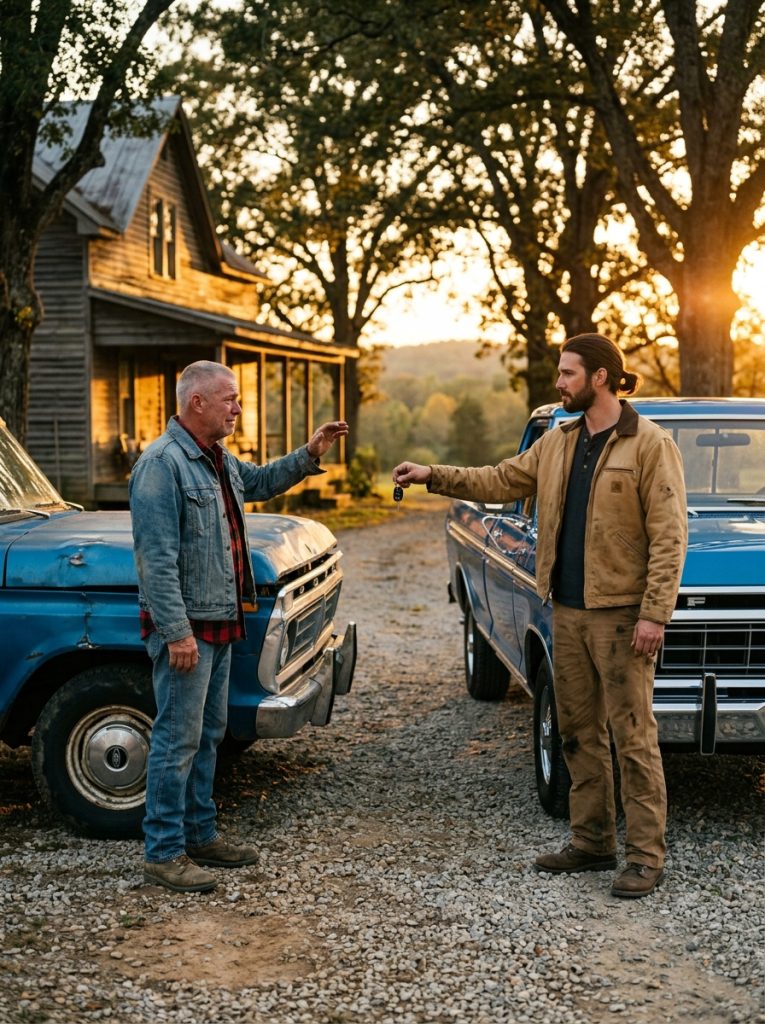
Jesse didn’t move from the bottom of the steps.
Just stood there. Keys in his extended hand. Waiting.
The way he always waited — like a man who’d learned that patience was safer than asking.
Ray gripped the porch railing and pulled himself up. His knees protested. His back protested. Everything in his sixty-two-year-old body protested except his heart, which was beating faster than it had in a decade.
“You rebuilt it,” Ray said. Not a question.
“From the frame up. Found a matching body in a yard outside Memphis. Took me two years of weekends.”
“Why?”
Jesse lowered the keys slightly. Looked at the old truck. Looked at the new one.
“Because I needed to build something that meant what it meant. Not just buy one. Build it. The way you built everything for me — slow, careful, with your hands.”
Ray’s throat closed.
He stepped off the porch. One step. Two. The gravel crunched under his boots — the same sound it had made every evening for twenty years when he’d walk to the truck and Jesse would appear beside it like a shadow drawn to headlights.
He reached Jesse.
Stood in front of him.
Close enough to see that the boy he remembered was gone — replaced by a man with thick hands and a steady gaze and the kind of calm that only comes from surviving something and choosing to be gentle anyway.
“You look good, son.”
The word slipped out before Ray could catch it.
Son.
He’d never said it before. Not in three years of fostering. Not once. The system had rules about that — about not creating “unrealistic attachment expectations.” About keeping distance. About being a “placement” instead of a parent.
Ray had followed those rules.
He’d hated every second of it.
Jesse heard the word. His eyes changed — not dramatically, not a movie moment — just a slight loosening around the edges. Like a knot that had been tied for a decade quietly coming undone.
“Can I show you something?” Jesse asked.
“Yeah.”
Jesse walked to the new truck. Opened the passenger door.
Inside, on the seat — the same position Jesse used to sit in — was a small cardboard box. No wrapping. No bow. Just a box with the lid set loosely on top.
Jesse lifted the lid.
Inside: a photo album.
Ray took it. Opened the first page.
And his breath left him.
Photographs. Dozens of them. All taken from the passenger seat of the old truck. All at different seasons — spring green, summer gold, autumn red, winter gray. All showing the same thing: the view through the windshield of the back roads they used to drive.
“You took these?” Ray whispered.
“Every evening. For three years. On a disposable camera I bought at the Dollar General with my allowance. I’d hold it low so you wouldn’t see.”
Ray turned the pages.
The tobacco farm at sunset. The white church on Route 11. The river bridge where his late wife used to skip stones. The stretch of road between the Hendersons’ place and the elementary school where the oak trees made a tunnel in June.
Every road. Every turn. Every mile he’d driven in silence with a boy who couldn’t speak — photographed from the angle of someone looking out a passenger window and memorizing home.
“I didn’t know how to tell you what those drives meant,” Jesse said quietly. “I couldn’t say it. Not then. So I kept a record instead.”
Ray closed the album.
Held it against his chest the way Earl held Marcus’s folder — like it was more than paper. Like it was proof.
“You drove these roads every night for three years,” Jesse continued, “and you never once asked me to talk. You never pushed. Never demanded an explanation for why I was the way I was. You just… drove.”
“You needed quiet.”
“I needed you. The quiet was just how I could handle it.”
Ray sat on the running board of the old truck. The metal creaked under his weight. Familiar.
Jesse sat beside him. The new truck behind them. The old truck beneath them. Two blue Fords bookending a decade of absence.
“Where’d you go?” Ray asked. Not an accusation. Just a question he’d carried for ten years.
“Everywhere. Nashville for a while. Memphis. Worked in shops. Slept in the back of a truck — not one as nice as this. Drank too much for a few years. Stopped. Got sober. Got my GED. Got a certification.”
“You’re a mechanic.”
“Like you taught me.”
Ray looked at him.
“I never taught you—”
“You did. Every time you popped the hood on a Saturday. Every time you lay under the chassis with the trouble light. I watched. I always watched.”
Ray remembered. The boy who wouldn’t talk but who’d stand three feet away every time Ray worked on the truck. Handing tools without being asked. Holding the light without being told.
Learning.
In silence.
The way he learned everything.
“I came back for a reason,” Jesse said.
Ray waited.
“I heard your fostering license expired. I heard your knees are bad. I heard you’re out here alone.”
“Who told you that?”
“Mrs. Patterson. At the church. I called her six months ago. Asked about you.”
Ray’s neighbor. The woman who brought him casseroles he never asked for.
Advertisement
“She said you won’t move to town. Said you won’t sell the house. Said you’re stubborn.”
“Sounds right.”
“So I’m not asking you to move.” Jesse pulled something from his jacket pocket. A folded piece of paper. “I’m asking if I can stay.”
Ray took the paper. Unfolded it.
A lease application. For the apartment above Ray’s detached garage — the one he’d converted for older foster teens years ago. Empty since the last kid aged out.
Jesse’s name was already filled in.
“I’ll fix what needs fixing,” Jesse said. “Drive you to appointments. Keep the truck running. Help with the property. I’m not asking for anything except proximity.”
Ray stared at the paper.
“You want to live here.”
“I want to come home.”
The word hung in the October air like woodsmoke.
Home.
Ray had never called it that for the kids. The system didn’t allow it. “Placement.” “Temporary living situation.” “Foster arrangement.”
Never home.
But Jesse was calling it home.
Ten years after leaving.
Ten years after the system said he was done.
Ten years after the gravel drive and the silence and the left turn at the county road.
“One condition,” Ray said.
Jesse looked at him.
“You drive me in the evenings. Like before. Back roads. No talking required.”
Jesse smiled.
Not a big smile. A small one. The kind Ray remembered — rare, quiet, and entirely real.
“That’s why I built the truck, Pop.”
Pop.
The word landed like the first drop of rain after years of drought.
Ray didn’t correct him.
Didn’t say “the system says—”
Didn’t say “I was just your placement.”
Just nodded.
And handed him the keys to the old truck.
“Then let’s go. Both trucks. I’ll follow you.”
Jesse took the keys.
Looked at them the way Ray had looked at the album — like holding something he’d been missing for a decade.
“Where to?” Jesse asked.
“Doesn’t matter. Just drive.”
And they did.
Two blue trucks on a Tennessee back road at golden hour. One old. One new. Both going nowhere in particular.
Both finally going home.