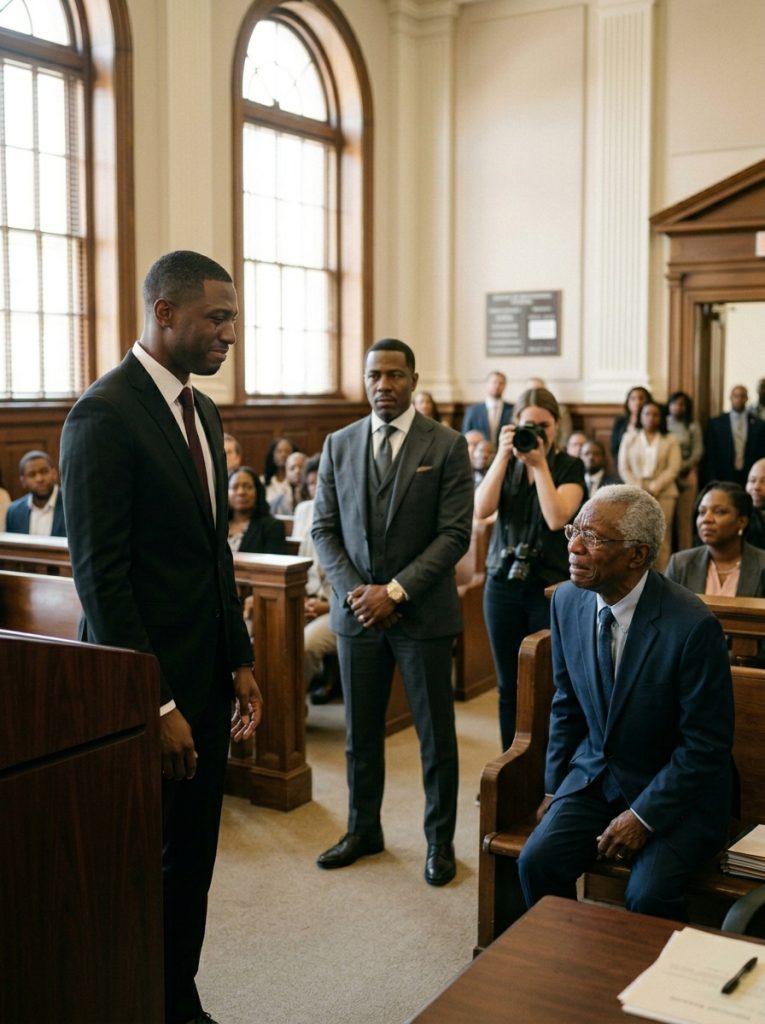
Earl took the folder with both hands.
Pressed it against his chest.
And Marcus turned back to the judge.
The oath was short. Twenty-three words. Marcus said each one like he was carving it in stone.
When it was done, the courtroom applauded again — but Marcus was already moving. Back toward the gallery. Back toward Earl.
He reached into his jacket pocket.
Pulled out something small. Silver. Flat.
A pin.
The state bar insignia. Polished that morning. Fitted with a clasp on the back.
Marcus held it up.
“This belongs to you, Pop.”
Earl looked at it. Then at Marcus. His lower lip trembled — the only time Marcus had ever seen that face show anything close to fragility.
“Son, that’s yours. You earned—”
“I earned it because you made it possible. Every dollar you didn’t spend on yourself. Every morning you woke up at four a.m. for that bus. Every night you checked my homework when you could barely keep your eyes open.” Marcus pressed the pin gently into Earl’s palm. “This isn’t mine alone. It never was.”
Earl stared at the pin.
His glasses were fogged beyond use. He took them off. Wiped his eyes with the back of his hand — the same hand that had gripped a steering wheel for thirty-one years so a boy could hold a pen.
“You’re gonna make an old man cry in public,” Earl whispered.
“Too late, Pop.”
The gallery laughed. Softly. The kind of laughter that comes from people witnessing something sacred.
Marcus pinned the insignia to Earl’s borrowed lapel. Right over the heart. The navy fabric was too thin — the pin poked through easily, but Earl didn’t flinch.
He just looked down at it.
Touched it once with his thumb.
And nodded.
That was all.
But it was everything.
Terrence hadn’t moved.
He stood in the aisle — photographer beside him, camera now hanging at his side like a useless prop. His three-piece suit looked suddenly costume-like. His gold watch too bright. His smile too rehearsed for a room that had already decided what was real.
He tried anyway.
“Marcus.” Terrence’s voice carried over the settling applause. “Son. That was beautiful. I’d love to—”
“Don’t.”
Marcus didn’t turn around.
“Don’t call me son. Don’t stand in this room. Don’t pretend the last twenty-two years were a pause instead of an absence.”
Terrence’s jaw tightened.
“I’m your father.”
“You’re my biology,” Marcus said evenly. “He’s my father.” He placed his hand on Earl’s shoulder. “And everyone in this room knows the difference.”
Terrence’s photographer shifted uncomfortably. Put the lens cap on. Stepped backward.
Terrence looked around the courtroom. At the judge, who watched him with neutral professionalism. At the other families, who had turned away. At Earl, who sat with a pin on his chest and tears drying on his weathered cheeks.
Nobody invited him to stay.
Nobody asked him to leave.
He simply became irrelevant.
And irrelevance, for a man who’d arrived expecting a spotlight, was worse than rejection.
Terrence straightened his jacket. Tugged his cufflinks. Turned.
And walked out of the courtroom without another word.
The photographer followed.
The doors closed behind them with a soft click that sounded, to Marcus, like the period at the end of a sentence he’d been writing his whole life.
Afterward, Marcus and Earl sat in the courtroom lobby. Just the two of them. The other families had filtered out to restaurants and celebrations.
Earl held the leather folder in his lap. The bar insignia caught the overhead light on his chest.
“You didn’t have to do that,” Earl said quietly.
“Yeah, I did.”
“I mean — in front of everyone. You didn’t have to make it public.”
Marcus leaned back against the bench.
“Pop. You drove a bus in silence for thirty years so I could stand in a courtroom and speak. The least I can do is make sure people heard why.”
Earl was quiet for a long time.
Then he reached into the inner pocket of the borrowed suit. Pulled out something Marcus hadn’t seen in years.
A photograph.
Small. Worn at the edges. Taken at a kitchen table Marcus barely remembered.
A six-year-old boy. Missing front tooth. School uniform slightly too big. Looking up at the camera with the kind of trust only a child offers freely.
And behind him, reflected in the kitchen window, a man in a bus driver’s uniform — already late for his shift but refusing to leave before the photo was taken.
“First day of first grade,” Earl said. “You didn’t want me to go to work.”
“I remember.”
Advertisement
“You grabbed my belt loop and said, ‘Just five more minutes, Pop.'”
Marcus’s throat tightened.
“Every morning after that,” Earl continued, “I’d wake up early enough to have coffee with you before school. Even when my shift started at 4:45. Even when it meant three hours of sleep.”
“I didn’t know that.”
“You weren’t supposed to. That’s what parents do.”
Marcus took the photograph. Looked at it for a long time.
That boy. Small. Trusting. Holding onto a belt loop like it was the only anchor in the world.
And the man behind him — already exhausted, already running late — choosing to stay five more minutes anyway.
Every single day.
For thirty years.
“Pop,” Marcus said.
“Yeah?”
“I’m buying you a new suit.”
Earl looked down at the borrowed jacket. The pin still sat over his heart. The sleeves still bunched at his wrists.
“This one’s fine,” he said.
“It’s three sizes too big.”
“It got me here, didn’t it?”
Marcus laughed.
Earl smiled.
And for a long moment, in the marble lobby of a federal courthouse in Atlanta, two men sat in comfortable silence — the kind that only comes from a lifetime of showing up.
Not for applause.
Not for cameras.
Just because one man decided, thirty years ago, that a boy with a garbage bag of clothes deserved better.
And then spent every day proving it.
Three days later, the photographer posted one image online.
Not Terrence in his three-piece suit.
Not the courtroom in its grandeur.
Just Marcus — pinning a small silver insignia to the chest of an old man in a borrowed suit.
The caption read: “The man who actually raised him.”
It was shared 2.4 million times in a week.
Earl never saw it.
He doesn’t use the internet.
But every morning, when he puts on his new suit jacket — the one Marcus bought him the following Saturday — he touches the pin first.
Every single morning.
Just to make sure it’s still there.
And every Sunday, when Marcus calls — same time, same voice, same “How you doing, Pop?” — Earl answers on the first ring.
Because that’s what you do.
When someone is worth it.
You show up.
Every single day.
The way Earl always did.
The way Marcus always will.
And somewhere in Atlanta, a tailored charcoal three-piece suit hangs in a closet nobody visits anymore. A gold watch sits in a drawer. A photographer’s SD card holds images that will never be printed.
Because some men build legacies with money.
And some men build them with bus passes and sleepless nights and sold trucks and borrowed suits.
And the world — when it’s paying attention — knows which one lasts.