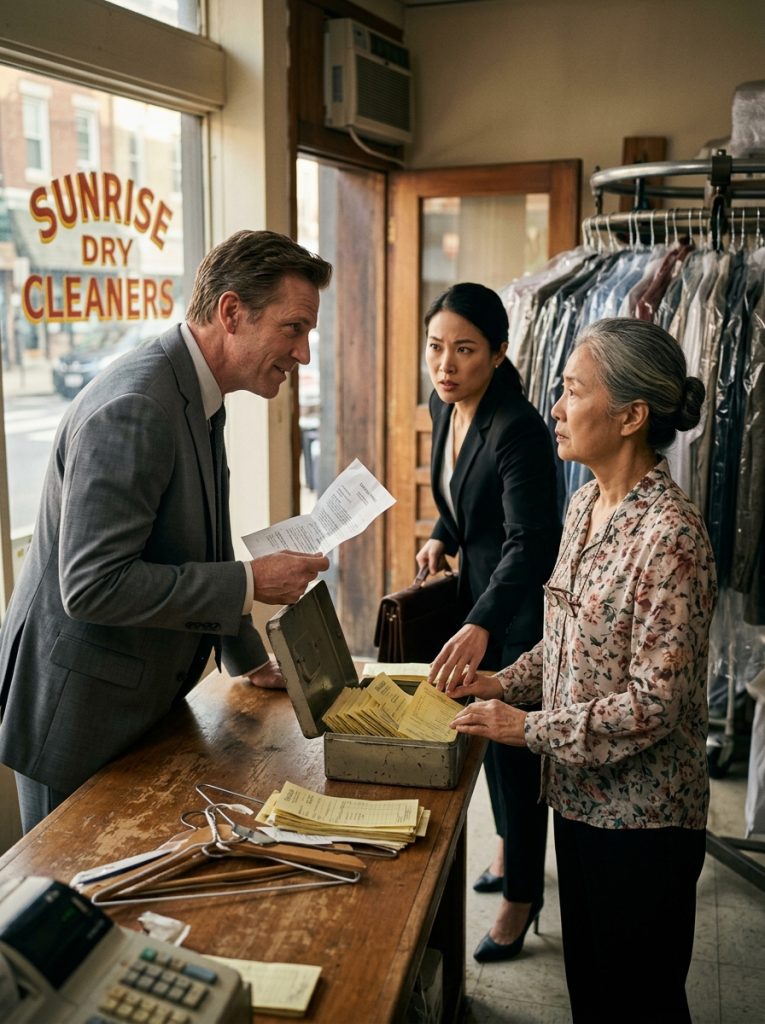
Karen Park walked into the Philadelphia County Courthouse on a Tuesday morning in October carrying a fireproof metal box, a leather briefcase, and the kind of expression that made opposing counsel check their notes twice before speaking.
She was thirty-four years old. Five-foot-eight in heels. Black suit pressed to a knife edge. Hair pulled back tight enough to mean business.
People in her firm called her “the closer.” Not because she was flashy. Because she was precise. Because she prepared like a surgeon and argued like a mathematician. Because she never walked into a courtroom without knowing every fact, every precedent, and every exit her opponent might try to use.
Northwestern Law. Seven years at Morrison & Kline. Specializing in commercial real estate disputes — the kind of cases where men in expensive suits tried to take things from people who couldn’t afford lawyers.
She’d never lost one of those cases.
And she wasn’t about to start with her mother’s dry cleaner.
The courtroom was half-empty. Judge Patricia Delano presided. Gerald Whitmore — the attorney representing Whitmore Property Group — sat at the plaintiff’s table in a gray suit that probably cost more than Mrs. Park’s monthly rent.
He looked relaxed.
Why wouldn’t he be?
He was suing an elderly Korean immigrant who ran a dry cleaner. In his world, this was a formality. A rubber stamp. The kind of case that gets filed on Monday and resolved by Friday because the other side can’t afford to fight.
He hadn’t counted on Karen.
“Your Honor,” Gerald began, standing with the ease of a man accustomed to having rooms listen. “Whitmore Property Group acquired this building in March of this year. Upon review of the premises, we found Mrs. Park operating without a valid lease, without documented rent payments, and without authorization from the current owner. We are simply requesting the court enforce an orderly eviction under standard landlord-tenant law.”
He sat down.
Smiled.
Folded his hands.
Karen stood.
“Your Honor.”
“Ms. Park. Proceed.”
Karen opened the fireproof box.
She lifted the first stack of receipts. Placed them on the table.
“These are twenty years of rent receipts. Each one stamped with the date of payment and signed by the previous building owner, Bernard Hoffman, who leased this space to my client in 2006. There are two hundred and forty monthly receipts in this box. Not a single one is missing.”
She placed a second item on the table.
“This is the original lease agreement, signed by Bernard Hoffman and Eunji Park in 2006. It is notarized. It is witnessed by two parties. And it includes a renewal clause that automatically extends the lease in five-year increments as long as rent is paid on time.”
She placed a third document.
“This is the notarized amendment from 2011, signed by both parties, updating the monthly amount and confirming the renewal clause remains in effect. Also witnessed. Also filed with the city clerk.”
Gerald’s smile faded.
“And this” — Karen placed a final sheet — “is a certified copy of the original lease filing from the city clerk’s office. Recorded. Stamped. Public record. Available to anyone who cared to look before filing a fraudulent eviction claim.”
She turned to face Gerald directly.
“Counsel for the plaintiff either failed to conduct basic due diligence before filing this action — or knew this documentation existed and chose to proceed anyway. Either scenario concerns the court.”
Gerald stood.
“Your Honor — we were told no documentation existed. The previous owner passed away and his records—”
“Were filed with the city,” Karen said. “Which is where any competent attorney would have checked before dragging a sixty-two-year-old woman into court.”
Judge Delano looked at Gerald over her glasses.
“Mr. Whitmore. Did your client check the public record before filing?”
Gerald’s jaw worked.
“We relied on internal property records—”
“Internal records are not public records, counsel. And public records are where leases live. You know this.”
The courtroom was very quiet.
Gerald sat down.
He did not look relaxed anymore.
Judge Delano reviewed the documents. Turned each receipt. Examined the notarization. Read the renewal clause twice.
Then she removed her glasses.
“This eviction claim is dismissed with prejudice. The lease is valid. The renewal clause is enforceable. Mrs. Park is under no obligation to vacate.”
She looked at Gerald.
“Furthermore — I’m referring this matter to the District Attorney’s office for review. Filing a fraudulent eviction claim against a documented tenant is not a ‘misunderstanding,’ Mr. Whitmore. It is, at minimum, a violation of the Unfair Trade Practices Act. The DA can determine if it rises to something more.”
Gerald’s face went white.
“Your Honor—”
“We’re done here.”
The gavel came down.
Karen closed the metal box. Clicked the latches. Turned to her mother, who sat in the gallery in her pressed floral blouse with her reading glasses on a chain and her hands folded in her lap.
Mrs. Park’s expression hadn’t changed throughout the entire hearing.
Composed. Quiet. Dignified.
But when Karen sat down beside her — when the courtroom emptied and the noise faded and it was just the two of them on that wooden bench — Mrs. Park reached over and took her daughter’s hand.
She squeezed once.
That was all.
That was everything.
They drove back to the shop together. Karen parked on Girard Avenue. Walked her mother to the door.
Mrs. Park unlocked it. Flipped the sign to OPEN. Walked behind the counter she’d stood behind for twenty years.
The garment rack began its slow rotation.
The bell above the door chimed.
Advertisement
Mrs. Delgado walked in carrying her curtains.
“Well?” she said.
Mrs. Park smiled.
“We stay.”
Within an hour, the news had traveled the block. Neighbors came. Not with dry cleaning — with flowers. With food. With a bottle of champagne someone produced from the Italian deli next door.
The shop that had been two weeks from disappearing was full.
Fuller than it had been in years.
Not because people suddenly needed their clothes cleaned.
But because they needed Mrs. Park to know what she meant to them.
Twenty years of pressing suits for job interviews. Twenty years of hemming dresses for quinceañeras. Twenty years of knowing every family’s name, every child’s size, every grief and every celebration.
Twenty years of being the constant on a block that never stopped changing.
Karen stood by the door and watched her mother accept every embrace with the same quiet grace she’d carried her entire life.
No dramatics. No victory speech. No told-you-so.
Just a woman in a floral blouse.
Behind her counter.
Where she belonged.
That evening, Karen drove home to her apartment in Center City. Set the briefcase by the door. Made tea. Sat in the silence of her living room.
Her phone buzzed.
A text from her mother. A photo.
The shop counter. Clean. Ready for tomorrow. A single orchid in a vase someone had brought. And the fireproof box — closed, latched, back in its place beneath the register.
Underneath the photo, one message in Korean:
“Thank you, daughter.”
Karen stared at the message for a long time.
She didn’t respond with words.
She sent back a single heart.
And then she set the phone down, leaned back, and smiled.
Because her mother had spent twenty years saving every receipt.
Every single month. Without fail. Without anyone asking her to.
Not because she expected a fight.
But because she knew — in the quiet, certain way that immigrants learn through experience — that the world doesn’t always protect you.
So you protect yourself.
One receipt at a time.