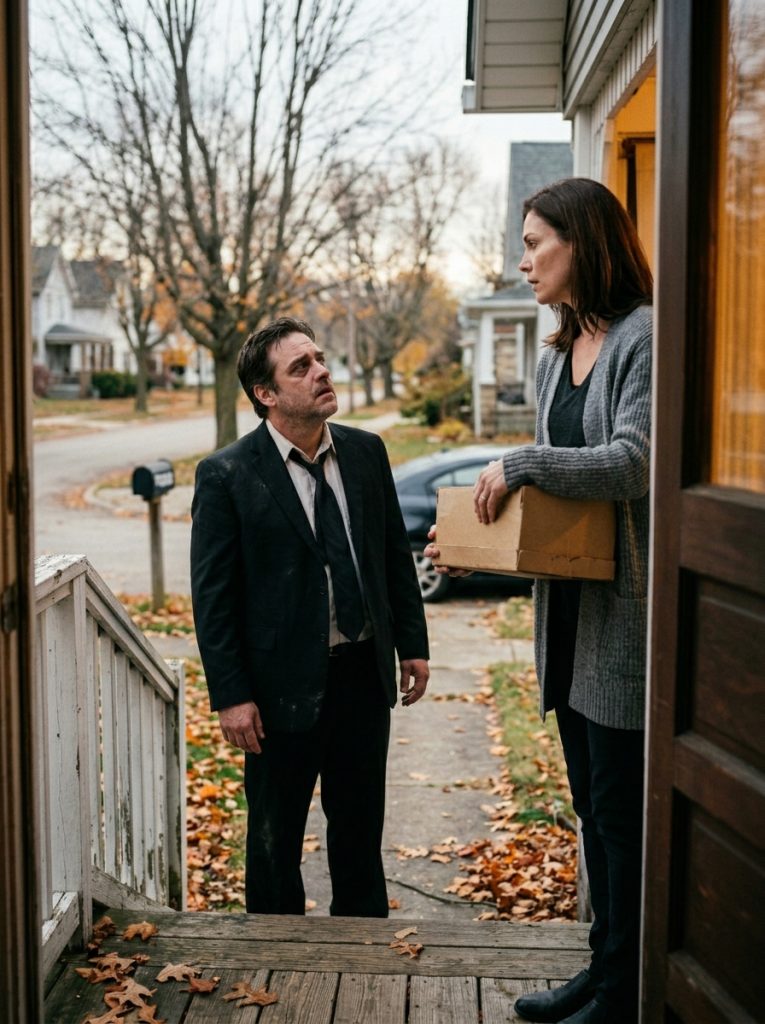
Grace stood in the doorway for a long time without speaking.
The shoebox pressed against her chest. The letters inside shifted with her breathing — old paper rustling against old paper.
“You’re Thomas,” she said again. Like saying it twice would make it real.
“Yeah.”
“You look like him.”
“Like who?”
“Like James.” Her eyes glistened. “The photos — in the letters — your mother sent photos. Of both of you. Every year until you were about fifteen. Then they stopped.”
Thomas felt his chest tighten.
“She never told us about you.”
“I know.”
“How long have you known?”
“Since I was eighteen.” Grace’s voice was quiet. Steady. Like someone who’d had twenty-four years to make peace with a truth that still ached. “My parents — my adoptive parents — told me when I graduated high school. They gave me the first letter. Then the rest.”
“And you never reached out?”
Grace lowered the box slightly.
“Your mother asked me not to.”
Thomas felt the ground shift.
“She what?”
“In the letters. She explained — she said your father was dangerous. That she gave me up to protect me. That if he ever found out I existed, it would put everyone at risk. She begged me to stay away. To let you and James live without knowing.”
Thomas stared.
His father — Earl Beckett — had died when Thomas was twenty-two. Heart attack. Big man. Hard hands. A temper that filled rooms like weather.
He’d always known his father was difficult.
He’d never known his father was the reason he grew up without a sister.
“Can I read them?” he asked.
Grace nodded.
She stepped aside.
“Come in.”
The house was small and warm. A couch with a crocheted blanket. A kitchen that smelled like coffee. Family photos on the walls — Grace with her adoptive parents, Grace at a graduation, Grace with two teenage children Thomas hadn’t known existed.
They sat at the kitchen table.
Grace set the shoebox between them and removed the lid.
Inside: forty-seven envelopes. Hand-addressed. The ink on the earliest ones was dark and sharp. The later ones trembled.
Thomas picked up the first.
Postmarked 1984.
His mother’s handwriting — neat, small, familiar as breathing.
“Dear Grace,” it began. “You are three months old today. I am writing this because someday you will need to know why. And I may not be there to tell you in person.”
Thomas read the letter.
Then the next.
Then the next.
The story unfolded like a wound reopening.
His mother — Margaret Beckett — had gotten pregnant with Grace in 1983. Their father, Earl, had been at his worst. Drinking. Raging. Breaking things. Margaret was terrified that another child — especially a girl — would become a target.
She made a decision.
She carried Grace in secret. Told Earl she was helping a friend in Columbus during the final months. Delivered at a hospital in Athens. Signed the adoption papers the same day.
A couple named Hollister — good people, stable, kind — took Grace home.
And Margaret went back to Dayton.
Back to Earl.
Back to raising two boys in a house where silence was survival.
She wrote to Grace every year.
Every single year for fifteen years.
She sent photos. Updates. Small details about Thomas and James — their birthdays, their schools, their achievements. She wrote about the guilt. About the hope that one day, when Earl was gone, she could bring everyone together.
But Earl didn’t die until 2005.
And by then, Margaret was already sick.
She died in 2008 without ever reuniting her family.
The last letter was dated 2007. The handwriting was barely legible. Three sentences:
“Dear Grace. I am sorry I ran out of time. Please find your brothers.”
Thomas set the letter down.
His hands were shaking.
“She asked you to find us.”
Grace nodded.
“But I didn’t. Not right away. I was scared. I didn’t know if you’d want to know me. I didn’t know if it would help or if it would just rip something open that was better left alone.”
“And then James—”
“Died. Before I worked up the courage.”
Advertisement
The words hung in the kitchen like smoke from a blown-out candle.
Thomas stood up. Walked to the window. Looked out at the quiet street — the bare maples, the fallen leaves, the ordinary afternoon of a town that had no idea what was unfolding in this kitchen.
He thought about James.
About the last time they spoke — a phone call eight months ago that lasted four minutes. How are you. Fine. You. Good. Okay. Talk soon. The mandatory exchange of men who had lost the language for closeness.
He thought about all the things James might have been carrying in that one-bedroom apartment. The loneliness. The silence. The feeling of being the last one left.
Except he wasn’t the last one left.
He just didn’t know it.
Thomas turned back to the table.
His voice was rough.
“He was alone, Grace. He died alone in that apartment. No one found him for two days. And you were three towns over.”
“I know.”
“If he’d known—”
“I know.”
She was crying now. Quietly. The way people cry when the grief isn’t fresh but isn’t finished either.
“I’m sorry, Thomas. I’m sorry I waited. I’m sorry I was afraid. I thought I had more time.”
Thomas looked at her.
This woman who looked like his brother. Who had his mother’s letters in a shoebox on her kitchen table. Who had spent twenty-four years holding a secret that wasn’t hers to carry.
“It’s not your fault,” he said.
“It feels like it is.”
“It’s not. It’s Dad’s fault. And it’s Mom’s — for thinking silence was the same thing as safety.”
Grace wiped her eyes.
“What do we do now?”
Thomas thought about that.
About the grave in Dayton. About the empty apartment. About the forty-three years of missed holidays and missed phone calls and missed everything.
“I don’t know,” he said. “But I’d like to start by knowing you.”
Grace almost smiled.
“I’d like that too.”
They sat at the table until the autumn light turned amber.
Grace made coffee. Thomas read more letters. They talked about their mother — the woman they shared but never shared at the same time.
When Thomas left that evening, Grace walked him to the porch.
“Will you come to the grave with me?” she asked. “James’s grave. I’d like to see it.”
“Yeah.” Thomas nodded. “I’ll take you.”
The following Saturday, they drove together.
Small cemetery. Flat headstone. The name JAMES ROBERT BECKETT carved in simple block letters.
Grace knelt.
She took one letter from the shoebox — the last one. The three-sentence one. Their mother’s final words.
She placed it on the headstone.
Pressed it flat with both hands.
And whispered: “I’m here now. I’m sorry it took so long.”
Thomas stood behind her with his hands in his coat pockets and tears on his face.
The brother who died alone had family all along.
Twenty-six miles away.
Waiting.
Afraid.
But here now.
Finally here.
And that was enough.
Not to undo the years.
Not to erase what was lost.
But to prove — standing together at a grave on a cold Saturday morning — that family doesn’t always arrive on time.
Sometimes it arrives too late for one person.
But just in time for the ones who remain.