The phone hit the linoleum with a dull plastic clatter. It slid across the wet floor, stopping near the base of the counter.
Frank stared at it. Then he stared at the old man. The color drained from his face, leaving him looking pale and slick with sweat. The red neon sign from the window reflected in his wide, unblinking eyes.
“You’re bluffing,” Frank stammered. His voice cracked. He took a half-step back, his rubber shoes squeaking against the floor. “Sterling Development doesn’t sell. They bulldoze. I have the memo. I have the email.”
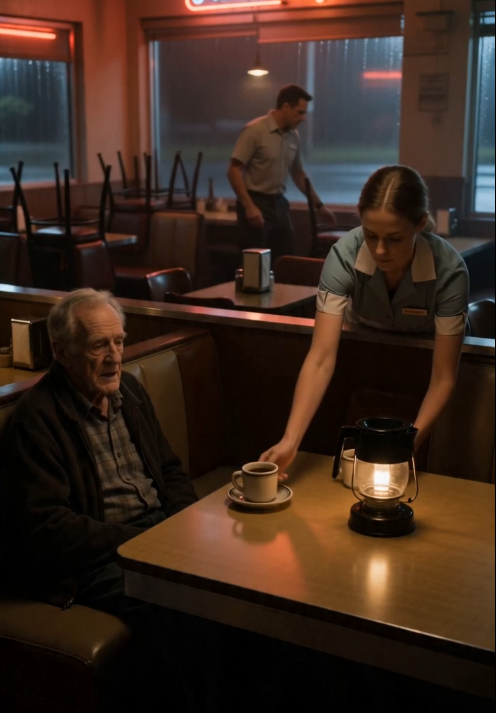
The old man didn’t answer immediately. He just wrapped his hands around the white ceramic mug again. The kerosene lantern flickered, casting long, dancing shadows across his weathered face.
“Sterling Development,” the old man said softly, “is a subsidiary of Oak Creek Holdings. Oak Creek Holdings leveraged their debt to buy this block. But Oak Creek missed their quarterly payment to First National on Tuesday.”
He took another sip of the coffee.
“I bought the defaulted note,” he continued. “Which means I own the debt. Which means I own the collateral. Which means I own this diner.”
Frank’s mouth opened and closed. He looked like a fish gasping for air. He lunged for his phone on the floor, snatching it up with trembling hands. He tapped the screen frantically, his thumb smearing against the glass.
“I’m calling Sterling,” Frank said. His voice was high, tight, vibrating with panic. “I’m calling the regional director. You’re a crazy old man. You’re trespassing.”
He pressed the phone to his ear. The dial tone hummed in the quiet diner. The rain hammered against the glass.
I stood there, holding the empty coffee pot. My heart was hammering against my ribs. I looked at the old man. He just looked back at me, his pale blue eyes calm, anchored in the storm.
“Hello?” Frank said into the phone. “Yeah, it’s Frank at the Route 66 location. I have a situation. There’s a homeless guy in the diner claiming he bought the building… No, I’m serious. He says he bought the note from First National… What do you mean the note was sold?”
Frank’s arm dropped. The phone slipped from his hand again, dangling by the charging cord.
“He… he sold it,” Frank whispered. He looked at the old man. The arrogance was completely gone. He just looked small. “The regional director just confirmed it. The note was sold this morning.”
The old man set the mug down. He reached into the inner pocket of his dark jacket. He pulled out a thick, folded document. The paper was heavy, cream-colored, stamped with the raised seal of First National Bank.
“My name is Elias Thorne,” the old man said. His voice filled the diner, bouncing off the chrome and the vinyl. “I built this place in 1978. I sold it in 1998 to pay for my wife’s cancer treatments. I heard the new management was cutting staff, skipping repairs, and treating the waitresses like garbage.”
He looked at Frank. The look wasn’t angry. It was just cold. Dismissive.
“I bought it back to save it,” Elias said. “And the first order of business is clearing out the dead weight.”
Frank’s face twisted. The panic shifted into a desperate, clawing survival instinct. He turned to me. He pointed a shaking finger at my chest.
“Chloe!” Frank shouted. “Tell him! Tell him I’m a good manager! Tell him I kept the schedules! You’re the one who gave him the coffee! You’re the one who encouraged him to stay!”
I looked at Frank. I looked at the stacked chairs. I looked at the rain outside.
“I gave him coffee because he was cold, Frank,” I said. My voice didn’t shake. “Not because he’s the owner.”
Elias stood up. He was taller than I thought. He buttoned his jacket. He picked up the heavy document and slipped it back into his pocket.
“You’re fired, Frank,” Elias said. “Leave your keys on the counter. And don’t come back.”
“You can’t do this!” Frank screamed. He slammed his fist on the table. The coffee mug rattled. “I have a mortgage! I have a kid in college! You can’t just fire me because of a piece of paper!”
“Security is already on the way,” Elias said. He didn’t raise his voice. He didn’t have to. “They’re coming to escort you off the property. If you’re not gone in five minutes, they will arrest you for trespassing.”
Frank stared at him. The fight drained out of him all at once. His shoulders slumped. He looked at the counter. He looked at me. He didn’t say another word. He just unclipped his key ring from his belt and dropped it on the Formica. It landed with a metallic jingle.
He walked out the front door. The bell chimed. The rain swallowed him.
The diner was quiet again. Just the hum of the refrigerator and the hiss of the rain.
Elias sat back down in the booth. He looked at the empty chair across from him.
“Sit down, Chloe,” he said.
I walked over and slid into the vinyl seat. The leather was cold.
“You did good tonight,” Elias said. He pushed the coffee mug toward the center of the table. “Most people would have thrown me out. Frank would have called the cops. You gave me coffee.”
“I just didn’t want you to get wet,” I said.
Elias smiled. It was a small, sad smile, but it reached his eyes. “That’s exactly why I kept the place. I need a manager who knows the difference between a customer and a human being.”
He reached into his pocket again. He pulled out a set of keys. Not the cheap metal ones Frank had dropped. These were heavy, brass, attached to a leather fob. He slid them across the table.
“The diner opens at 6 AM,” Elias said. “I’ll see you then.”
He stood up, walked to the door, and pushed it open. The wind blew in, carrying the smell of wet asphalt and ozone. He stepped out into the rain and disappeared into the dark.
I sat in booth four. I looked at the brass keys. I looked at the kerosene lantern. The flame burned steady and bright, casting a warm, golden light over the empty diner.