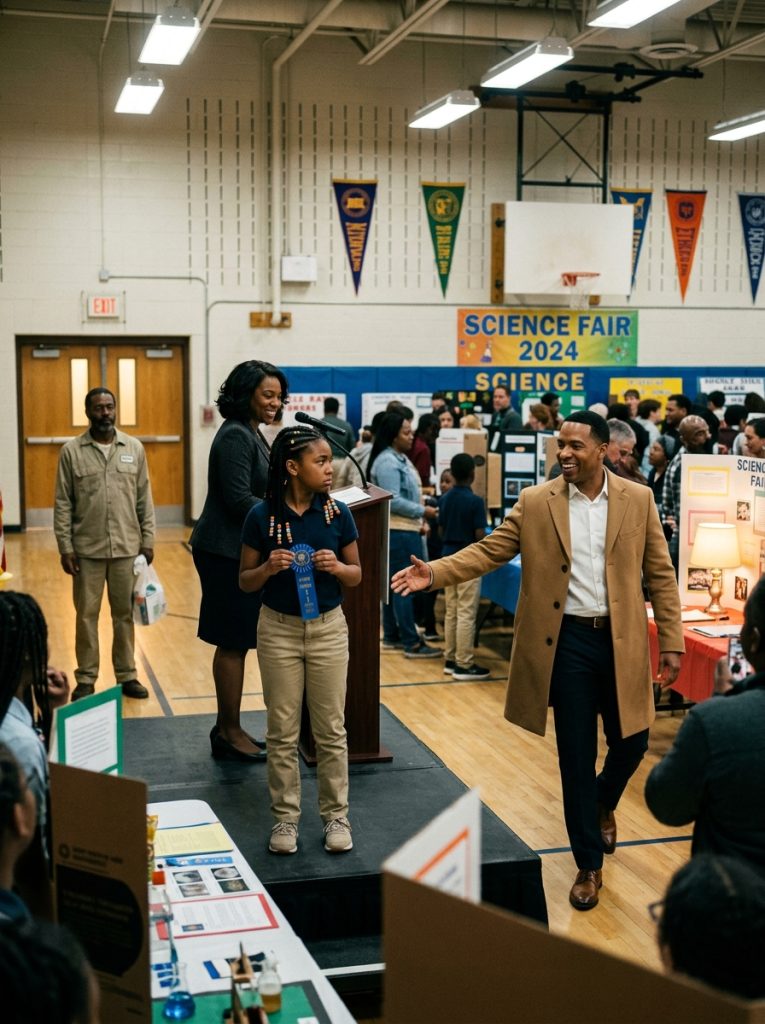
Maya looked at the principal’s outstretched hand shaking Victor’s.
She looked at her father — this man in a camel overcoat who smelled like cologne and confidence — smiling for a camera she hadn’t asked anyone to bring.
Then she looked toward the back of the gymnasium.
Uncle Ray stood by the double doors. Same khaki uniform he always wore. Same clean button-down layered over it because he never wanted to embarrass her at school events. Same gentle, tired eyes.
He was holding the plastic bag with the extra baking soda and food coloring. The backup supplies. The emergency kit he’d insisted on bringing “just in case the volcano needs a second run.”
He was smiling.
But his smile was the kind that sits on top of something heavier. The kind a man wears when he’s decided that his feelings aren’t the ones that matter today.
Maya’s hand tightened on the blue ribbon.
She turned back to the microphone on the podium. The one the principal had just used to announce her name. It was still on. Still live. Still broadcasting to three hundred people in folding chairs.
She leaned forward.
“Um — excuse me.”
The gymnasium quieted.
Victor turned. Still smiling. Still expecting this to be part of the celebration.
“I want to say something,” Maya said.
The principal nodded encouragingly. “Of course, Maya. Go ahead.”
She took a breath.
Eleven years old.
Standing on a gymnasium stage in a school polo and khakis with beads in her braids and a ribbon in her hands and three hundred people waiting.
“I want everyone to know that this project was built by me and my Uncle Ray. He’s the one who helped me. Every night for three weeks. He came home from work at ten o’clock and stayed up with me until midnight. He’s the one who figured out the right ratio of vinegar to baking soda. He’s the one who drove to three different stores to find the right paint for the cone.”
She pointed toward the back of the room.
“That’s him. By the door. In the brown shirt.”
Three hundred heads turned.
Ray stood perfectly still.
The plastic bag hung at his side.
His eyes were wet.
Maya continued.
“My father—” she looked at Victor — “hasn’t been here. Not for the project. Not for this year. Not for any year. He showed up tonight. And I love him for coming. But I don’t want anyone to think he built this with me. Because he didn’t.”
The gymnasium went completely silent.
Not uncomfortable silence. Not the kind that comes from scandal.
The kind that comes from truth.
Victor’s smile collapsed.
Not all at once. In stages. The mouth first. Then the eyes. Then the posture — the expensive coat suddenly looking less like confidence and more like costume.
He stood alone on the stage with his hand still extended toward a principal who had already withdrawn his.
Nobody moved.
Then the principal stepped to the microphone.
“Thank you, Maya. And thank you to whoever helped you create this incredible project.” He looked toward the back of the room. “Sir — would you like to join us up here?”
Ray didn’t move at first.
He looked at Maya.
She nodded.
He set the plastic bag on the nearest chair. Straightened his shirt. And walked — slowly, carefully, like a man not accustomed to being seen — up the center aisle between rows of families.
The applause started before he was halfway there.
Not loud at first. A few parents. A few teachers. Then more. Then the whole room.
By the time Ray reached the stage, three hundred people were on their feet.
He climbed the three steps.
Maya walked straight to him.
She wrapped her arms around his waist and pressed her face against his chest — the way she’d done since she was four years old, since the night he picked her up from the hospital after her mother died and carried her home to a one-bedroom apartment that became the whole world.
Ray put one arm around her.
The ribbon crinkled between them.
He didn’t speak.
He didn’t need to.
The room said everything for him.
Victor Odom stood alone at the side of the stage.
His coat seemed heavier now. His shoes seemed too polished. His smile was gone.
He watched the standing ovation with the expression of a man who had just learned — publicly, irrevocably — that showing up once doesn’t erase seven years of absence.
He walked off the stage without saying goodbye.
Down the steps. Up the aisle. Through the gymnasium doors. Into the parking lot where his rental car — a black sedan with out-of-state plates — sat under a flickering light.
Nobody stopped him.
Nobody called after him.
Nobody noticed.
Because Victor Odom had spent seven years being absent. And in the end, absent was exactly what he became again.
Advertisement
Later — weeks later — he would send Maya a text message. A long one. Full of explanations and half-apologies and promises about “next time” and “doing better.”
Maya would read it.
She wouldn’t respond.
Not out of cruelty.
Out of clarity.
Because she was eleven years old, and she already understood something most adults spend decades learning: that love is not a performance. It’s not a coat you put on when the cameras arrive. It’s not a handshake with a principal or a photo for social media.
Love is baking soda at midnight.
Love is driving to three stores for the right shade of red.
Love is a janitor’s uniform under a clean shirt and a plastic bag held by the gym door just in case.
After the fair, the principal pulled Ray aside.
“Mr. Simmons — I owe you an apology. I should have confirmed who—”
Ray shook his head.
“You didn’t know. It’s okay.”
“It’s not okay. Maya’s records list you as her legal guardian. I should have checked before allowing anyone to—”
“It’s okay,” Ray said again. Firmer this time. “She handled it. That’s what matters.”
The principal nodded.
“You raised a remarkable kid, Mr. Simmons.”
Ray looked across the gymnasium. Maya was showing her project to a group of classmates. Explaining the eruption. Demonstrating the trigger mechanism. Laughing.
“She raised herself,” he said quietly. “I just made sure the lights stayed on.”
They walked home that night.
Maya carried the ribbon. Ray carried the plastic bag and the volcano — balanced carefully on a cardboard tray.
Three blocks. Streetlights. March air.
“Uncle Ray?”
“Yeah, baby?”
“Are you mad at me? For what I said?”
Ray stopped walking.
He crouched down — the way he’d crouched a thousand times at bedtime, at school drop-off, at every moment that mattered.
“Maya. What you did up there was the bravest thing I’ve ever seen. And I’ve seen a lot of brave. You hear me?”
She nodded.
“Good. Now let’s get this volcano home before it falls apart.”
Maya grinned.
They walked the rest of the way in comfortable silence.
The apartment was small. The kitchen table was still covered in newspaper and dried food coloring.
But it was theirs.
And that night, for the first time in a long time, Ray Simmons went to sleep without the ache of being invisible.
Because his niece had stood on a stage in front of three hundred people and said his name.
And that was worth more than any ribbon.