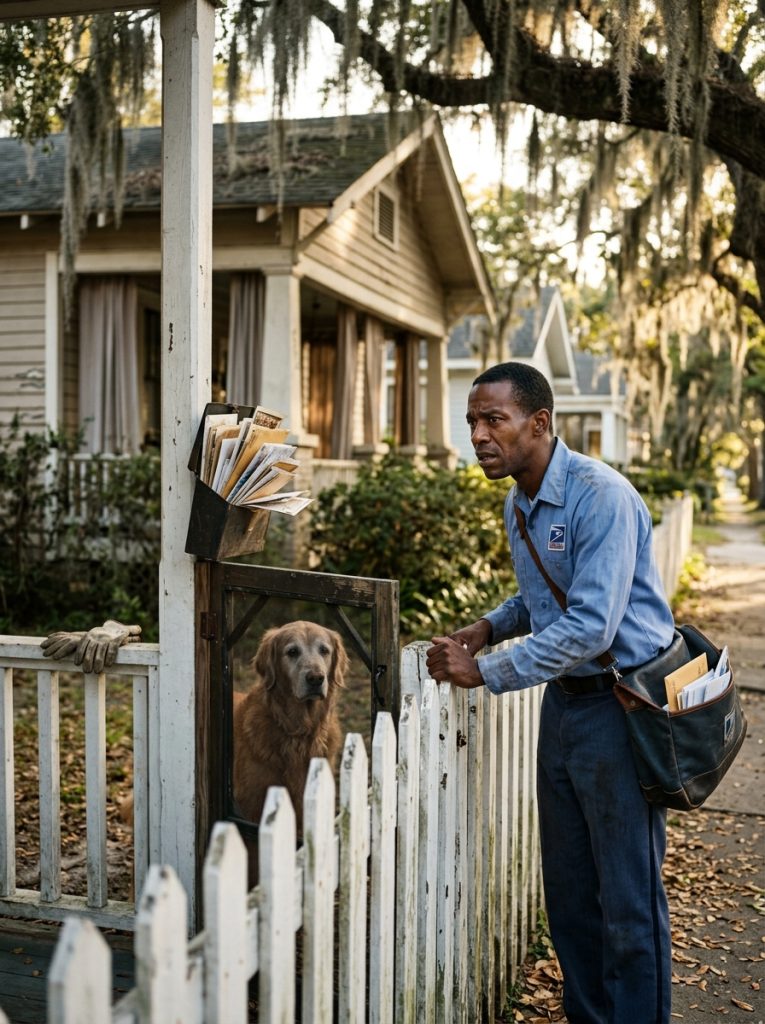
The paramedics said one more day and Harold wouldn’t have made it.
One more day on that kitchen floor. One more day without water. One more day with nothing but a dog pressed against his ribs and the slow, steady sound of Beau’s breathing keeping him anchored to a world that was fading out.
Harold Jennings spent nine days in the hospital.
Fractured hip. Severe dehydration. A urinary tract infection that had gone septic in the forty-eight hours before they found him. The doctors spoke in the careful, measured way they do when they don’t want to scare you but want you to understand how close you came.
Harold understood.
He’d been a carpenter for fifty years. He knew the difference between a beam that was holding and one that was about to give.
His had been about to give.
Sam visited him twice.
Both times after his route. Still in uniform. Mailbag left in the truck. He brought a newspaper the first time — Harold’s subscription had piled up at the house — and a small bag of Milk-Bones the second.
“For when you get home,” Sam said.
Harold smiled. Thin. Tired.
“Where is he?”
“Animal control picked him up when the ambulance took you. He’s at the Chatham County shelter. I called — he’s okay. Eating fine. They said he’s quiet, though. Won’t wag for anyone.”
Harold closed his eyes.
“He’s waiting for me.”
Sam nodded. “I know.”
On day five, Harold’s son flew in from Charlotte.
Kevin Jennings. Forty-four. Business casual. A carry-on bag and a rental car. He walked into the hospital room with the stiff posture of a man performing obligation rather than feeling it.
“Dad. How are you?”
“Still here.”
Kevin sat in the visitor’s chair. Pulled out his phone. Checked it twice in three minutes.
“We need to talk about next steps.”
Harold knew what that meant.
Assisted living. The house sold. Everything he’d built with June for forty years — the porch, the garden, the wind chime she’d hung on their anniversary, the fence he’d repainted every spring — all reduced to a real estate listing and a monthly invoice.
“I’m not leaving my house,” Harold said.
“Dad, you can’t live alone anymore. You fell and nobody found you for three days.”
“Sam found me.”
“The mailman found you. That’s not a plan, Dad. That’s luck.”
Harold didn’t respond.
On day seven, Harold’s daughter arrived from Tampa. Rachel. Forty-one. She lasted two hours before the arguments started.
She and Kevin disagreed about the house. About the money. About whether Harold needed full-time care or just part-time. About who would handle the paperwork. About who would pay for what.
Not once in those conversations did either of them ask about Beau.
Not once did they visit the shelter.
Not once did they ask their father what mattered most to him.
On day nine, Harold was discharged. Kevin drove him home. Rachel had already arranged for a temporary home health aide — a woman named Debra who would come four hours a day.
Harold walked through his front door for the first time in nearly two weeks.
The house was clean. Kevin and Rachel had sent a service.
But it was empty.
The absence of Beau was the loudest thing in every room.
No click of nails on linoleum. No warm body pressed against his feet while he read the paper. No wagging at the window when the mail truck rounded the corner.
Harold sat in his recliner.
And waited.
Three days later, Kevin called.
“Dad — about the dog.”
“His name is Beau.”
“Right. About Beau. Rachel and I talked about it. The shelter said they can rehome him. He’s still healthy. Good temperament. Someone will adopt him.”
Harold gripped the phone.
“You’re not taking my dog.”
“Dad, you can barely walk right now. You can’t take care of a ninety-pound retriever.”
“He took care of me.”
“That’s not—”
“He laid beside me for three days on that floor, Kevin. He didn’t eat. He didn’t drink. He didn’t leave. Three days. While you were in Charlotte and Rachel was in Tampa and nobody called. Beau stayed.”
Kevin went quiet.
“I’ll think about it,” he finally said.
But Harold knew what “I’ll think about it” meant from his children. It meant the decision was already made and they were waiting for him to accept it.
That evening, Sam Whitfield’s route ended at 4:30 p.m.
He parked his mail truck at the depot. Changed out of his uniform. And drove to 1614 Magnolia Lane.
He knocked.
Harold opened the door. Walker in hand. Slower than before. But upright.
“Sam.”
Advertisement
“Hey, Mr. Harold. Brought your mail.”
He handed over a small stack. Harold took it with a trembling hand.
Then Sam said: “Can I ask you something?”
“Go ahead.”
“What’s happening with Beau?”
Harold’s face changed. The composure he’d been holding since the hospital cracked — just slightly — around the edges.
“My kids want to rehome him.”
Sam nodded slowly.
“And what do you want?”
“I want him home. But they say I can’t manage him alone. And they’re probably right. My hip isn’t—” He stopped. Pressed his lips together.
Sam stood on the porch in the golden afternoon light. Spanish moss swayed overhead. The empty fence — the fence where Beau had waited every afternoon for seven years — stretched between them.
“What if he came home with me?” Sam said.
Harold looked at him.
“I live four blocks away. I have a yard. He knows me. He’s been waiting for me at that fence since he was a puppy.” Sam’s voice was steady but his eyes were not. “I’d bring him by every day. Every single day. You’d see him as much as you want. He’d just sleep at my place.”
Harold stared at him for a long time.
Then he nodded.
Slowly.
“Okay.”
“Okay?”
“Okay, Sam. Take him home.”
Sam drove to the shelter that evening.
When the kennel door opened, Beau lifted his head from the concrete floor. His tail didn’t move. His eyes — old, golden, tired — scanned Sam’s face.
Then something shifted.
Recognition.
The tail moved. Once. Twice. Faster.
Beau stood.
Walked to Sam.
Pressed his graying muzzle against Sam’s knee.
And for the first time in two weeks, his whole body relaxed.
Sam knelt. Scratched behind both ears. Let Beau lean his full weight against his chest.
“Hey, old man,” he said. “Let’s go home.”
He walked Beau to the car. Opened the back door. The retriever climbed in like he’d done it a thousand times — circled once, lay down, sighed.
And from that night forward, Beau slept at Sam’s house.
But every afternoon — rain or shine, route or no route — Sam walked him to 1614 Magnolia Lane.
Harold waited on the porch.
Beau waited at the fence.
And for one golden hour every day — an old man, a mail carrier, and a dog who never stopped believing someone would come — sat together on that porch like the world was exactly as it should be.
Kevin called his father two weeks later.
“How’s the dog situation?”
“Beau’s fine. Sam takes him.”
“The mailman?”
“Yes. The mailman.”
Kevin paused. “That’s… good. I guess.”
Harold looked out the window. He could see the fence from his recliner. And every afternoon at 4:45, like clockwork, a lean man in civilian clothes would appear at the gate with a golden retriever on a leash.
And every afternoon, Harold would walk — slowly, carefully, walker and all — to that porch.
And they’d sit together until the light turned amber and the Spanish moss glowed.
Some bonds don’t need a bloodline.
They just need someone willing to show up.
Every single day.
Rain or shine.
Without being asked.