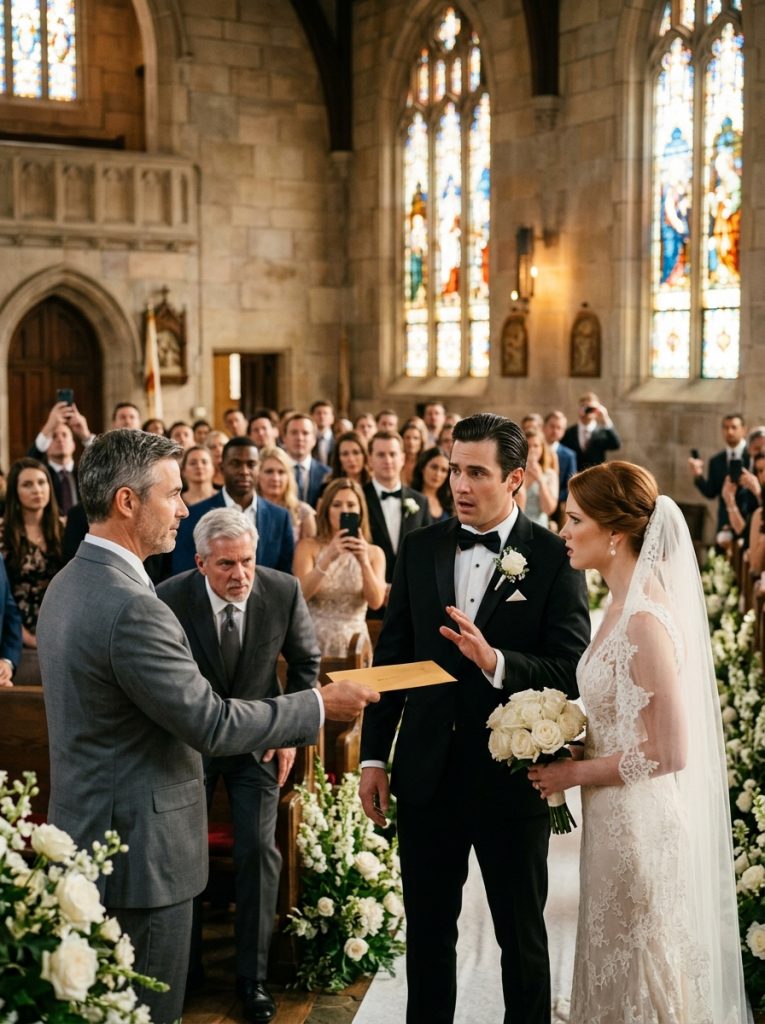
The document was a court summons from Fulton County Superior Court, State of Georgia.
Filed six days ago.
Case number. Plaintiff name. Defendant: Trent Michael Holloway.
And one sentence that made every word Trent had ever said to Savannah a lie.
“Petition for dissolution of marriage — Holloway v. Holloway. Marriage recorded March 14, 2021. No final decree entered. Status: Active.”
Savannah read it twice.
Her eyes moved over the words with the slow precision of someone memorizing evidence.
Then she folded the paper. Carefully. Along the original creases. And placed it back inside the envelope.
Her hands were steady.
Her voice was steady.
Everything about her — from the pearls at her ears to the lace at her wrists to the posture her mother had drilled into her since childhood — was utterly, terrifyingly steady.
She turned to Trent.
“You’re already married.”
It wasn’t a question.
Trent’s mouth moved. His jaw worked like a man trying to chew through something invisible. But no sound came out. He looked like a man drowning in a room full of air — a room he had built himself, brick by careful brick.
“Savannah — please — let me explain—”
“You’re already married. You have a wife. And you stood at this altar — in front of my family, in front of two hundred people who love me, in front of God — and you were going to say vows you legally cannot make.”
Her voice didn’t rise.
That’s what made it devastating.
Not anger. Not collapse. Just clarity.
The kind of clarity that comes when you suddenly see a person without the story they’ve been selling you.
The officiant stepped backward. His book was still open to the vows — vows that would never be spoken. His face was ashen. He’d performed over three hundred ceremonies and never once watched one detonate like this.
In the front pew, Savannah’s father stood fully now. Richard Cole. Sixty years old. Silver hair. Charcoal three-piece suit. The kind of man who had spent forty years in corporate litigation and could recognize a legal instrument from across a room.
His jaw was granite.
“Trent.” One word. Low. The voice of a man choosing restraint because the alternative — in a house of worship, on camera — was not something his daughter needed added to this day.
Trent turned to him.
“Mr. Cole — sir — I can explain everything — it’s not what—”
“You can explain to my attorney. On Monday. Not to my daughter. Not here. Not today.”
The guests were murmuring now. Two hundred people in silk dresses and pressed suits, shifting in wooden pews. Phones rising above heads like periscopes. The string quartet sat with bows lowered, staring at the scene like passengers watching a slow-motion collision.
The maid of honor — Jess, Savannah’s college roommate — had both hands over her mouth. Her eyes were wet. Her body trembled.
And through it all, Savannah stood at the altar in her grandmother’s pearls and her ivory gown, holding a manila envelope like a woman holding a verdict she’d already accepted before it arrived.
She didn’t cry.
She didn’t scream.
She reached up with both hands.
And removed her veil.
Slowly. Pin by pin. The tulle whispered against her fingers as it came free. She folded it once — twice — like a woman folding something she would never need again.
She placed it on the altar beside the envelope.
Then she removed her engagement ring.
A two-carat cushion cut. The one Trent had proposed with on the rooftop of a restaurant in Midtown last October while the city sparkled below.
She set it on top of the veil.
Ring on tulle.
Tulle on wood.
Done.
Then she looked at Trent one final time.
“Who is she?”
Trent swallowed. “It’s not what you think—”
“That’s not what I asked. Who. Is. She.”
The chapel was silent enough to hear the candles flicker on the altar behind them.
Trent’s voice dropped to a whisper. “Her name is Danielle. We were — it was three years ago. In Tennessee. We separated after four months but the paperwork—”
“Was never filed.”
“I thought it was handled. My lawyer said he’d take care of—”
“Your lawyer. Did your lawyer also know you proposed to me? Did he know about the venue deposit? The hundred thousand dollars my parents spent on this day? The rehearsal dinner last night where you held my hand and told my father you’d protect me for the rest of your life?”
Trent had no answer.
There was no answer.
The silence stretched until it became its own kind of weight — two hundred people simultaneously realizing they were witnesses to something that would become a story told at every dinner table for years to come.
Savannah took one step back from the altar.
Then another.
Her bare feet — she’d kicked off her heels at some point without realizing — pressed against the cold chapel stone.
She turned and faced the congregation.
Two hundred faces looked up at her. Some shocked. Some pitying. Some already angry on her behalf. Her mother sat rigid in the second row, hands folded so tight her knuckles were white.
Advertisement
And Savannah — twenty-eight years old, standing in a chapel she’d dreamed of since she was nine — straightened her spine and spoke clearly enough for the last row to hear.
“I want to thank everyone for being here today. I know many of you traveled a long way. I’m sorry that what you came to witness is not going to happen.”
She paused. Let the silence carry.
“But I would rather know the truth standing at this altar than discover it six months from now sitting in a lawyer’s office. So I am grateful. To whoever filed that petition. To whoever sent that man today. I’m grateful they thought I deserved to know before I signed my name to something that was never, ever real.”
She looked at Trent.
“I hope you figure out your life, Trent. But you won’t be doing it with mine.”
Then she walked.
Down the three altar steps.
Past the first pew where her father stood with his hand extended — which she took, gripping it hard.
Past the bridesmaids in their sage-green dresses, frozen with bouquets pressed against their chests.
Past the flower arrangements and the programs and the unity candle that would never be lit.
Past the cake in the vestibule. Three tiers. White fondant. Monogrammed with initials that no longer meant anything.
She walked through the double doors of that chapel into the Atlanta afternoon with her father beside her, the summer air warm on her face, and two hundred people behind her sitting in a silence so thick it pressed against the stained glass windows.
Jess caught up to her in the parking lot. Running in heels. Mascara streaked.
“Savannah — are you okay — what can I—”
Savannah turned.
Her face was calm. Dry. Resolved.
“I need you to do two things.”
“Anything.”
“Cancel the reception. Tell the caterer to donate the food to the women’s shelter on Peachtree. Every plate.”
Jess nodded.
“And tell the photographer to delete everything from today. I don’t want a single image.”
“Done. What about you?”
Savannah looked at the chapel doors behind them.
Inside, she could hear the murmuring rising. Chairs scraping. Trent’s voice — distant, pleading — saying something to someone she couldn’t see and no longer cared to hear.
“I’m going to take off this dress,” she said. “I’m going to eat something. And then I’m going to call my own attorney in the morning.”
Jess almost smiled through the tears.
“You’re going to be okay.”
Savannah nodded.
“I know.”
She slipped off her remaining heel. Stood barefoot on the warm parking lot asphalt. Looked up at the sky — cloudless, blue, indifferent.
And for one strange, impossible moment — despite everything that had just happened — she felt lighter than she had in months.
Because the weight she’d been carrying wasn’t heartbreak.
It was a lie.
And now it was his to carry alone.