Alicia spent three months looking for him.
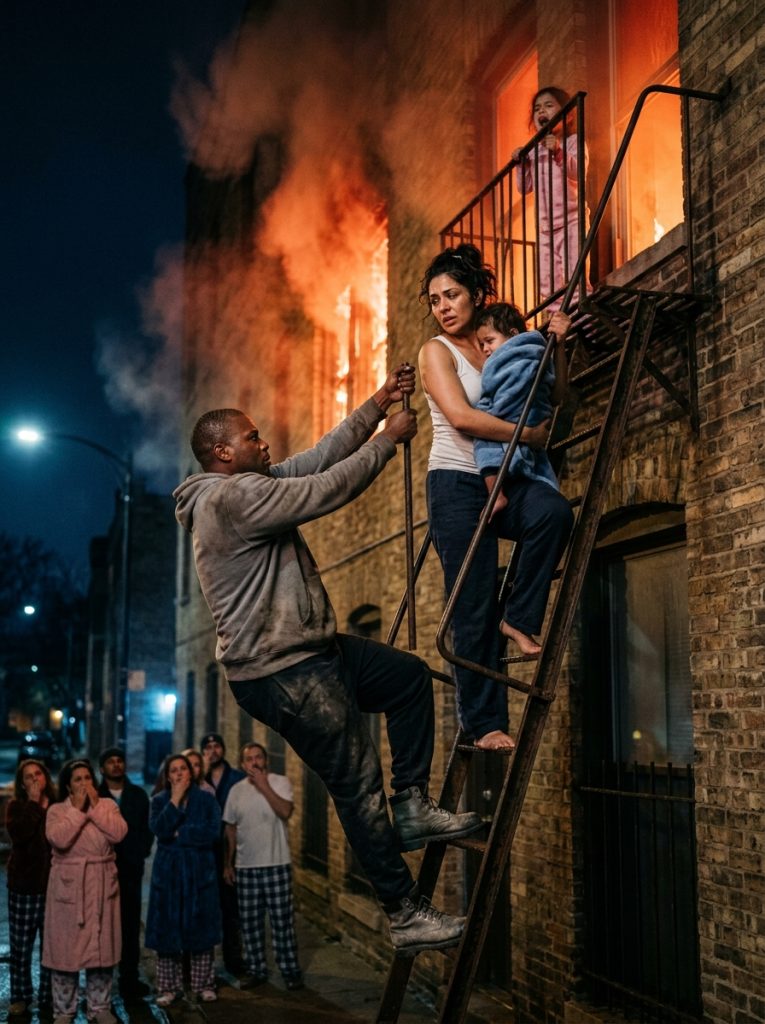
She didn’t have a last name. Didn’t have a phone number. Didn’t even have a clear picture of his face — just the voice. That steady, impossibly calm voice rising through smoke and screaming, saying the only words that mattered: “I won’t let go.”
The fire department report listed him as “unidentified male bystander — approximately 30-35, Black male, gray hooded sweatshirt.” The police supplement said the same. A local news crew aired a twelve-second clip the following morning showing a man in a hoodie bracing a rusted ladder against a brick wall — but the camera angle caught only his back, his boots, and the orange glow above.
Nobody got his face.
Nobody got his name.
And by the time the ambulances left South Ashland Avenue that night, he was already gone. Vanished into the dark like he’d never been there at all.
Alicia tried every path she could think of.
She called the building manager — a man who hadn’t set foot on the property in six months and knew nothing. She asked neighbors. Most had only come outside after the fire trucks arrived. The bodega owner on the corner said he might have seen a man in a gray hoodie walking east around 2:30, but couldn’t be certain.
The insurance adjuster didn’t care about the stranger. The Red Cross caseworker assigned to Alicia’s family cared, but had no resources to track him. The police said it wasn’t a criminal matter and closed the inquiry.
Three months of nothing.
In that time, Alicia rebuilt. Her cousin Elena offered a spare bedroom in Humboldt Park. Camila started first grade at a new school. Diego needed three follow-up appointments for smoke inhalation, but the doctors cleared him by May.
Alicia went back to work part-time at the community resource center on North Avenue. She was six months away from her full clinical social work license. Every morning she woke at 5:45, got both kids ready, dropped them off, and spent eight hours helping people access services they didn’t know existed.
Scholarships. Housing programs. Legal aid. Veterans’ assistance. Emergency relief.
She knew how to navigate systems built to be confusing.
She just couldn’t navigate the one system that mattered to her — finding a man who didn’t want to be found.
Then came a Thursday in June.
Alicia was walking Camila home from school, crossing West 47th near a construction site she’d passed a hundred times without noticing.
But today Camila stopped.
“Mommy. That man looks like the fire man.”
Alicia followed her daughter’s gaze through the chain-link fence.
A broad-shouldered man in a gray hoodie and steel-toe boots stood at a concrete mixer. His back was turned. His sleeves were pushed up past his forearms. His hands — large, calloused — gripped the chute guide.
The posture.
The boots.
The way he held himself — deliberate, grounded, like a man accustomed to bearing weight.
Alicia’s heart hammered.
“Stay here, baby.”
She walked to the site entrance. Found a man in a hard hat holding a clipboard.
“The man at the mixer — what’s his name?”
The foreman glanced over. “Marcus. Why?”
“Marcus what?”
“Hayes. Is there a problem?”
“No. No problem.”
She didn’t approach Marcus that day.
She went home. Fed the kids. Read Camila a story. Put Diego in his crib. Then she sat alone at the kitchen table and thought about what she actually wanted to say.
Because what she wanted wasn’t just to say thank you.
Thank you is a sentence. A moment. A handshake and a goodbye.
What Alicia wanted was to give something back. Something equal to what he’d given. Something that matched the weight of three lives saved with bare hands and rusted steel.
She spent a week researching.
She used every skill her job had taught her.
She found Marcus Hayes in public records. Age 34. Single father. One daughter — Keisha, seventeen — enrolled at Lincoln Park High School. Honor roll. Headed into senior year. College applications due in the fall.
She found his work history. Construction laborer. Union. Consistent employment but no advancement because he never had time for the certification courses — always working doubles to cover rent and Keisha’s expenses.
She found that Keisha wanted to study engineering.
And that Marcus had no idea how to afford it.
The next Tuesday, Alicia walked back to the site.
This time she went straight to the mixer.
“Marcus.”
He turned. Squinted against the sun. Then his face shifted — confusion becoming recognition becoming something close to alarm.
“You’re — from the fire.”
“Yes.”
He wiped his hands on his jeans. Stepped back from the mixer.
“The kids okay? You okay?”
“Everyone’s fine. All three of us. Because of what you did.”
He shook his head. “I didn’t—”
“You did. And you walked away without telling anyone your name.”
“Wasn’t about that.”
“I know. But I need you to hear something.”
She pulled the folder from her bag.
“My name is Alicia Dominguez. I’m a licensed social worker. I spend every day connecting people to resources they don’t know exist. And I spent the last week putting this together.”
She opened the folder on the hood of a parked truck.
Inside: a full-ride scholarship application to the University of Illinois College of Engineering. A pre-filled community service verification using the fire department’s official report. A letter of recommendation template addressed to Marcus, ready for his foreman’s signature. Financial aid forms. Housing information. A personal essay prompt circled in red: “Describe a time someone in your family demonstrated extraordinary courage.”
Advertisement
Marcus stared at the papers.
“This is for Keisha.”
“Yes.”
“How do you know about—”
“Because I looked. Because it’s what I do. And because your daughter deserves this, and so do you.”
Marcus picked up the scholarship page. Read it slowly. His calloused thumb left a faint smudge of concrete dust on the corner.
“I can’t afford the application fee.”
“There is no fee. It’s fully funded. Room, board, books, everything. The foundation reviews community service records and family impact. What you did that night — it qualifies.”
“A rescue qualifies?”
“Extraordinary civic courage qualifies. You saved three lives, Marcus. That’s not nothing. That’s the essay. That’s the whole application.”
He set the paper down.
His hands were trembling.
“Why are you doing this?”
Alicia closed the folder. Handed it to him.
“Because you held the ladder.”
Marcus took the folder. Pressed it against his chest with both hands — the way a man holds something too valuable to risk dropping.
He didn’t say thank you.
He didn’t need to.
The look on his face said everything that words couldn’t reach.
Three weeks later, Keisha Hayes sat in a borrowed blazer across from the scholarship board at the University of Illinois. She told them about her father. About the double shifts. About the nights he came home covered in dust and still sat at the table to help her with physics problems he didn’t fully understand.
She told them about a night in March.
About a rusted ladder and a burning building and a man who ran toward the screaming when everyone else ran away.
The board voted unanimously.
When Keisha called her father from the hallway, Marcus answered on the first ring.
“Dad. I got it. Full ride.”
He pressed the phone against his ear.
And for the first time in Keisha’s memory, he cried.
Not loud. Not dramatic.
The quiet kind.
The kind that comes from a man who spent thirty-four years holding everything up — ladders, families, concrete, silence — finally being allowed to set something down.
Alicia heard the news two days later from the foundation director.
She didn’t call Marcus.
She didn’t need to.
She just walked past the construction site that afternoon and saw him at the mixer. Same hoodie. Same boots. Same steady hands.
But this time, when she waved through the chain-link fence, he waved back.
And for the first time since the night they met — he was smiling.