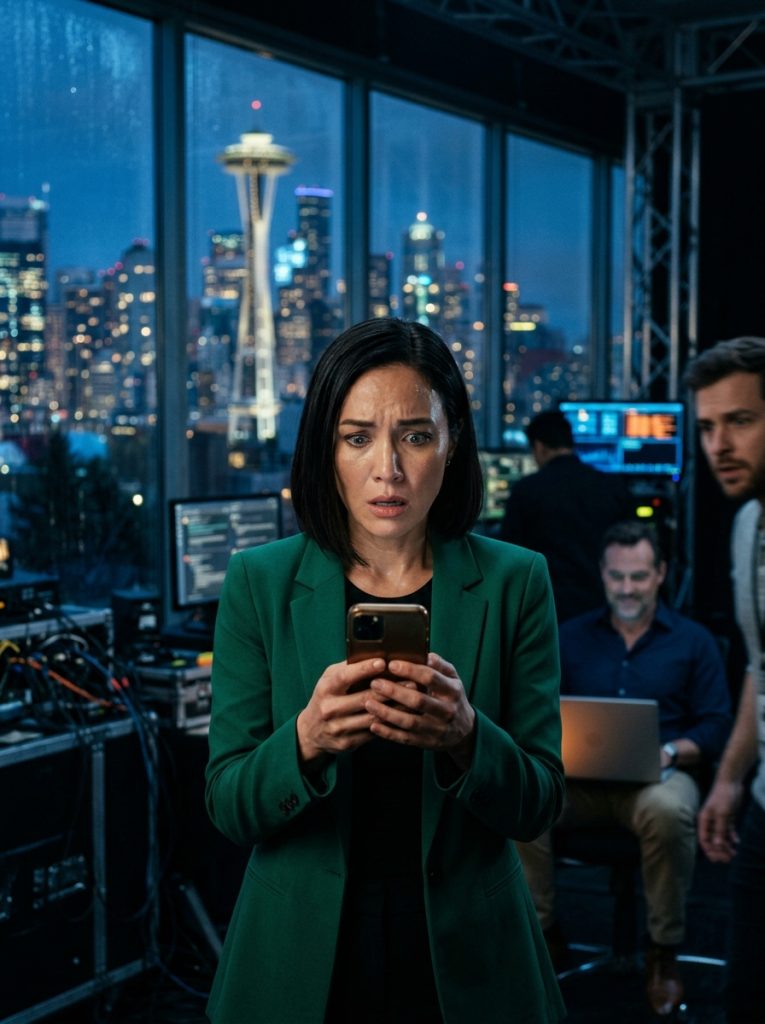
By the time the sun was fully up, the thread had turned into something nobody could have engineered.
The nurse’s reply was just the first. Beneath it came a teacher, who posted a screenshot from thirteen years ago — a fifteen-year-old kid, failing out, messaging a stranger at midnight, and the stranger answering: You are not stupid. You’re exhausted and scared, and those feel the same at 2 a.m. Let’s do one problem. Just one. The teacher wrote: “I’m the kid. I teach algebra now. She’s the reason.”
Then a soldier. Then a young mother. Then a man who simply wrote, “I didn’t have a plan to see this morning, fifteen years ago. She stayed on with me until it was light out. I’m forty-one now. I have two daughters.”
Dozens of them. Then hundreds.
Because here is what that anonymous username actually was.
Fifteen years ago, I was twenty-four. Broke, grieving a parent, sleeping badly, working a job I hated. And at night, when I couldn’t sleep, I logged onto a peer-support forum — the kind of place desperate people drift to at 3 a.m. when the official help lines are full and the dark gets loud.
I wasn’t a therapist. I had no training, no certificate, no idea what I was doing. I just remembered, very precisely, what it felt like to be on the other side of that screen with no one answering. So I answered.
I sat up most nights, under a handle and no name, and I talked to teenagers who’d run away, to kids hiding in bathrooms, to people standing on the wrong side of a railing. I didn’t fix anyone. I’m not pretending I did. I mostly just stayed. Kept them talking. Walked them to a hotline, a shelter, a morning.
I never told anyone, because it was never mine to tell. Those conversations belonged to the kids who had them. They’d trusted a stranger in the dark with the very worst night of their lives, and they had every right to keep that locked away forever.
Which is exactly why, when Garrett Lowe dug up that username and waved it around as proof that I was “hiding who I really am,” I couldn’t defend myself.
To explain the account, I’d have had to drag those people into the daylight against their will.
So I sat in my office, in my green blazer, and I said nothing, and I prepared to lose the company.
Then they came forward. On their own. One by one, and then in a flood, the people I’d sat up with told the internet what the account had been — each one careful, each one offering only their own story, no one else’s.
They protected each other the way I’d tried to protect them.
I want to be careful here, because it would be easy to make this sound like a clean, instant triumph, and it wasn’t. Not at first.
For a few hours that morning it was just noise — cruelty and confusion stacked on top of each other, my phone too hot to hold, my board’s silence louder than any of it.
The kindness didn’t arrive all at once to rescue me. It trickled in. One frightened, brave person at a time, each of them deciding privately that I was worth stepping into the daylight for.
That’s the part that still undoes me. Every single one of them had to choose it.
By noon, the story had completely flipped. The hashtag that had trended with “this is who she REALLY is” was now full of people finishing that sentence for Garrett, and they were not finishing it the way he’d hoped.
This is who she really is.
I finally posted. Once. Five sentences.
I said I couldn’t confirm individual conversations, because they were never mine to share. I said that fifteen years ago I’d been a scared kid who learned that sometimes the only thing you can give another person is to refuse to leave. I said I was sorry to anyone who’d been afraid this morning that their darkest night was about to become a stranger’s content. I said I would protect their privacy with everything I had. And I said thank you — to the ones who’d chosen, today, to speak.
That was all.
Garrett Lowe did not handle the reversal well.
He’d been so sure. He’d spent two years nursing the grudge of a man the board had pushed out for cause, and he’d thought he’d finally found the thing that would burn me down. He’d even started telling reporters, off the record, to “ask her about the account.”
They asked him about it instead. They asked how he’d obtained a private fifteen-year-old account. They asked whether he’d considered that the “scandal” he was selling was a suicide-prevention volunteer. They asked the investors he’d been quietly courting whether they wanted their names anywhere near the man who’d tried to weaponize that.
The investors stopped returning his calls. The reporters stopped taking them. A man whose entire comeback depended on me being a villain discovered, in real time, that he’d spent his ammunition exposing the best thing I’d ever done.
The launch went ahead that night.
I almost canceled it. It felt obscene to walk onstage and sell software the same day all of that had been ripped open. But my head of communications — the one who’d begged me for a statement that morning — found me backstage and said something I’ve kept.
“They didn’t come forward to save the launch,” she said. “They came forward to save you. The least you can do is let them see that it worked.”
So I went out.
I didn’t do the launch we’d rehearsed. I set the slides aside. I told a room full of investors and press that our company builds tools for kids who learn at 2 a.m. because 2 a.m. is when their houses go quiet enough to think — and that I happened to know something about who’s awake at 2 a.m., and what it means to have someone answer.
We closed the round. The product shipped. None of that is the part I think about.
The part I think about is the message I got three days later, through the company, routed carefully so I could choose whether to answer.
It was from the nurse. The first reply. The one who’d written “this account is the reason I’m still alive.”
She didn’t want anything. She just wanted me to know her name, finally — the real one, attached to the kid I’d sat up with on a night neither of us was sure she’d survive. She’d become an ER nurse, she said, because she wanted to be the one who stays.
We talk now. Not often. On the bad-anniversary nights, mostly, the ones she still has to get through. I stay on with her until it’s light out.
Garrett tried to ruin me with the one chapter of my life I was proudest of and most determined to keep quiet.
He didn’t understand that you can’t shame someone with their own kindness. You can only, accidentally, introduce them to everyone they ever helped.
Cruelty assumes everyone has a buried, ugly reason for the things they do at 2 a.m. It genuinely never occurred to Garrett that a person might sit up all night, for years, asking for nothing — simply because someone had once failed to do it for them.
I never wanted that username made public. I’d have kept it buried forever.
But I’ll tell you the strangest gift in all of it. For fifteen years I’d lain awake wondering whether any of those nights had mattered — whether the kids on the other side of that screen had made it, gotten older, gotten okay.
Now I know.
Hundreds of them grew up. And on the morning a man tried to bury me, they all reached back into the dark at the same time, and pulled.