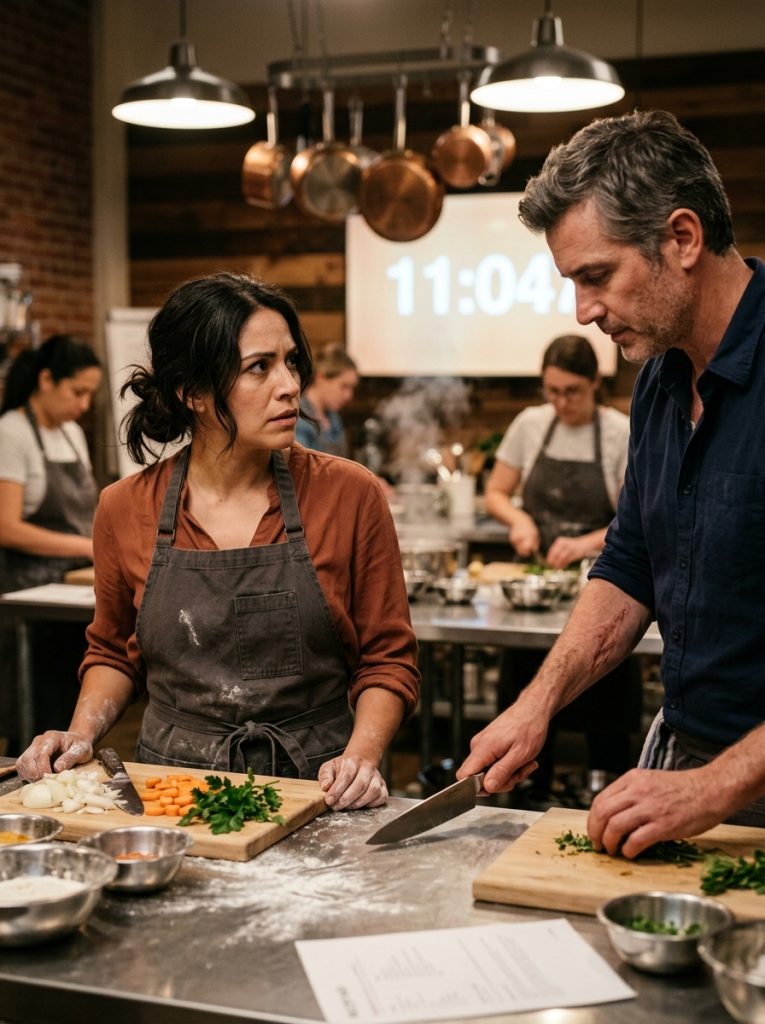
The buzzer went off before either of us could say another word.
Time. Plates down. Around the studio, five other couples laughed and groaned and presented their slightly burnt attempts to the instructor, who made kind noises at each one.
Julian and I plated ours in silence. It was good. Of course it was good. He’d spent his life cooking, and I’d spent mine refusing to stop.
The instructor came to our station last. She tasted, and her eyebrows went up, and she said something about “clearly some experience at this table,” and moved on, oblivious to the five years sitting between us like a sixth ingredient.
“Walk with me a second,” Julian said quietly, untying his apron. “You can throw a pan at me after. I’d just rather you knew the truth first.”
We stepped out to the little prep alley behind the studio kitchen. Cold air. A streetlight. Almost exactly the kind of place he’d shut a door on me five years before.
He didn’t waste it.
“That night you came to Lumière,” he said. “I need you to know what was happening on the other side of that door, because you couldn’t have known, and I couldn’t tell you with him standing there.”
“Him?”
“The owner. Marchetti.” Julian’s jaw tightened around the name. “Three days before you showed up, he’d told me to cut my kitchen staff by a third and replace them with unpaid ‘stages’ — kids fresh out of culinary school, desperate enough to work sixteen-hour days for a line on their résumé and no paycheck. He churned through them. Worked them until they broke, then replaced them with the next desperate kid at the door.”
I felt something cold move through me that had nothing to do with the alley.
“You came to that door,” Julian said, “on the worst week of your life. Laid off. Your mom sick. Three hundred dollars to your name. You told me you’d take anything.” He shook his head. “You were exactly who he wanted. Hungry enough to say yes to being used up. If I’d hired you, I’d have been handing you straight to him.”
“So you slammed the door in my face,” I said. “To protect me. That’s the story?”
“No.” He met my eyes. “That’s not the whole story, and I don’t blame you for not buying it. Reach into your memory. When I said ‘this isn’t the place for you’ — did I hand you anything?”
I stopped.
Because I’d buried that part. The humiliation had been so total that I’d edited out everything except the closing door. But now, dragged back to it, I remembered: he’d pressed something into my hand. A card. I’d been crying so hard I’d shoved it in my coat pocket without looking and never thought about it again.
“There was a card,” I said slowly.
“There was a name on it,” Julian said. “Renata Voss. She ran a small, honest place across town. Paid fair, taught everyone, treated her cooks like people. I called her before you even left the alley and told her a cook was coming who was worth more than the place she’d just walked up to. I wrote her name on that card and I put it in your hand and I told you ‘this isn’t the place for you’ — and I meant it as the kindest thing I knew how to say with my boss watching me through the pass.”
My throat closed.
“You never came to Renata’s,” he said. “I checked for months. I figured you’d thrown the card away. Or thrown your knives away. I never knew which, and it’s haunted me for five years.”
I thought of that coat. A thrift-store peacoat I’d worn that whole awful winter and then donated in the spring because it reminded me of the worst weeks of my life.
The card had gone with it. Unread. In a pocket.
“I lost the coat,” I whispered. “I never looked. I spent five years believing you thought I wasn’t good enough to wash your dishes.”
“Marisol.” He said my name like it cost him something. “I left Lumière four months after that night. I couldn’t stand what the place did to people. I gave back the fancy title and the waitlist and the reviews, and I started teaching — here, places like here — because I wanted cooking to go back to being about feeding people instead of breaking them.”
He paused. “Lumière closed about a year after I left, for what it’s worth. Three former stages filed complaints over unpaid wages. The health of a kitchen always shows up in the food eventually. Marchetti’s just took a little longer than most.”
He almost smiled. “Your sister found me through the school. She had no idea. She just thought I seemed ‘nice and a little sad.'”
I laughed. It came out wet and ridiculous. “She’s not wrong.”
We stood in that cold alley a long time.
I’d carried a clean, simple story for five years: the great chef who looked at me and found me wanting. It had been a useful story, in a terrible way. It gave my failures a face. Every catering gig I scraped through, every dream I shrank to fit my budget — I could lay it at the feet of a man who’d shut a door.
And the man had actually been the only person in that building who tried to save me.
“I don’t know what to do with this,” I admitted.
“You don’t have to do anything with it tonight,” he said. “I just couldn’t stand across a cutting board from you for two hours and let you keep hating me for the one decent thing I did that year.”
The misunderstanding didn’t vanish in a puff of movie music. Five years is five years. You don’t get them back, and a card you never read can’t un-lose itself.
But a wall I’d built brick by brick, out of a story that was never true, came down in a cold alley behind a cooking studio in Portland.
We went back in. We cleaned our station side by side, the way restaurant people do, easy and wordless. He washed; I dried. It felt, absurdly, like the most natural thing in the world.
At the door, he asked — careful, no pressure — if I’d want to do the intermediate class. “Same time next week. You’d actually learn something. The instructor’s mediocre but the company’s improving.”
I said yes.
Not because five years dissolved. Because for the first time since that winter, the door was open instead of closing, and this time I could see the name written on what he was handing me.
I went home and told my sister everything. She cried. Then she said, “So my terrible blind date setup was actually the best thing I’ve ever done,” and I told her not to push it.
Mari Vega still caters other people’s best days. But there’s a small storefront I’ve started looking at, and a man who knows more than anyone alive about doing it the honest way keeps offering, very casually, to look at the lease with me.
He says things like “fair wages aren’t a luxury, they’re part of the recipe,” and he means it, and watching him mean it has done more to heal that winter than any apology ever could have.
We’re not rushing anything. Five years taught me not to mistake a beautiful plan for a safe one — and, it turns out, not to mistake a closed door for a cruel one.
Some things you only learn the slow way.
I think I’ll let him.
Some doors close to protect you from what’s on the other side.
It just took me five years, and a ticking timer, and a cold alley to learn that the man who closed one on me had been trying, the whole time, to point me toward a better one.