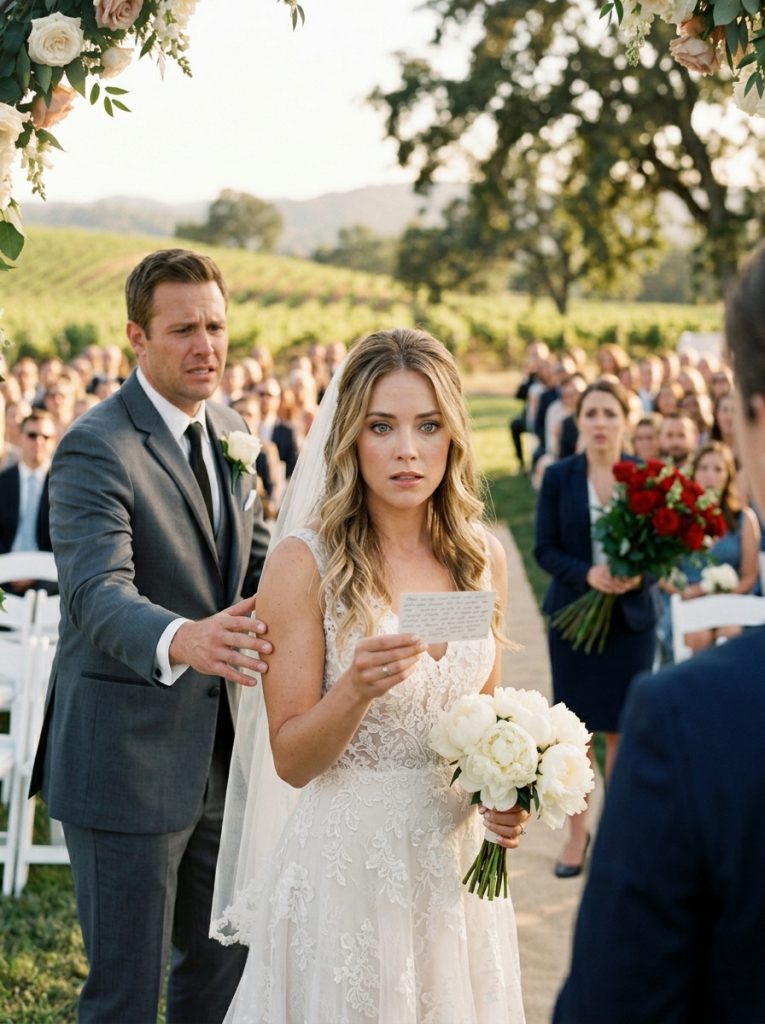
“Trevor,” I said. “Whose flowers are these?”
That was the question. Five words. I asked it calm and clear, with the card in my hand and two hundred people holding their breath in a vineyard.
He had an answer ready for a different question. I could see him reaching for it — the deny-everything reflex, the “I have no idea what that is.” But I hadn’t asked whether he knew. I’d asked whose they were. And he couldn’t make himself say a stranger’s name, because there wasn’t one to say.
The silence stretched. The officiant looked at his shoes. My father started to rise from the front row.
“Brooke,” Trevor finally said, low, just for me. “Not here. Please.”
“Here’s good,” I said.
Because here is what was written on that card, in a woman’s looping hand, the three words I’d read twice to be sure: To my husband.
To. My. Husband.
Not “good luck.” Not “best wishes.” A claim. From a woman who believed she had a prior one.
I held the card up so he could see I’d read it. “She calls you her husband, Trevor. On our wedding day. So either she’s confused, or I am, and I’d really like one of us to stop being confused right now.”
He didn’t answer. He didn’t have to. His face did it for him.
There’s a particular silence a man makes when the lie he’s been living finally runs out of road. It isn’t dramatic. He just stops.
The charm switches off like a lamp, and underneath it there’s nothing prepared — because he never once planned for the version of the day where he got caught before the vows instead of after.
I learned the rest over the next two weeks, in pieces, the way you do.
Her name was Diane. They had been together for three years — overlapping, almost entirely, with the four Trevor and I had. She wasn’t a mistake or a slip. She was a parallel life. The “work trips.” The face-down phone. The perfume.
I’d noticed all of it, honestly. In the way you notice a draft in a house you love and decide it’s just an old house settling.
I’d had the evidence for a year. What I hadn’t had was the nerve to call it what it was. The card did that part for me. Sometimes the truth has to arrive in a form you can physically hold in your hand, at a moment you can’t possibly explain away.
But here’s the part that turned my stomach, the part I didn’t know standing at that altar.
Diane wasn’t just the other woman.
They were already married.
Eight months before he proposed to me, Trevor had married Diane at a courthouse two counties over. Quietly. No announcement. She’d believed they were building toward a “real” wedding someday. He’d kept her in a drawer like a face-down phone — and then he’d turned around and tried to marry me, too.
What I almost did that afternoon, in a white dress under a flower arch, was commit a felony I didn’t know I was committing. Bigamy. His.
The roses had been Diane’s last attempt to be acknowledged. She’d found out about my wedding — found out she was the secret, not the bride — and in a fury of grief she’d ordered a dozen red roses sent to the “bridal suite,” with a card addressed to her husband. She told me later she didn’t even mean for it to land mid-ceremony. The florist’s timing did the rest.
We met once, on purpose, about a month later. A coffee shop halfway between our two lives.
I’d braced myself to hate her. I couldn’t manage it. She’d been lied to longer than I had, and more cruelly — three years, a courthouse vow, and a belief that someday she’d be the one in the white dress.
She slid her phone across the table and showed me their marriage certificate, dated eight months before Trevor knelt on my balcony. “I needed you to see it wasn’t in my head,” she said. “He spent years making me feel like it was all in my head.”
I knew that feeling exactly. I’d lived a smaller version of it for a year.
She and I are not friends. How could we be. But we are two women who got the same lie in two different shades, and we both said the same thing when we finally talked: thank God for that florist.
I did not marry Trevor Hale.
I want you to picture the cleanest version of walking away, because that’s what it was. I set my peonies down on the empty chair in the front row. I took off the ring I hadn’t quite finished putting on. I handed it to him. And I walked back up the aisle I’d come down ten minutes earlier, past two hundred faces, on my own two feet, in no hurry at all.
My father met me at the end of it and just put his coat around my shoulders, the way you do for someone who’s been out in the cold.
The annulment took an afternoon. There was nothing to dissolve — there had been no valid marriage, because he was already married. That’s the strange mercy of how it all fell out. I didn’t have to divorce him. Legally, I’d never been his wife at all.
Diane filed for her own divorce the same month. She kept the courthouse date as the only thing of his she wanted: proof, in the record, that she’d come first and been hidden anyway.
Trevor lost both of us in the same afternoon. The bigamy didn’t go anywhere criminally — neither of us pushed it, and the prosecutor had bigger things — but it went everywhere socially. In a town like ours, “tried to marry two women at once and got caught at the altar by a flower delivery” is not a thing you outrun. He moved. I heard he moved twice.
I didn’t track him. I want to be honest about that. The satisfying thing was never imagining his bad years — it’s that I stopped having to imagine him at all.
For four years my future had a Trevor-shaped hole drilled through the center of it. The afternoon in the vineyard didn’t break my life. It handed it back to me, intact, just a little early.
People keep asking me how I stayed so calm. The video went a little bit around — somebody always films — and the thing that traveled wasn’t Trevor’s face. It was a bride lowering her bouquet and reading a card out loud instead of running.
The truth is I wasn’t calm. I was clear. There’s a difference. Calm is when nothing’s wrong. Clear is when everything is, and you can suddenly see all of it at once, and you know exactly which way the door is.
My grandmother would have called it grace under fire. I just call it finally trusting my own eyes.
I think about the version of me who didn’t notice the card. Who married him in another ninety seconds. Who found out about Diane a year later, or three, maybe with a baby on my hip. That woman’s marriage was a crime she didn’t commit knowingly, built on a wedding that was a fraud from the flowers in.
A clumsy florist and a slipped card saved me from years.
I kept one thing from that day. Not the dress — the dress went back. I kept the card.
To my husband. Three words in a stranger’s handwriting.
It’s in a drawer now, and on the bad days, when I miss the life I thought I was getting, I take it out and read it.
And I remember that the worst thing that happened to me that afternoon was also the luckiest. The truth came early, in red roses, while I could still set down the bouquet and walk.
Some women get the truth too late to walk. I got mine with two hundred witnesses and the door wide open.
I took it.