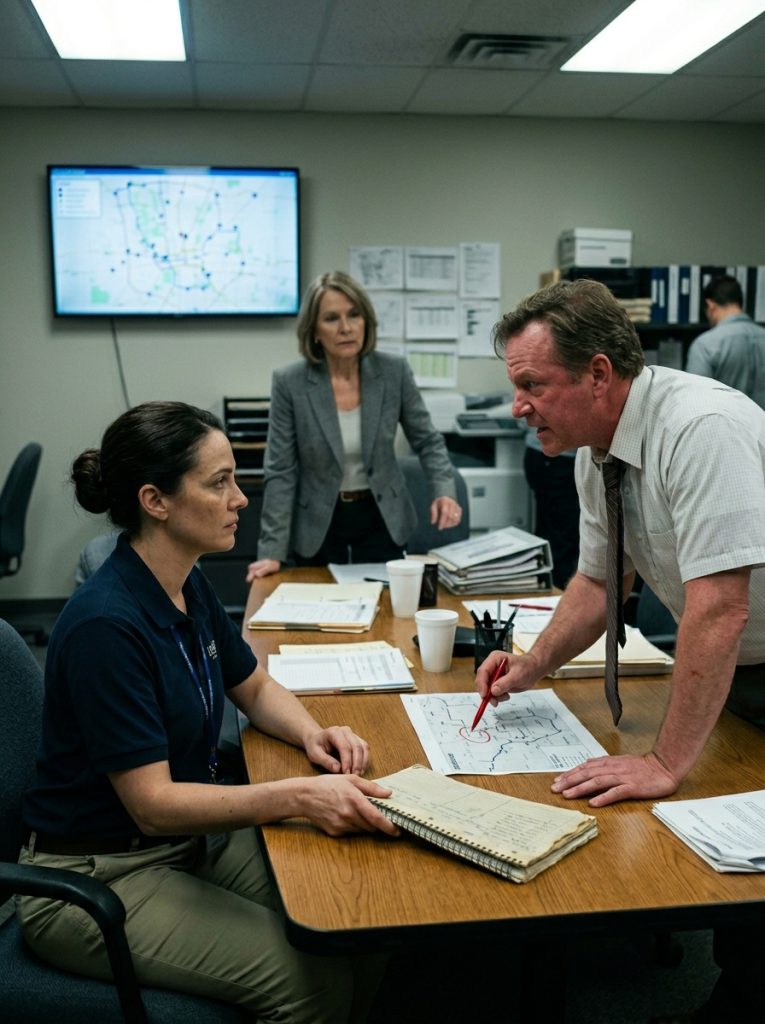
The woman in the gray blazer didn’t raise her voice. She didn’t have to.
“Roger,” she said, “I’d like you to keep reading those margins out loud. All of them. Slowly.”
Roger looked at her, confused, the red pen frozen in his hand. “I’m sorry — and you are?”
“Eleanor Voss.” She walked to the head of the table. “I own the company. I built it out of one cargo van in 1994. I do an unannounced site review every quarter, and I sit in on whatever’s happening that day. Today, apparently, it’s this.”
I have never watched the color leave a man’s face so fast.
“Ms. Voss,” Roger said, scrambling. “I — this is a routine audit. Mileage discrepancies. I was protecting the company’s—”
“You were accusing one of my drivers of theft,” Eleanor said, “based on a pattern you didn’t bother to understand before you hauled her into a room and threatened her job. So let’s understand it now. Out loud. Keep reading.”
He didn’t want to. He read anyway.
“Drove Sandra’s kids — chemo.” “Took the Petrov twins home, their dad on a double.” “Waited with the Alvarez boy until his mom got off work.” Date after date. Each one a detour Roger had circled in red as fraud. Each one a kid who’d have been standing alone on a curb if Denise Carter hadn’t quietly decided that wasn’t acceptable.
His voice got quieter with each line. By the bottom of the page the red pen was just sitting dead in his hand.
He’d built the whole case in his head — lazy single mom, padded numbers, an easy win for a supervisor who liked easy wins. And now he was reading the actual answer out loud, one child’s name at a time, and there was nowhere left for the story he’d wanted to go.
When he finished, the room was very quiet.
“Now,” Eleanor said. She turned to me. “Ms. Carter. How many of these trips did you ever submit for reimbursement?”
“None,” I said. “They weren’t company business. They were mine.”
“You spent your own gas, your own time, off the clock, for over a year, covering for coworkers in crisis, and never asked the company for a cent.”
“It wasn’t about the company,” I said. “Somebody had to get the kids.”
My voice didn’t shake. That surprised me. For twenty minutes I’d sat there bracing to be fired, already rehearsing how I’d tell Ava we’d be tight on money again for a while.
And now the only thing I felt was tired, and a little fierce — the way you get when someone finally asks the right question after spending an hour asking all the wrong ones.
Eleanor was quiet for a moment. Then she turned back to Roger.
“Here’s what I learned in this room today,” she said. “I learned my company has a driver whose first instinct, when a colleague is diagnosed with cancer, is to make sure their children don’t sit alone after school. And I learned I have a supervisor whose first instinct, when he sees an unexplained pattern, is to assume theft and reach for a termination form.”
She set her folder on the table.
“One of those instincts I can build a company on. The other one I can’t afford.”
Roger Mabry was not fired in that room. Eleanor was more careful than that. But the audit he’d opened on me got turned around into a review of how he’d treated the parents on his shift — and there was a pattern there too, one a lot uglier than some margin notes. A single dad written up for leaving to get a sick kid. A pregnant dispatcher’s hours quietly cut. By the end of the month, Roger was managing a warehouse in another state, and the door he’d been told not to let hit him on the way out did, a little.
What happened to me was stranger to get used to.
Eleanor asked me to help design something. A program. She called it the thing I’d been doing for free, except now the company would do it on purpose.
We built a carpool and emergency-childcare stipend for field staff. If your coworker’s in the hospital, in chemo, stuck on a double — there’s a fund, and a sign-up, and paid time to do the driving I used to do off the clock. They asked me to run the pilot.
Me. The single mom who twelve months earlier was eating the cost of other people’s gas because nobody had built the thing that should have already existed.
I said yes on one condition: that we name it after Sandra, who beat her cancer that spring and cried in the break room when she heard.
Sandra found me at my locker the week it launched. She didn’t say thank you — we’re not really thank-you people, the two of us.
She just stood there a second and then said, “You never told me. A whole year, and you never once made me feel like I owed you anything.”
I told her she didn’t.
“I know,” she said. “That’s exactly why I’m naming my next dog after you.”
We laughed so we wouldn’t cry. That’s another thing about working parents. We laugh at the very edge of things, because we can’t afford to fall in.
The Sandra Fund. It’s in four states now.
I think a lot about why I never said anything in that conference room until the very end. Why I just sat there in my navy polo and let Roger build his whole case before I slid that logbook across the table.
The truth is, I didn’t think it would matter. I’d spent my whole life being the kind of invisible that single mothers learn to be — the one who handles it, who doesn’t make a fuss, who assumes that if she explains herself she’ll just sound like she’s making excuses.
I almost let him fire me rather than make a scene.
What I didn’t know was that the quiet woman in the corner had spent twenty minutes watching not the spreadsheet, but the two people arguing over it. One clicking a red pen, certain. One sitting still, certain in a different way.
She told me later that you learn more about a person from how they behave when they think the power in the room isn’t theirs than from anything they’ll ever put on a résumé.
I’ve turned that line over a hundred times since.
Roger behaved like a man who was certain no one above him was watching. I behaved like a woman who was certain no one above her cared. Eleanor Voss had spent her whole career learning to be the person nobody notices in the corner — precisely so she could see both of those things clearly.
Roger thought the power was his.
I thought I didn’t have any.
We were both wrong, and the woman in the gray blazer was the only one in that room who knew it the whole time.
My daughter Ava is fourteen now. She knows the short version of the story — that her mom got in trouble for being kind, and that it turned out okay.
What I want her to know, the version I’ll tell her when she’s older, is this: the world will try to convince you that quietly doing the right thing is the same as being a pushover. That if nobody claps, it didn’t count.
It counted.
Every kid I got off a curb counted. And the day someone finally read the margins out loud, the quiet thing I’d been doing in the dark turned out to be the loudest thing in the building.
I still keep a logbook. Force of habit.
These days the margins are full of names again — but now there’s a fund behind every one of them, and a company that decided kindness was worth writing into the budget.
Somebody had to get the kids. Turns out, all along, that somebody could be all of us.