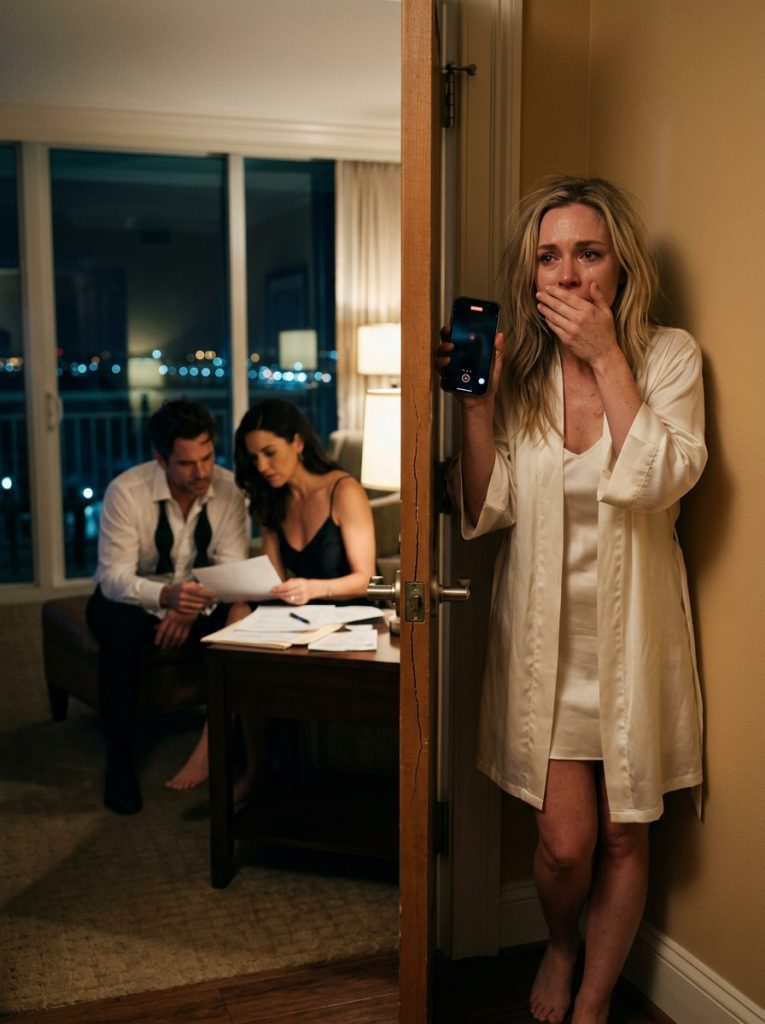
Adam came back into the suite smelling of someone else’s plan.
He slid into bed and kissed my forehead and said, “Get some sleep, Mrs. Whitlock. Big day tomorrow.” And I said it back, soft, like a bride. “Big day.”
I lay awake the whole night with my grandmother’s voice in my head. Be smarter than they think you are.
I did not cry. Crying was a luxury for a woman who hadn’t just been handed a recording of her own husband planning to have her erased.
I had a recording. So instead of crying, I made calls. Quietly. From the bathroom, water running, at four in the morning.
The first was to Eleanor Reyes — no relation to anyone, just the best estate attorney my grandmother ever trusted, and the woman who’d drafted my trust. She picked up on the second ring the way lawyers who handle real money do.
I played her ninety seconds of the recording.
There was a silence. Then she said, “Don’t sign anything. Don’t accuse him. Go to the brunch tomorrow and smile. I’ll be there before noon.”
You have to understand what Adam never bothered to learn about the trust he married.
My grandmother didn’t build her company by being naive about men in nice suits. When she wrote my trust, she included a clause her lawyers called the “bad-faith provision.” In plain words: any spouse who attempts to seize control of the trust through fraud, coercion, or a manufactured incapacity claim forfeits every marital interest in it. Permanently. The moment the attempt is documented.
Adam hadn’t just confessed to a betrayal on my wedding night.
He’d triggered the exact clause designed to destroy him. On tape. With a witness — his “consultant” — corroborating every word.
The woman in the black dress, by the way, was not a stranger.
Vanessa Cole. I found out the next morning what Eleanor’s people turned up in three hours: she wasn’t an “estate consultant” at all. She was an attorney who’d already been censured once for exactly this kind of scheme — coaching spouses on how to have wealthy partners declared incompetent. Adam hadn’t found a clever advisor. He’d hired a repeat offender with a paper trail.
The wedding brunch was on the resort terrace. Sunlight, mimosas, my new in-laws beaming.
Adam put his hand on the small of my back and introduced me to his aunt as “my wife, who I plan to take very good care of.”
I almost laughed. Take care of. I knew now exactly what that phrase meant in his family.
At 11:40, Eleanor Reyes walked onto the terrace in a charcoal suit with two associates and a folder of her own.
Adam’s mother frowned. “Can we help you?”
“I’m Claire’s attorney,” Eleanor said pleasantly. “I’m here for the prenuptial reconciliation meeting. Didn’t Adam mention it?” He had not, because it did not exist. “Claire, dear, shall we use the library?”
I excused myself from my own wedding brunch. Adam followed, suddenly nervous, Vanessa trailing behind him with her poise cracking at the edges.
In the resort library, Eleanor set a small speaker on the table.
She pressed play.
Adam’s voice filled the room. His own words about the episodes, the friendly doctor, the timing. Vanessa’s voice answering. The phrase declared unfit, crisp and clear.
The color left Adam’s face the way it leaves a man who has just heard his own confession played back to him in front of a lawyer.
“That’s — that was taken out of context,” he started. “That’s illegally recorded, that’s not—”
“South Carolina is a one-party consent state,” Eleanor said, not unkindly. “Claire was a party to her own marriage, in her own suite. It’s admissible. But honestly, Adam, admissibility is the least of your problems.”
She slid a single page across the table.
“This is the bad-faith provision of Claire’s trust. I’d read it slowly. The short version is that by conspiring to have my client declared incompetent in order to seize her assets, you have forfeited any claim — spousal or otherwise — to a single dollar of them. Forever. As of last night, when you said it out loud.”
Adam read it. I watched his eyes track down the page and stop. Then start over and read it again.
The man who’d planned to manage me like an asset finally understood that he had been the easy mark in the room the entire time.
Vanessa stood up. “I should go.”
“You should sit down,” Eleanor said. “Because the recording also documents an attorney advising a client to procure a fraudulent medical evaluation. I’ve already sent a copy to the state bar. Your second offense, I understand. They were very interested.”
Vanessa sat down.
I didn’t say much through any of it. I’d said everything I needed to say into a phone at four in the morning. I just stood by the window with my hand resting where my bouquet had been the day before, and I watched the plan unravel in the exact reverse order they’d built it.
The marriage was annulled, not divorced — Eleanor argued, successfully, that consent obtained while concealing a scheme to defraud was no consent at all. Adam walked away with what he came in with, which was a rented tux and a great deal of debt I’d never been told about. That debt, it turned out, was the whole reason for the timeline. He didn’t want a wife. He needed a bailout, and my grandmother’s trust was it.
I almost felt something for him, in the library that day. Almost.
Then I remembered the word “gradual.” How calmly he’d talked about staging episodes in front of people who would vouch for them. How he’d kissed my forehead an hour later and called me Mrs. Whitlock.
The almost did not survive the memory.
Vanessa Cole was disbarred eight months later. The bar complaint, with the recording, was not difficult for them to rule on.
Adam’s mother — the one who’d frowned at my attorney — called me once, weeks after, to tell me I’d “overreacted” and “humiliated the family.” I let her finish. Then I said the only thing I’ve ever said to any of them since.
“He recorded himself, Diane. I just pressed play.”
I think about my grandmother more than I expected to.
She died when I was twenty-four. She left me a piece of a company and a sentence I didn’t understand until I was thirty-one and standing barefoot in a honeymoon suite with my eye to a cracked door.
Be smarter than they think you are.
They thought I was a soft girl who married for love and would sign whatever was put in front of her. They were half right. I did marry for love. I’m not ashamed of that part.
But I keep my phone charged. I read what I sign. And I will never again mistake a beautiful plan for a safe one.
My grandmother knew something at twenty-four that I didn’t, when she held my hand a beat too long. She knew the people who come for your money rarely come carrying a knife. They come with a ring, and a soft voice, and a plan with neat little tabs in it.
She couldn’t stop them from coming. So instead she left me a clause, and a sentence, and the faith that I’d be standing on the right side of a door when it finally mattered.
I kept the dress. I don’t know why. It’s in a box in a closet in the Charleston condo that is, and always was, entirely mine.
Some nights the harbor lights still come through the glass the way they did that night. I pour one glass of champagne. I drink it alone, on my own balcony, in a home no one is plotting to take.
It tastes a great deal better than the first one did.