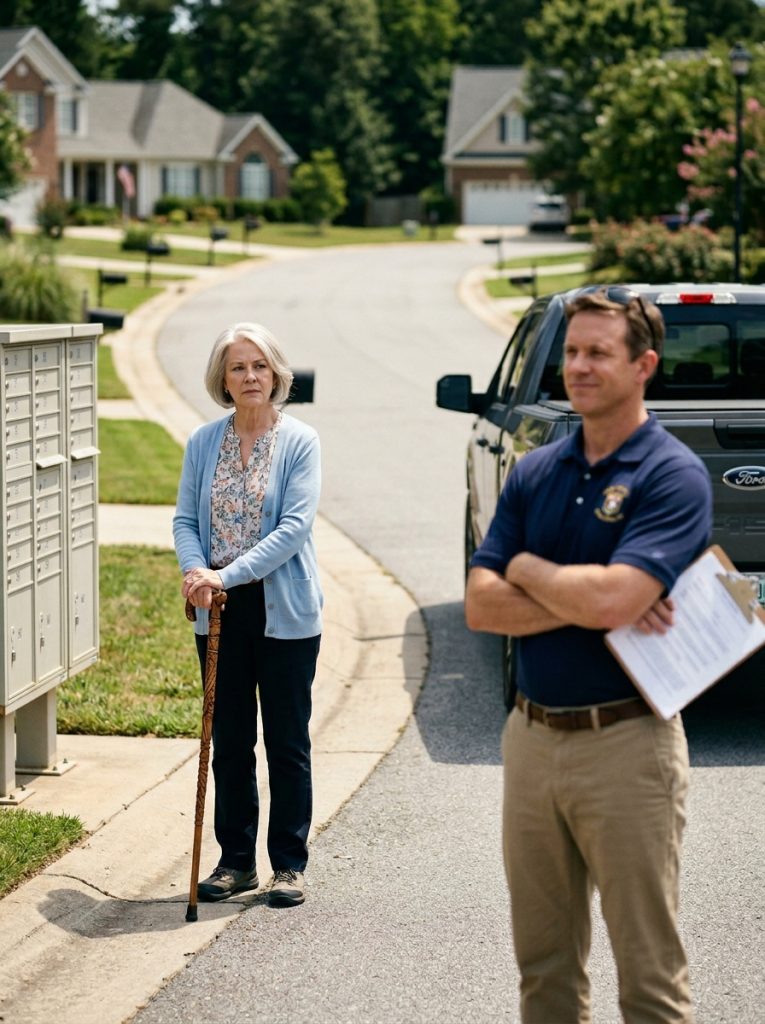
Brad came down his driveway with the clipboard held against his chest like a shield, already talking.
“If this is about the mailbox,” he announced to the postal supervisor climbing out of the truck, “the relocation was approved by the board. We have every right to set community standards. She’s been told.”
The supervisor — her name tag said Ramirez — didn’t even look up from her own clipboard.
“Are you the homeowner who filed the accessibility request?” she asked me.
“I am,” I said. “Margaret Dunlap. Thirty-one years a carrier with this same service, if it matters.”
It mattered. I saw it land. Ramirez’s eyebrows went up half an inch, the way one carrier’s do when they meet another.
“Thirty-one years,” she repeated. “Then you know what I’m about to say better than I do.”
“I do,” I told her. “I just couldn’t be the one to enforce it on my own street. So I asked the people whose job it is.”
“It doesn’t take thirty-one years to know the rule,” she said, mostly to me, but loud enough. “It takes about five minutes.”
Then she turned to Brad.
“Sir, the Postal Service has a long-standing policy. When a customer has a documented physical condition that prevents them from reaching a centralized box, we are required to provide an accommodation. Curbside or door delivery. That policy doesn’t ask the homeowners’ association for permission. It overrides it.”
Brad’s mouth opened. “But the bylaws—”
“Your bylaws don’t govern mail delivery,” Ramirez said. “Federal regulations do. You can paint every box on this street the same shade of beige if it makes you happy. You cannot move a recovering surgical patient’s mail four hundred feet from her door and call it a community standard.”
She said it the way you’d read a weather report. No drama in it at all.
That’s the thing men like Brad never understand about rules. The rules don’t care how loud you are at a meeting. They were written down long before he ever bought that polo, by people who had already imagined a man exactly like him.
I have waited a long time to watch a man read a room and realize he’s read it wrong his whole life.
“Her box goes back to her curb,” Ramirez said. “Today. And since the association is the party that removed it, the association covers the cost of reinstalling it. I’ll be putting that in writing.”
Brad tried one more time. The clipboard came up. “There’s a process for—”
“There is,” Ramirez agreed. “She used it. She wrote a letter and cited the regulation by number. Honestly, it was the cleanest complaint I’ve gotten all year.” She glanced at me, and there was the smallest smile there. “Like she’d done it before.”
Walter’s old mailbox post went back into the ground by that Friday.
I’d like to tell you that was the end of it, but you don’t poke a man like Brad Keller and watch him simply walk away. He stewed. He told people I’d “gone over everyone’s head.” He called me, again, the difficult one.
The difference was, this time, people had watched.
Helen from the corner house had filmed the whole driveway conversation from her porch — not for any reason, she just films things now. Her clip of a federal supervisor calmly explaining the law to Brad Keller, while he hugged his clipboard, made the rounds of every group chat on Juniper Court by dinnertime.
Mrs. Tran from across the way brought me a casserole that night. She’d never so much as waved at me before — Brad had told everyone I was “litigious” and best kept at a distance.
She set the dish on my counter and said, quietly, that her own mother uses a walker. That she’d watched me make that long walk twice a day all summer and said nothing. And that she was ashamed of that.
I told her the truth. Fear makes cowards out of nice people. That’s exactly how a man like Brad keeps a whole street in line — one scared neighbor at a time.
And once people stopped being afraid of him, they started doing math of their own.
The Hendersons remembered the “fine” they’d paid for a trash can left out one night. The young couple at number nine pulled out the “violation” Brad had written them for a porch flag. Somebody asked, out loud, at the next meeting, why the association’s landscaping contract went to Brad’s brother-in-law.
That was the question that did it.
Because when a forensic-minded retiree two doors down — a woman who’d run audits for the state before she retired — asked to see the association’s books, Brad refused. Said they were “confidential.”
They are not confidential. That’s also a rule. I happen to know a few.
She got the books. And the books had a story to tell about a landscaping contract, a “special assessment” for a front-gate project that never broke ground, and a reserve account that was lighter than it should have been.
It wasn’t a fortune. That’s almost the saddest part. Brad Keller hadn’t looted the place for millions.
He’d skimmed the kind of small, steady amounts a man takes when he’s sure no one will ever dare to check. A few hundred here. A brother-in-law’s padded invoice there. A “gate project” that lived only on paper.
He’d built himself a little kingdom out of other people’s fear of confrontation. And he’d simply never met someone who wasn’t afraid of him.
Brad resigned before the recall vote could formally remove him. Resigned, in his letter, “to spend more time with family.” The same week, the new board voted to reimburse three years of selectively enforced fines, mine included.
I framed my hundred-dollar refund check. I never cashed it. It hangs in my hallway next to my retirement pin.
People ask me why I’d frame a check instead of spending it. I tell them it was never about a hundred dollars. It was about a man deciding the rules applied to everyone on Juniper Court except the woman he’d judged too old and too slow to fight back.
The check is just proof, in writing, that he was wrong about that.
Here’s the thing I keep coming back to.
Brad Keller looked at a sixty-four-year-old woman with a cane and a hip that still aches when it rains, and he saw someone safe to push around. Difficult, sure. But powerless.
He never once asked what I did for thirty-one years. He never wondered why “the difficult one” stayed so calm while he moved my mail to the end of the earth.
I wasn’t calm because I was beaten.
I was calm because I knew the rulebook better than he knew his own street, and I knew that the right letter, mailed to the right office, outranks any man with a clipboard and a grudge.
These days I walk to my own curb. It’s about thirty feet. My hip’s getting stronger; the surgeon says I’ll lose the cane by fall.
I still get letters from carriers I trained, scattered across three states now. One of them heard this story and wrote to tell me he reads the accessibility regulation to every new hire on their first day — and tells them about a lady named Meg who used it to take her own mailbox back.
I keep that letter in the box Walter built, too.
Every afternoon I open the box Walter built, on the post Walter set, and I bring in the mail myself.
And if I happen to pass Brad Keller’s house on my way back, I wave.
He doesn’t wave back. That’s all right.
The difficult one got her mailbox home. That was always the only thing I was fighting for.