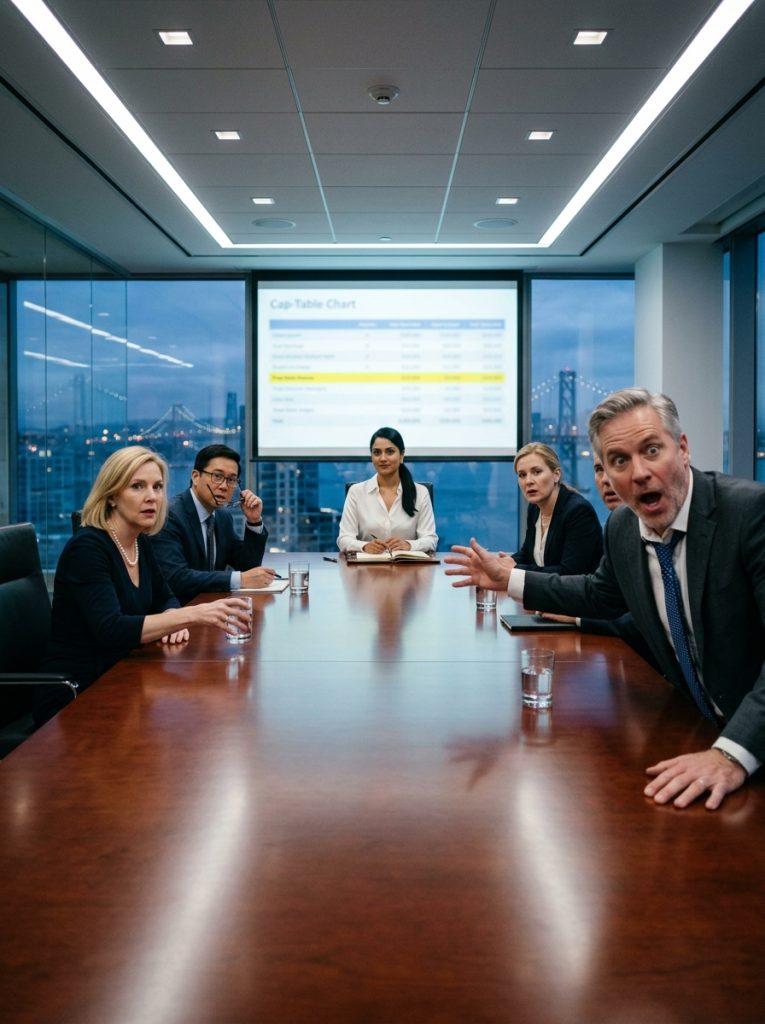
I said six words.
“I vote no. Meeting adjourned.”
The boardroom didn’t move.
Blake Mercer’s mouth was still open. His hand was still raised in the gesture he’d used to point at my name on the slide five minutes earlier. The hand that waved me away like a line item on a spreadsheet nobody reads.
That hand was shaking now.
“You can’t—” He looked at the attorney. “She can’t do that. One person can’t kill a vote.”
The attorney didn’t look up from his documents.
“The motion requires fifty-one percent of undiluted voting shares. Without Ms. Sharma’s block, you have forty-six point eight percent. The motion fails.”
Blake slammed both hands on the table.
“This is a two-billion-dollar acquisition. You’re telling me an executive assistant just vetoed it?”
I didn’t flinch.
“Not an executive assistant anymore,” I said. “Controlling shareholder.”
The room rearranged itself in real time.
Board members who’d been laughing thirty seconds ago were now doing math. I could see it in their eyes — the rapid recalculation of who in this room actually held power and who’d been performing it.
David Chen, the longest-serving board member, leaned forward.
“Ms. Sharma. May I ask why you’re voting no?”
I looked at him directly.
“Because this merger would gut the R&D division. It would lay off sixty percent of the workforce. And it would sell our core patents to a firm that will license them to competitors for profit while the technology we built dies.”
“With respect,” Blake cut in, “the financial analysis—”
“The financial analysis values short-term extraction over long-term value. I’ve been here eleven years, Blake. I watched this company grow from nothing. I watched the first product ship. I watched the team build something that mattered. And I’m not going to sit here and let you sell it for parts because your payout depends on closing before Q3.”
Blake went still.
Because that last part was true — and everyone in the room knew it. His compensation package included a $14 million acceleration clause triggered by the acquisition. He wasn’t advocating for the company. He was advocating for himself.
“This is personal,” Blake said. “This is about you feeling slighted because—”
“This is about fiduciary responsibility,” I said. “Which I take seriously. More seriously, apparently, than the man who just laughed at a controlling shareholder in front of the entire board.”
Another beat of silence.
Then David Chen spoke again.
“I think we should take a recess.”
The recess lasted four hours.
In those four hours, the following happened:
Blake Mercer called Vantage Capital’s managing partner and told him the vote failed. The managing partner threatened legal action. Blake’s attorney told him there was no basis — a shareholder exercising their vote is not a breach of anything.
Three board members who’d been Blake-aligned requested a private meeting with me in Conference Room B. They asked what I wanted.
I told them: “A new CFO. A five-year R&D commitment. And a formal governance review of every compensation package tied to exit events.”
They looked at each other.
One of them — Patricia Okafor, the board’s audit chair — actually smiled.
“You’ve been planning this,” she said.
“I’ve been paying attention,” I corrected. “Planning implies I expected to be in this position. I didn’t. But since I am — I’m not going to waste it.”
Blake Mercer was asked to resign the following Monday.
He negotiated a severance package. He left without a public statement.
The Vantage acquisition was formally withdrawn.
Meridian Technologies continued operating independently.
The R&D division kept its sixty-person team. The core patents stayed in-house. Three new products entered development pipeline within eighteen months.
I was offered a board seat.
I declined.
“I don’t want to govern,” I told David Chen. “I want to build. Put me back in operations. Give me the chief of staff role. Let me do what I’ve always done — keep this company running while everyone else is in meetings.”
He laughed.
“You just killed a two-billion-dollar deal from a folding chair at the end of a conference table. And you want to go back to operations?”
“That’s where the work is.”
I got the role.
Chief of Staff. Reporting to the CEO directly. Full visibility into every department. The position that had always been mine in practice — finally mine in title.
Six months later, I ran into Blake Mercer at a conference in New York.
He was between jobs. Consulting. The kind of consulting people do when they’ve been quietly pushed out and don’t want to say it.
He saw me across the hotel lobby.
For a moment, I thought he’d walk the other way.
He didn’t.
He walked over.
“Priya.”
“Blake.”
A pause.
“I owe you an apology,” he said.
I waited.
Advertisement
“Not for voting against me. That was your right. But for the way I spoke about you in that room. The laughing. The comment about your shares. It was—” He exhaled. “It was disgraceful.”
I looked at him.
“Yes. It was.”
He nodded.
“I spent twenty years in boardrooms treating people like line items. You were the first one who made me realize line items vote.”
I didn’t smile.
But I didn’t hold it either.
“Good luck with whatever’s next, Blake.”
He nodded again and walked away.
I went back to my conference. Back to the work. Back to the company I’d believed in since I was twenty-three years old and the only thing they could offer me was two hundred shares and a promise.
That promise held.
Not because of luck.
Not because of timing.
Because one founder — eleven years ago — wrote a clause into my grant that said: no matter how big this gets, the people who believed first will never be erased.
I believed first.
And when the room forgot that — I reminded them.
Six words.
“I vote no. Meeting adjourned.”
That’s all it took.
Three months after the boardroom vote, Meridian’s stock hit an all-time high.
The R&D division — the one Vantage would have gutted — shipped a product that landed three enterprise contracts in its first quarter. Revenue projections doubled.
The board members who’d laughed at my name on a slide sent me thank-you emails.
I didn’t respond to most of them.
Not out of pettiness. Out of efficiency. I had work to do.
But Patricia Okafor — the audit chair who’d smiled when I listed my demands — became an ally. A mentor. The kind of board member who understands that governance isn’t about authority. It’s about stewardship.
She invited me to lunch once a month. We talked strategy. Vision. The long game.
“You could run this company,” she told me once.
“I don’t want to run it. I want to protect it.”
“Same thing,” she said. “Done right.”
Maybe she was right.
The original founder — Marcus Webb, the man who wrote my equity clause eleven years ago — reached out after the news broke. He’d left the company in Year Four after a board dispute. Moved to Portland. Started a nonprofit.
He’d followed the merger fight from a distance.
“I always knew those shares would matter,” he said over the phone. “I just didn’t know when.”
“Did you know they’d matter to me?”
A pause.
“I hoped they would. You were the only person in that room who believed in the mission more than the money. I wrote the clause to protect people like you.”
People like me.
The ones who show up early and stay late.
The ones who take notes while others take credit.
The ones who believe when believing costs something.
Two hundred shares.
That’s what belief looked like on paper.
But in practice — in the moment when it mattered — belief looked like a woman at the end of a boardroom table setting her pen down and saying no.
Not loudly.
Not dramatically.
Just clearly.
And that was enough to change everything.