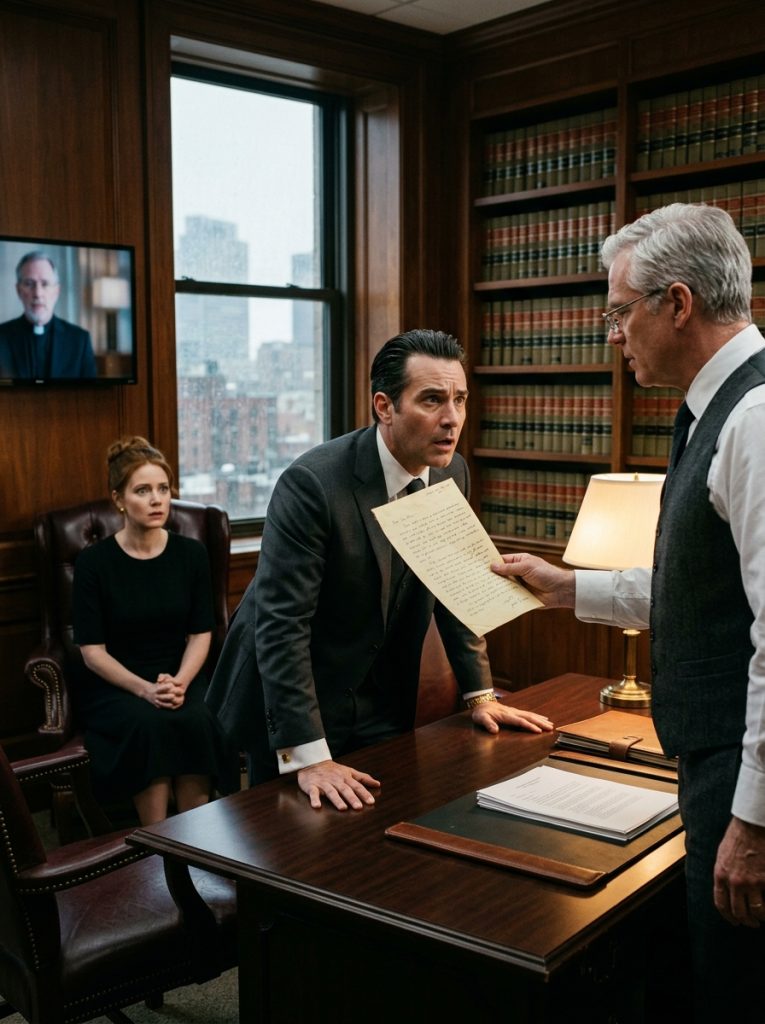
Father Thomas Brennan appeared on the video screen with the quiet composure of a man who’d spent decades sitting beside the dying.
“Father Brennan,” the attorney said. “Can you confirm the circumstances under which this codicil was prepared and signed?”
“I can.” His voice was gentle but firm. “Edward Ashton asked me to arrange it. He was lucid. He was determined. And he told me — in no uncertain terms — that this was the most important thing he’d done in years.”
Gregory stood fully now.
“This is absurd. My father was on high-dose morphine. He was confused. He didn’t know what he was signing.”
Father Brennan’s expression didn’t change.
“Mr. Ashton, your father asked me three specific questions on the day we prepared this document. First: whether a handwritten codicil was legally enforceable in Massachusetts. I confirmed it was. Second: whether I was willing to serve as witness alongside Nurse Maria Santos. I was. Third—” He paused. “He asked whether his son Gregory had visited at any point during the previous twelve months.”
Gregory went still.
“I told him no. Because the answer was no.”
The room was silent.
Gregory’s attorney leaned over and whispered something.
Gregory shook his head.
“This can be challenged,” he said. “Undue influence. My sister was his caregiver. She could have—”
“Mr. Ashton.” The estate attorney removed his glasses. “Your sister did not know about this codicil until I read it in this room. She was not present when it was prepared. She was not mentioned in the instructions your father gave me for safekeeping. In fact, your father explicitly said—”
He looked down at a note attached to the codicil.
“‘Do not tell Nora. I want her to hear it when Gregory hears it. So she knows I saw her. Even when she thought I didn’t.'”
Nora made a sound.
Small. Involuntary. Like the sound of something cracking open that had been sealed too long.
She pressed her hand to her mouth.
Gregory turned toward her.
For one moment — one fraction of a second — something moved across his face that might have been shame.
Then it hardened.
“I’ll contest this,” he said. “I’ll have it overturned.”
The attorney set his glasses on the table.
“That is your right, Mr. Ashton. But I should inform you that the probability of success is extremely low. The codicil meets every Massachusetts requirement for a valid holographic amendment. Two witnesses. Notarization. A separate capacity assessment documented by Father Brennan on the same date. And your father’s medical team has already provided a statement confirming he was not cognitively impaired at the time of signing.”
He paused.
“Additionally — and I say this as counsel, not as a participant — any challenge will become public record. The grounds for your father’s decision, as expressed in the codicil itself, will be entered into court filings.”
Gregory’s jaw tightened.
“Meaning?”
The attorney picked up the handwritten page.
“The final paragraph of the codicil reads as follows.”
He adjusted his glasses and read aloud:
“To my son Gregory: I leave you what you gave me in my final months — nothing. Not because I didn’t love you. But because love without presence is not inheritance. It is assumption. You assumed I would always be here. You assumed the house would always be yours. You assumed Nora’s sacrifice would never be counted. You were wrong about all three.”
Gregory’s face went white.
Several people in the room looked at the floor.
Nobody spoke.
The attorney continued reading:
“To my daughter Nora: I leave you everything that matters — not because you earned it through service, but because you gave it without expecting anything in return. That is the rarest gift. You held my hand when I was afraid. You sang to me when I forgot your name. You stayed when staying cost you everything. I cannot give you back the time. But I can give you the house you cared for me in. It is yours. It was always yours.”
Nora was crying now.
Silently. Hands in her lap. Face wet. Shoulders shaking with the contained grief of a woman who’d held steady for eighteen months and finally — in the reading of a dead man’s handwriting — was allowed to feel what it cost her.
Gregory gathered his coat.
“This isn’t over,” he said.
But his voice lacked conviction.
Because he knew — everyone in the room knew — that a public challenge would mean those words being read aloud again. In open court. On record. For anyone to find.
To my son Gregory: I leave you what you gave me in my final months — nothing.
He walked out.
The door closed behind him.
The room exhaled.
Nora didn’t move from her corner chair.
The attorney crossed the room and set the codicil on the small table beside her.
“This is yours to keep, Ms. Ashton. The original will be filed with probate. But this copy — his handwriting — belongs to you.”
Nora picked it up.
She held it the way you hold something fragile and irreplaceable.
She could see her father’s hand in every line. The tremor. The determination. The ink that pressed harder at certain words — as if he was pushing his voice through the pen because his body no longer could.
He saw her.
Even at the end. Even when the morphine made him forget her name sometimes. Even when his eyes looked through her like she was a stranger.
He saw her.
And this page — this one page of shaking blue ink — was proof.
Nora took the codicil home to the brownstone that night.
She sat in the chair beside her father’s hospital bed — still there, not yet removed — and read it again.
Advertisement
Then again.
Then she folded it carefully, slid it into the drawer of her father’s nightstand, and said the only thing she had left to say.
“I saw you too, Dad.”
The house was quiet.
The lamp beside the bed cast the same warm circle it had cast for eighteen months of vigil.
And Nora — for the first time since her father’s death — slept through the night without dreaming of all the ways she feared she’d been forgotten.
She wasn’t forgotten.
She was the last thing he fought to say.
Gregory’s challenge never came.
His attorney filed preliminary motions. Discovery requests. Capacity depositions. For three weeks the legal machinery churned.
Then it stopped.
His attorney called the estate counsel and said two words: “We withdraw.”
No explanation.
But Nora understood.
Gregory had calculated the cost. Not the financial cost — the reputational one. A public probate fight would mean the codicil’s language entered court records. Searchable. Permanent.
To my son Gregory: I leave you what you gave me in my final months — nothing.
That sentence would follow him to every boardroom, every networking event, every Google search of his name for the rest of his life.
He chose silence.
Nora didn’t hear from him for six months.
She didn’t reach out.
She moved into the brownstone fully. Repainted the living room. Replaced the hospital bed with a reading chair. Kept the nightstand drawer where her father’s codicil lived.
She returned to her career — slowly. Part-time consulting at first. Then a full position at a nonprofit that provided respite care for family caregivers.
She understood those families now.
She’d been one.
On the first anniversary of her father’s death, she went to the cemetery alone. She brought a single white rose and a copy of the codicil in her pocket.
She didn’t read it aloud. She didn’t need to.
She just sat beside the headstone and said: “I’m doing okay, Dad. The house is warm. I’m not invisible anymore.”
The wind moved through the cemetery grass.
Nora stayed until the light changed.
Then she walked home.
To the brownstone her father left her.
To the life she’d earned not by inheritance — but by presence.
By showing up when no one else would.
By holding a hand in the dark.
By being the one who stayed.