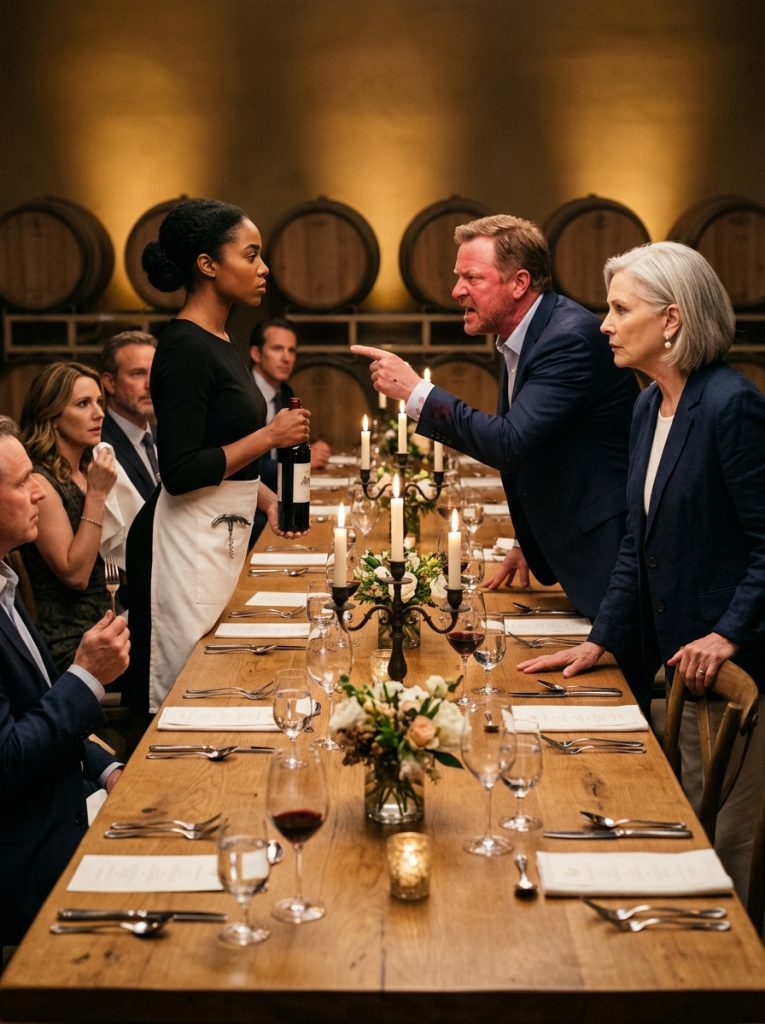
The room stayed silent for a full ten seconds after Margaret Ashford finished speaking.
Then Richard Holt did the only thing a man like him knows how to do when cornered: he tried to recover.
“Margaret, I had no idea you were—” He adjusted his jacket. “I was simply offering a different perspective on the wine. Healthy debate.”
Margaret didn’t sit back down.
“Richard. You didn’t debate. You humiliated a young woman in front of her colleagues and my guests to make yourself feel important. And you were wrong while doing it.”
Another guest — a woman in her forties at the center of the table — set down her glass.
“He also called her ‘sweetheart,'” she said quietly. “Just so we’re all clear about what happened here.”
Holt’s face went from white to red again.
“That was— I didn’t mean—”
“You meant it,” Margaret said. “You meant every word. And now everyone at this table knows exactly who you are.”
She turned to Clara.
Clara hadn’t moved. Her posture was still perfect. The bottle was still in her hand. But her eyes were glistening in the candlelight — not with tears, but with the controlled emotion of someone who’s just been publicly believed for the first time.
“Clara,” Margaret said. “Please continue. The wine is exceptional tonight, and I’d like our guests to enjoy it.”
Clara nodded once.
“Yes, Ms. Ashford.”
She poured the remaining glasses with the same steady precision she always used. No tremor. No hesitation. Each guest thanked her quietly — some with words, some with small nods that carried more weight than anything Holt had said.
The dinner continued.
Holt sat in silence for the remaining three courses. He didn’t touch the wine. He didn’t contribute to conversation. He stared at his plate like a man calculating damages in real time.
After dessert, Margaret found Clara in the kitchen hallway.
“Walk with me,” she said.
They stepped out a side door into the vineyard — rows of dormant vines under a sky full of cold December stars. The Napa hills rolled black and silent around them.
“How long have you been doing this work?” Margaret asked.
“Three years. Mostly private events. Some restaurant floor work.”
“And before that?”
“Community college. Then two years saving to take the WSET exams. I studied on my own mostly.”
Margaret nodded.
“Nobody funded you.”
“No, ma’am.”
“Nobody opened doors.”
“No.”
Margaret stopped walking. She turned to face Clara under the stars.
“I started this winery in 1987 with four barrels and a husband who told me women couldn’t make wine. He’s been gone a long time. The winery’s still here.”
Clara met her eyes.
“I have an apprenticeship program,” Margaret continued. “One position per year. Full immersion — vineyard, cellar, tasting room, production. You’d start in January. Room on the estate. Salary. And when it’s done, you’ll know more about wine than Richard Holt will learn in three lifetimes.”
Clara’s breath caught.
“Ms. Ashford, I—”
“You don’t have to answer tonight. But I’d like you to know the offer is real.”
“I know,” Clara said. “I could feel it was real the moment you stood up.”
Margaret smiled — the first warmth Clara had seen from her all evening.
“That’s because it was personal. A man talked to you the way men have been talking to women in this industry for fifty years. I stopped tolerating it about forty-nine years ago.”
They walked back inside.
Clara didn’t sleep that night.
She sat in her small apartment in Napa with a glass of tea and replayed the evening in her mind. Not the humiliation — she was used to variations of that. But the intervention. The specificity of Margaret’s knowledge. The calm. The public dismantling of a man who thought his money made his palate.
Clara said yes the next morning.
She started in January.
The apprenticeship lasted two years. She learned everything — from soil composition to fermentation chemistry to the business of running a boutique estate. Margaret was exacting, particular, and never once condescending.
“You already have the palate,” she told Clara. “Now you need the language and the structure to back it up in rooms full of men who’ll never admit they can’t taste what you taste.”
Clara learned.
Meanwhile, the video went viral.
A guest at the far end of the table — a tech executive named Sarah Lin — had filmed the entire exchange on her phone under the table. She posted it the day after the dinner with the caption: “Watch a man embarrass himself and a legend shut it down in real time.”
Three million views in a week.
News outlets picked it up. Wine publications ran profiles on Clara. Interview requests came from publications she’d only ever read in waiting rooms.
Clara declined most of them.
“Let the wine speak,” Margaret advised. “The noise dies. The work stays.”
Richard Holt’s company — a tech firm that relied heavily on Napa relationships for client entertainment — lost Ashford Estate’s distribution contract within days of the video going viral. Three other premium vineyards followed. A corporate sensitivity training mandate was issued by Holt’s own board.
He never attended another Ashford dinner.
Two years after that night, Clara launched her own label. A single-vineyard Pinot Noir from a small block Margaret helped her lease on the Sonoma Coast.
The first vintage earned ninety-four points.
The tasting note from the most respected critic in California read:
“Dark cherry and dried rose on the nose, building into elegant earthiness. Exactly what great Pinot should be.”
Advertisement
Clara framed that review.
Not because it validated her.
But because it was the same tasting note she’d given that night in the barrel room — word for word — when a man told her she was wrong.
She was never wrong.
And now the whole industry knew it.
Three months after joining the apprenticeship, Clara received a call from a restaurant group in San Francisco. They wanted her as head sommelier for a new fine-dining concept — a position that would have taken her five more years to earn through normal channels.
She asked Margaret’s advice.
“Take it when you’re ready,” Margaret said. “Not when they’re ready. There’s a difference.”
Clara stayed the full two years.
She learned blending. She learned business. She learned how to walk into a room full of men who assumed she didn’t belong and claim space without apology.
Margaret taught her all of it.
Not with lectures. With presence. With the daily example of a woman who’d built an empire in an industry that told her she couldn’t, and who still showed up at 6 a.m. every harvest to check the vines herself.
On Clara’s last day at the estate, Margaret handed her a bottle.
The 2019 Reserve Pinot.
The same wine from that night.
“Don’t drink it,” Margaret said. “Keep it. Open it the day you pour your own vintage for the first time. You’ll know what it means then.”
Clara kept it.
Two years later, standing in her own tasting room on the Sonoma Coast, pouring her debut vintage for a small group of writers and buyers, she opened Margaret’s bottle last.
She poured a glass for herself.
Raised it.
And said nothing.
Because Margaret was right.
Some things don’t need words.
They just need someone to believe you before the world catches up.
Clara Reeves was believed that night in the barrel room.
And she never forgot it.
Not the humiliation.
Not the intervention.
But the moment an older woman stood up in a room full of silence and said: you are correct, and you are enough.
That’s what changed everything.
Not the video. Not the viral moment. Not the career that followed.
Just one person standing up.