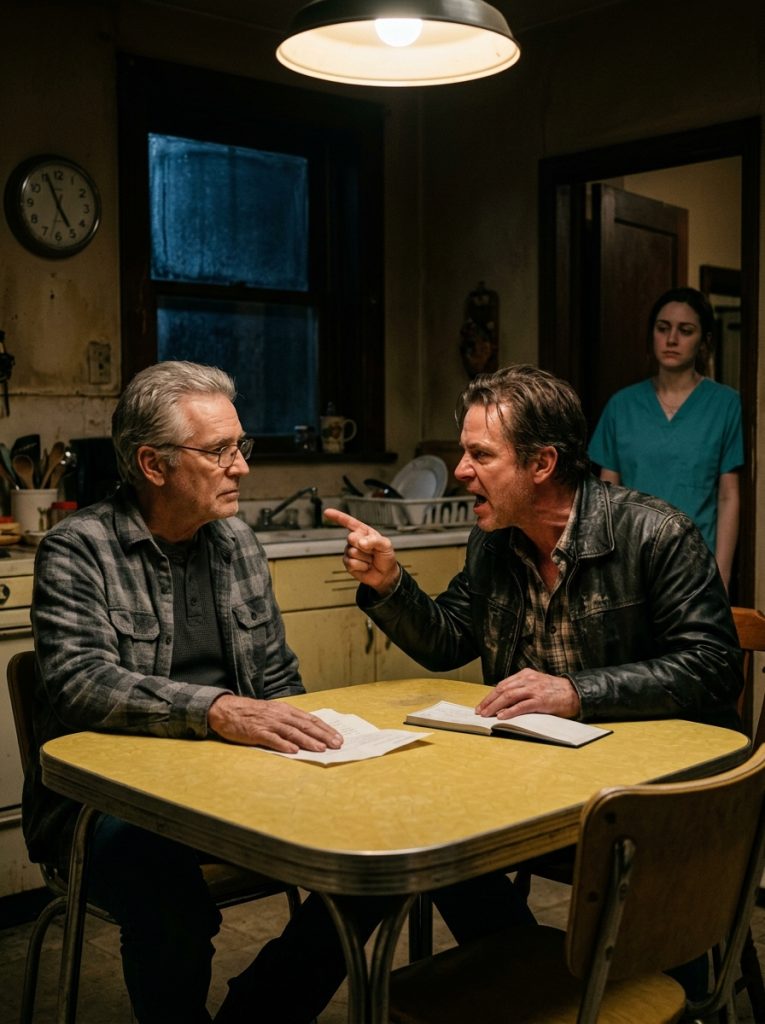
Wade read it twice. I watched him do it. The first time fast, looking for his own name. The second time slow, when he realized it wasn’t there.
Six months of pages. A line for every visit. And the same name on every line, in the same tired handwriting at the front desk.
Dana Mercer. Dana Mercer. Dana Mercer.
His finger went down the column like he could find himself if he looked hard enough. Wade Mercer was not on that paper. Not once. Not the weekend he was always “gonna come by.” Not Christmas. Not the day they told me the first round hadn’t worked and I sat in the parking garage for an hour because I didn’t want to call anyone and hear how busy they were.
“This doesn’t prove anything,” he said finally, but his voice had gone thin. “I called. You know I called.”
“You called the house,” I said. “Once. To ask if you could borrow the truck.”
In the doorway, Dana made a small sound. I think it was the first time she understood what I’d been carrying, and what I’d kept.
I should tell you about Dana, so you understand why this was easy for me.
The worst night, somewhere in the middle of all of it, I woke up at three in the morning sick as a dog, too weak to reach the call button, sure this was the night it finished me. And there was Dana, asleep in the plastic chair, still in her scrubs from a double shift, one hand resting on the edge of my bed like she’d dozed off mid-sentence. She wasn’t even on the clock. She’d come on her own time, after working all day on her feet, because she said the nights were when it got lonely and lonely was bad for healing. She woke up the second I stirred, got me through it, cleaned me up, and never told a soul. The next morning she brought me a coffee fixed exactly how I like it and pretended the night hadn’t happened so I wouldn’t feel small.
That’s the girl my brother wanted me to put behind “family.” That’s the line I was supposedly crossing by not cutting checks to men who’d let me die in that bed to save themselves the drive.
I never raised my voice. I want that on the record, because I’m proud of it. My whole life people figured the quiet man was the soft one. The pushover. The brother you could lean on and forget. I let them think it. It’s restful, being underestimated.
But quiet isn’t soft. Quiet is just a man keeping his own counsel until counsel is needed.
“Here’s what I figure, Wade,” I said. “You’re not actually mad that I won’t share. You’re mad that the math got done in public. Because as long as nobody added it up, you got to be my brother who loved me. Now there’s a piece of paper that says different, and you can’t stand to look at it.”
He started to bluster. I held up one hand and he stopped, the way he always stopped when our mother held up her hand, because some reflexes never leave you.
“I’m not gonna yell at you,” I said. “I’m sixty-one. I don’t have the wind for it, and you’re not worth the air. I just wanted you to read it. Now you’ve read it. You can go.”
He didn’t go right away. He sat there with the leather jacket and the open checkbook, and I think for the first time in his life my brother had nothing to say.
So I told him the rest, calm as anything, because he’d come for information and I figured he should leave with it.
“You want to know what I’m doing with the money. Fine. I’ll tell you, and then you can tell the cousins, save everybody the phone calls.”
“Dana,” I said, and I turned to my niece in the doorway, still in her scrubs, “is going to nursing school. Full ride, on me. She’s been picking up aide shifts and studying at two in the morning for three years. That ends. She’s going to be an RN, and she’s not going to owe anybody a dime when she’s done.”
Dana put her hand over her mouth. We hadn’t talked about it. I’d just decided, somewhere around the third infusion, watching her chart my vitals on her break.
“And the rest,” I said to Wade, “minus what I need to live quiet, is going into the union hardship fund. The one that helps a guy keep his lights on when he’s sick and can’t work. The one that helped exactly nobody in this family help me, because none of you put a dime in it either.” I folded the visitor log back up. “There’s men on that floor right now going through what I went through. Some of them have a Dana. Some of them have a Wade. I’d like the ones with a Wade to have something to fall back on besides their Wade.”
That landed. I saw it land.
He left without the checkbook. Forgot it on the table in his hurry, which felt about right. I mailed it back to him. Empty, the way he’d hoped it wouldn’t be.
The cousins stopped calling within the week, once the word got around that there was nothing in it for them. The buddies drifted off. Stevie never got his boat. My locker-mate of twenty years, the one who called me the closest thing to a brother he ever had, unfriended me on the computer, which Dana had to explain to me, and which I found pretty funny.
Here’s the thing nobody tells you about money landing on a man late in life.
It doesn’t change you. It just turns up the lights on everybody else, so you can finally see who was in the room all along.
I’d been in that hospital bed for six months thinking I was alone, and mostly I was. But the “mostly” had a name, and she wore teal scrubs, and she held the basin and learned my coffee order and never once mentioned that she was exhausted, because she didn’t want me to feel like a burden.
When you’re sick, you find out the truth about people for free. The money just made everyone say out loud what the visitor log already knew.
Dana’s an RN now. Graduated top of her class. She works the oncology floor — on purpose, she says, because she knows what it’s like to be the only name on somebody’s list, and she wants to be that name for the ones who don’t have a Dana of their own.
I go in sometimes, healthy now, and bring donuts for the nurses. They all know me. “Earl, Dana’s uncle.” I like that. I spent thirty-four years being a number on a mill floor. I’d rather be Dana’s uncle.
The hardship fund did something too. The union sent me a letter, formal, thanking me, and a few months later a man I’d never met found me at the diner. Younger fella, leukemia, two kids. He said the fund kept his power on through his treatment, that he didn’t know my name was on it until the rep let it slip. He just wanted to shake my hand. I told him to keep his thanks and put it in the pot himself someday, when he was well, for the next guy. He’s well now. He did.
Wade and I don’t talk. I don’t hate him. Hate takes wind too. I just took him off the list, the same way he took me off his when I had nothing to offer but a hospital chair to sit in.
People ask if I’m bitter about who showed up only when the check did.
No. I’m the opposite of bitter. I’m clear. Bitterness is for men who got cheated. I didn’t get cheated. I got the truth, on a printed page, for free, the way the sickest men always do. Most people pay for that lesson and never get a refund. I got mine and a buyout besides.
When I was dying, one person came.
When I die for real someday, I already know whose name will be on the page.
And this time, she’ll know I knew it all along.