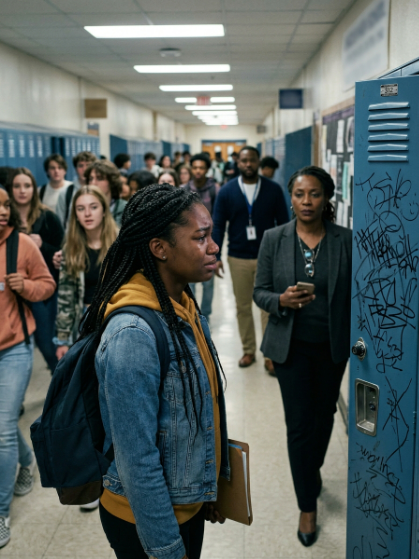
I spent third and fourth period sure that “give me until lunch” was just a gentler version of “let it blow over.”
I was wrong about Principal Okonkwo in every possible way.
I found out at 11:50, when the lunch bell rang and I came around the corner toward my locker with my stomach in a knot, expecting to see the word still there, or a blank scrubbed patch that everyone would remember anyway.
I couldn’t see my locker at all.
I couldn’t see it because it was covered. Buried. Every inch of blue metal under layers of paper — sticky notes, index cards, sheets torn from notebooks, taped edge to edge and overlapping like scales.
Hundreds of them.
“You belong here.” “Glad you came to Lincoln.” “Sit with us.” “Your hair is awesome.” “Welcome.” Some signed, some not. Some in careful handwriting, some in the scrawl of a kid who wrote it fast between classes and meant it anyway.
The hallway was full. Not crowded the way it gets at lunch — gathered. Kids standing back to look at it like it was something in a museum. And in front of it, holding a marker and a stack of blank cards for anyone who still wanted one, stood Principal Okonkwo.
She didn’t make a speech to me. She just handed me a blank card and a pen and said, “You get one too. What do you want this hallway to say?”
I couldn’t talk. I wrote something. I taped it up with the rest. I’m not going to tell you what it said. It was mine.
Here’s how she did it, because the how is the whole point.
After I left her office that morning, she pulled the hallway camera footage like she’d told the assistant to. It took about twenty minutes to find: two seniors, 7:14 a.m., one keeping watch while the other wrote. She had names by 9.
But she didn’t lead with punishment, and that’s the thing I keep turning over. She told me later why.
“Punishment is between me and those two boys,” she said. “It’s real, and it happened, and it was serious. But if all I do is punish, the only story this hallway tells is that someone hurt you. I wanted the hallway to tell a louder story than the one they wrote.”
So between 9 and 11:50, she’d gone classroom to classroom. She’d told teachers what happened — not the slur itself, she never repeated it, just that a new student had been targeted and that the school was going to answer. She handed out the cards. She asked one thing: if you’ve got something kind and true, write it, and bring it to the locker by lunch.
She bet four hundred teenagers would rather build something than watch something get torn down.
She won that bet by a landslide.
The two seniors were dealt with. I know it was real because the school doesn’t play around with that, and because one of them, about a week later, found me by the gym and apologized — clumsy, red-faced, clearly required, but also, I think, partly his own. He said he didn’t even know me. I said that was sort of the point. He nodded like that landed. I don’t know what he became after that. I just know he had to stand in a hallway papered with the opposite of what he’d written, and watch the whole school choose the other side.
The custodian, Mr. Reyes, never did scrub my locker. The principal asked him to leave the cards up.
They stayed up until the end of the year. The ink faded. Some corners curled. New ones appeared sometimes, from kids I never identified. By spring my locker was the landmark people used for directions. “Meet me by the wall,” they’d say, and everyone knew which wall.
I’m a senior now myself.
Last fall a freshman got something cruel scrawled on her gym bag, and I watched it happen in real time — watched her face do the thing my face did, the hot, stinging, here-we-go-again thing.
I didn’t wait for an adult.
I went and got a stack of blank cards from the front office, where Principal Okonkwo keeps them now, on purpose, in a little tray by the sign-in sheet. She saw me take them. She didn’t say anything. She just smiled, the same calm way she had the morning she told me to give her until lunch.
By the end of that day, the freshman’s locker was covered too.
That’s the part the people who wrote the word never understood. You can scrawl something ugly in thirty seconds and walk away feeling big.
But a wall built by four hundred people doesn’t come down.
And it teaches the next kid how to build one.