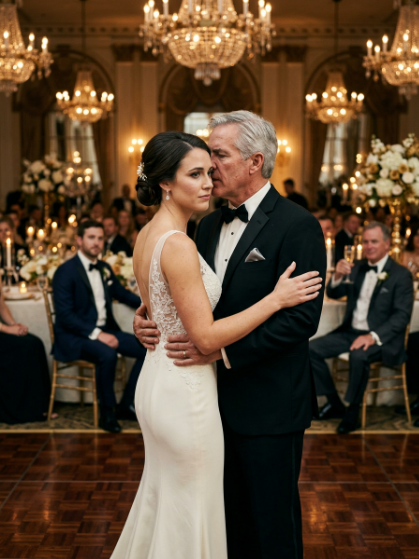
The song ended. I kissed my father’s cheek for the cameras, and under the applause he murmured, “What do we do?”
“We finish the reception,” I said, smiling at the room. “And then I make some calls. Don’t change your face, Dad. We’ve got a part to play tonight.”
That was the hardest performance of my life — three more hours of being a radiant bride at a wedding I already knew was a crime scene.
I danced with Connor. He held me and told me he was the luckiest man alive, and I looked up at him and tried to find the moment he’d decided I was a prop. I couldn’t. That’s the thing about people like the Lockharts. They don’t have a villain moment. They just never once considered that the decorative bride could read a balance sheet.
Let me back up, because the why matters.
The Lockharts ran a “logistics consultancy” that, as far as I could tell, mostly existed to move money. My father’s freight company, Mercer Freight, was old, clean, cash-heavy, and respectable — the perfect coat to wear. Two years ago the Lockharts had proposed a “partnership.” Connor had started courting me around the same time. I’d thought it was romance. It was access.
They funneled money through accounts dressed as freight contracts — shipments that didn’t ship, invoices for routes that didn’t run. By marrying me, they tied the two families together so tightly that when the audit my father had quietly requested finally landed, the Lockharts would be family, and family doesn’t testify, and family makes problems disappear at Thanksgiving instead of in a courtroom.
What they didn’t know — what nobody bothered to ask the bride — was that I’m the chief financial officer of Mercer Freight. Not in name only. I built our reconciliation systems. I’d been the one, eighteen months back, who first noticed a rounding pattern that wasn’t rounding at all, and I’d been quietly pulling the thread ever since, not knowing it led to the man I was about to marry.
My father found the other end of the thread last week. We were both holding the same rope from opposite ends, and we’d just realized it that morning. He’d waited until the dance to tell me because it was the only place in that ballroom where the Lockharts couldn’t read his lips.
So we played the part. We cut the cake. I threw the bouquet, and Connor’s mother caught it, and I laughed and meant none of it.
And at 11 p.m., while two hundred guests drank my father’s champagne, I went up to the bridal suite, took off the veil, opened my laptop, and sent the files.
I’d had them ready for days. Every transaction, traced and annotated, cross-referenced to the shell contracts. I sent them to the forensic team my father had already retained and, copied, to a contact at the federal field office who had been waiting on exactly this. I’d built the package the way I build everything — clean, sourced, undeniable.
Then I changed out of the dress, came back down, and danced until the band packed up, because a CFO knows you don’t tip your hand before the wire clears.
The marriage lasted nine days on paper.
I never moved in. I filed for annulment on the grounds of fraud — that consent obtained for the purpose of concealing a crime is not consent — and a judge agreed faster than I expected. Connor’s lawyers tried to make it ugly. My documentation made it short.
The federal case was not short. These things never are. But it moved, because the evidence was good, because the evidence was mine.
Gerald Lockhart — the man who raised a champagne flute to me across the ballroom like I was furniture — was indicted within the year on money laundering and wire fraud. Connor took a plea. The “consultancy” dissolved into a pile of subpoenas. The leveraged real-estate fund they’d been so proud of collapsed under the weight of frozen accounts.
Mercer Freight came through clean, because my father had been the one to call the audit and I had been the one to keep the books honest, and the record showed both. There’s a particular vindication in being the family that reported the crime instead of the family that hid it. We kept our name. In our business, the name is everything.
People ask if I’m bitter that my wedding was a trap. Honestly? Less than you’d think.
Because Gerald Lockhart looked at me in a white dress and saw a decoration. Connor looked at me across two years and saw a cover story. They picked me precisely because they were certain I couldn’t count.
I counted everything.
My father and I have a tradition now. Every year on what would have been my anniversary, we don’t commiserate. We pull the quarterly numbers, clean and honest and ours, and we go to dinner, just the two of us.
He always raises his glass first.
“To the best CFO I ever hired,” he says.
“You didn’t hire me,” I tell him every year. “I’m your daughter.”
“Best one I ever raised, then.” He clinks my glass. “They should’ve asked what you did for a living.”
They should have.
It was right there on my business card the whole time.