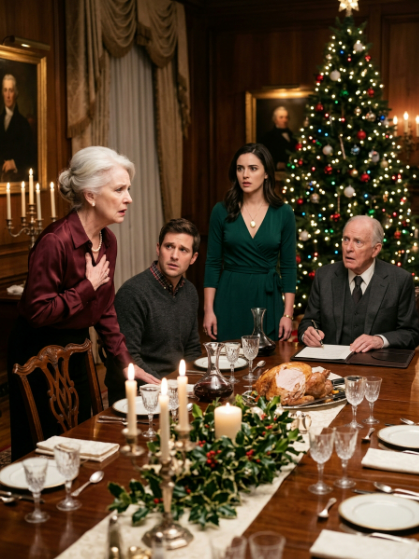
Ethan looked at his grandmother, then at me, then at the pen frozen in his grandfather’s hand, and he said the only true thing in the room: “I don’t understand what’s happening.”
Neither did I. Not yet.
Eleanor told us. She’d carried it thirty years, and Christmas Eve, with a stranger’s maiden name in the air, she finally couldn’t hold it.
“Voss Lumber,” she said, looking at the candle instead of at me. “Vermont. Your grandfather and Daniel Voss were partners once. Best friends. They built two mills together.”
Augustus set the pen down. He did it slowly, like it had gotten heavy.
“Then there was a fire,” Eleanor went on. “In the Voss mill. And a question of insurance, and a question of fault. Augustus had documents that would have cleared Daniel. He chose not to produce them. Daniel was ruined. The Vosses lost everything — the mill, the house, the name. And the contracts that should have been theirs came to us. That’s where Hartwell Mills came from. That’s where all of this came from.” She gestured at the long table, the silver, the tree. “It came from a fire we let one good man burn for.”
The dining room was so quiet I could hear the tree lights tick.
I want to be clear, because it matters: I didn’t know. I’d grown up on the other end of that story — the side where my grandfather lost a mill and a friend and his health all in one bad year, and where “the Hartwells” was a name my family said the way you say a bruise. I knew my people had been wronged. I had no idea the Hartwells were Ethan’s people. I’d fallen for a kind man with a complicated family, and that was all I thought I’d walked into.
Daniel Voss was my grandfather. He died when I was small, but I have his sign over my father’s garage and his name in my mouth, and I had just said it out loud at the table of the man who buried him.
I started to stand. “I should go. Ethan, I’m so sorry, I didn’t—”
“Sit down. Please.” It was Augustus.
He was eighty-one and he looked every year of it suddenly, the smugness gone, just an old man holding a contract he no longer wanted to sign.
“You don’t apologize in this house,” he said. “Not you. Not ever.” He turned the leather folder around so it faced away from him. “I was going to sign the mill over to a buyer tonight for eleven million dollars. A clean exit. End of an era, I said. I’ve been calling it an era so I wouldn’t have to call it what it was.”
He looked at his grandson. “Ethan, do you know why I let you bring her here tonight without asking a single question? Because I’m an old man who wanted one last clean evening before I sold the last of it and pretended the beginning never happened. And then she said her name.”
Nobody had touched the roast. It sat there, going cold, the most ignored turkey in New Hampshire.
I didn’t get a tidy movie ending. Real reckonings are slower and stranger than that.
The signing didn’t happen that night. Augustus called the buyer two days after Christmas and pulled out. Then he did the thing that surprised everyone, including, I think, himself: he called my father.
They met in January. I wasn’t in the room. My father came out of it quiet for a week.
What Augustus offered wasn’t charity and it wasn’t quite justice, because there isn’t enough money to un-burn a man’s life. But he restructured the sale. A significant share of the mill’s value — the share built on contracts that should have been Voss contracts — was placed in a trust in my grandfather Daniel’s name, directed by my father. The old insurance documents, the ones Augustus had buried for thirty years, he produced at last, notarized, so that the record finally said in writing what my family had only ever been able to say out loud: Daniel Voss did nothing wrong.
For my father, that paper meant more than the money. I watched him read it at our kitchen table and put his hand flat over his own father’s name like he was checking for a pulse.
Augustus died eighteen months later. He’d asked to see my father near the end, and my father went, and whatever passed between them, my father came home and said only, “It’s settled. As much as it can be.”
Ethan and I are still together. It wasn’t simple — you don’t fold two families’ worst chapter into a relationship and call it easy. There were months we weren’t sure. But he never once asked me to make it smaller than it was, and that’s the thing I married him for, eventually, in a small ceremony with no mill money in it at all.
Eleanor came. She’s the one who toasted us. She lifted her glass with a hand that shook a little and she said, “To names spoken at the right table, even thirty years late.”
I keep my grandfather’s old shop sign in our front hall now. Voss. Plain letters, hand-painted, a little weathered.
Every guest who comes through asks about it.
And I get to tell them the whole story, all the way to the end — the part where the name nobody was supposed to say out loud got carved back into the record, in ink, where a fire couldn’t reach it.