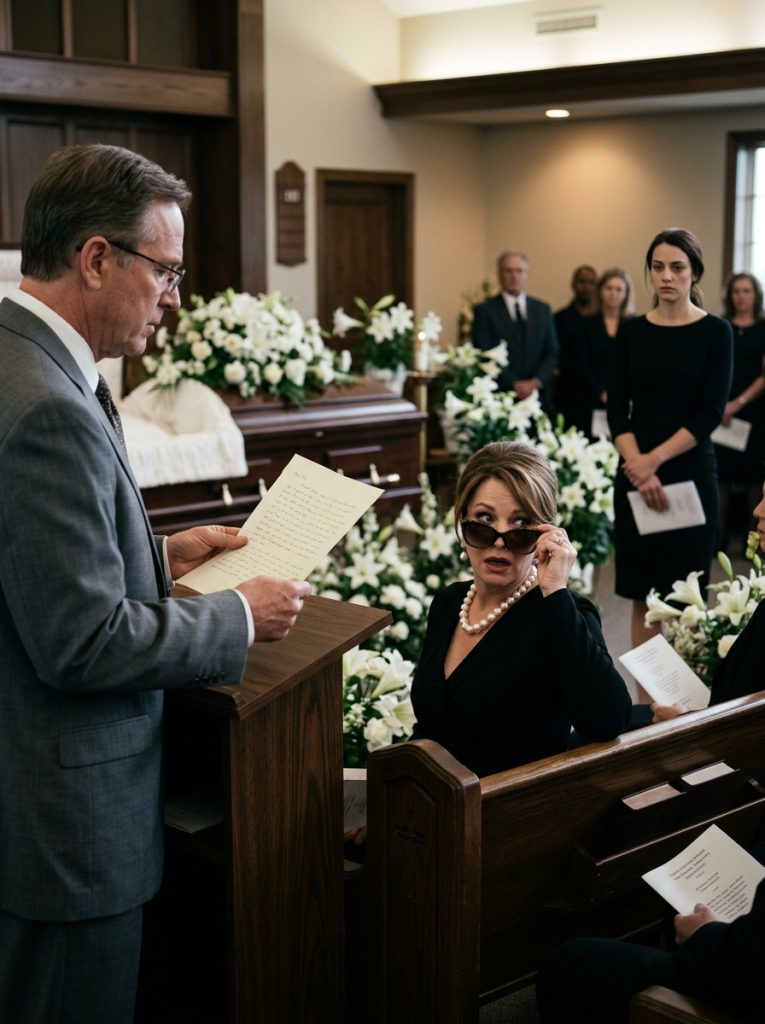
Gerald Pace put on his glasses, smoothed the page, and read my mother’s voice into that silent chapel.
“I want to thank the people who were actually in the room.
First, my daughter Quinn, who slept in a chair beside my bed for two years and never once let me wake up alone. Who learned my medications, my moods, and my bad jokes. Who held the basin and the line and her own breaking heart, and who I watched become the strongest person I have ever known while I got weaker. Everything good I am leaving behind, I am leaving because she earned it.”
I don’t remember sitting down. I just remember the back of the pew under my hand, holding me up.
Two years compressed into that one paragraph. The 3 a.m. pump alarms. The drives to chemo with her hand cold in mine. The night she couldn’t sleep and we watched infomercials until four because laughing at a miracle blender was the only thing that helped. The day she could no longer manage the stairs and I moved my whole life into the room beside hers without ever once deciding to — it just happened, the way these things do, one necessary night at a time. None of it had felt like sacrifice while I was doing it. It had just felt like love wearing its work clothes. Hearing my mother name it out loud, after she was gone, broke something open in me that two years of holding it together had kept sealed.
He kept reading.
“I had a long time to think, lying there. I thought a lot about who shows up. Not who sends flowers, not who posts the nice photo, not who tells a beautiful story at the end. Who shows up, in the boring middle, when there’s nothing to gain and a lot of laundry to do.
Some of you did. You know who you are, and I named you in the longer letter Gerald has.
And some of you did not. I’m not going to use this moment to shame anyone. Grief makes liars of all of us, and I forgive it. But I wrote my own obituary because I knew, the way mothers know, that if I didn’t, someone would write themselves into a role they never played. So consider this me, correcting the record on my way out the door. I was not alone at the end. I was held. By Quinn. Let that be the last true thing said about me.”
Gerald folded the page.
The silence in that chapel was the loudest thing I have ever heard.
And then, from the front pew, Lorna stood up.
I think she meant to salvage it. I think years of always getting there first had convinced her she could talk her way through anything. “Well,” she said brightly, her voice cracking at the edges, “Margaret was always so dramatic, bless her, she didn’t mean—”
“Sit down, Lorna.” It wasn’t me. It was my mother’s pastor, gently, from the second row. “Let the woman have her own words.”
Lorna sat down. Her oversized sunglasses had slid all the way down her nose, and for once she didn’t push them back up. She just stared at the casket, and I watched the performance drain out of her in real time, the way air leaves a balloon you’ve stopped holding.
Two hundred people had heard it. There was no version of the day she could rewrite now.
After the service, something happened I didn’t expect. People came to me. Not to her. One by one — Mom’s old neighbors, her bridge friends, the pastor, the women from her church — they came and took my hand and said the same thing in different words.
“We knew. We always knew it was you, honey. We’re just glad somebody finally said it out loud.”
That was the part that undid me. Not the obituary. The fact that the whole room had known, the whole time, and had just been waiting for permission to say so.
The will reading was three days later, in Gerald’s office. Lorna came in a new black dress, composed again, ready to fight. She’d already been telling cousins that Mom “wasn’t in her right mind at the end” and that the obituary was “the medication talking.”
Gerald shut that down before it started.
“Margaret revised her will fourteen months ago,” he said, “in this office, with two witnesses and a physician’s letter attesting to her capacity, which she requested specifically because she anticipated this exact challenge.” He looked at Lorna over his half-glasses. “Your sister was sharp as a tack, and she planned for you.”
The estate — the house, the savings, my grandfather’s land that everyone had circled for years — went to me. Not out of spite. Gerald read that part too, from the longer letter. “Not to punish anyone,” my mother wrote, “but because Quinn put her own life on hold to give me mine, and the only thing I have left to give is the security she sacrificed. Use it to start the life you postponed, my love. That’s an order from your mother.”
There was one line for Lorna, and it was kinder than she deserved. “To my sister Lorna, I leave the pearls she always admired, and the genuine hope that she learns the difference between being seen and being there. It is not too late for her. It was never too late for any of us.”
Lorna took the pearls. She did not take the lesson, at least not right away. She left without a word and didn’t speak to me for a year.
But here’s the strange thing about the truth. It works slow, but it works.
About a year later, Lorna called. Her own daughter had gotten sick — not seriously, but enough for a hospital stay — and Lorna, she told me, had sat in a chair beside the bed for three nights, and somewhere around the second sleepless 3 a.m., she’d understood.
“I get it now,” she said on the phone, and she was crying, and for once it wasn’t for an audience. “I’m so sorry, Quinn. I wrote myself into something I didn’t earn because I couldn’t stand to look at what I’d missed. She knew that. She forgave me before I even — before I even knew I needed it.”
We’re not close. Maybe we never will be. But we talk. It’s a start, and Mom would have wanted the start more than she’d have wanted the grudge.
I used the inheritance the way she ordered me to. I went back and finished the degree I’d dropped when she got sick. I bought a small place with a window that gets the morning light, and I put a feeder right outside it.
I also did one thing she didn’t put in the will. I took a portion of what she left and started a small fund through her church — money for people caring for a dying parent at home, to cover a few nights of respite, a tank of gas to the cancer center, a week of groceries. I named it after her. The first family it helped was a man my age looking after his father, and when he called to thank me, exhausted, half-apologizing for needing it, I told him the thing I wish someone had told me. “You’re not a burden, and neither is he. You’re just in the room. Stay in the room. It’s the whole thing.”
Cardinals come. Of course they do.
I think about that handwritten page all the time — my mother, weak and dying and clear-eyed, knowing exactly how the world tries to rewrite the quiet ones, and refusing to let it happen to her own story.
She didn’t get the last word by accident.
She wrote it down, sealed it, and handed it to a man she trusted to read it out loud when she no longer could.
I learned everything I know about showing up from her.
And the last thing she taught me, from inside a sealed envelope, was how to make sure the people who show up never get written out again.
I keep a copy of that obituary in the drawer of my nightstand.
On the hard days, I take it out and read the first line, in her hand.
“I want to thank the people who were actually in the room.”
I was, Mom. I was in the room.
And because of you, everybody knows it.