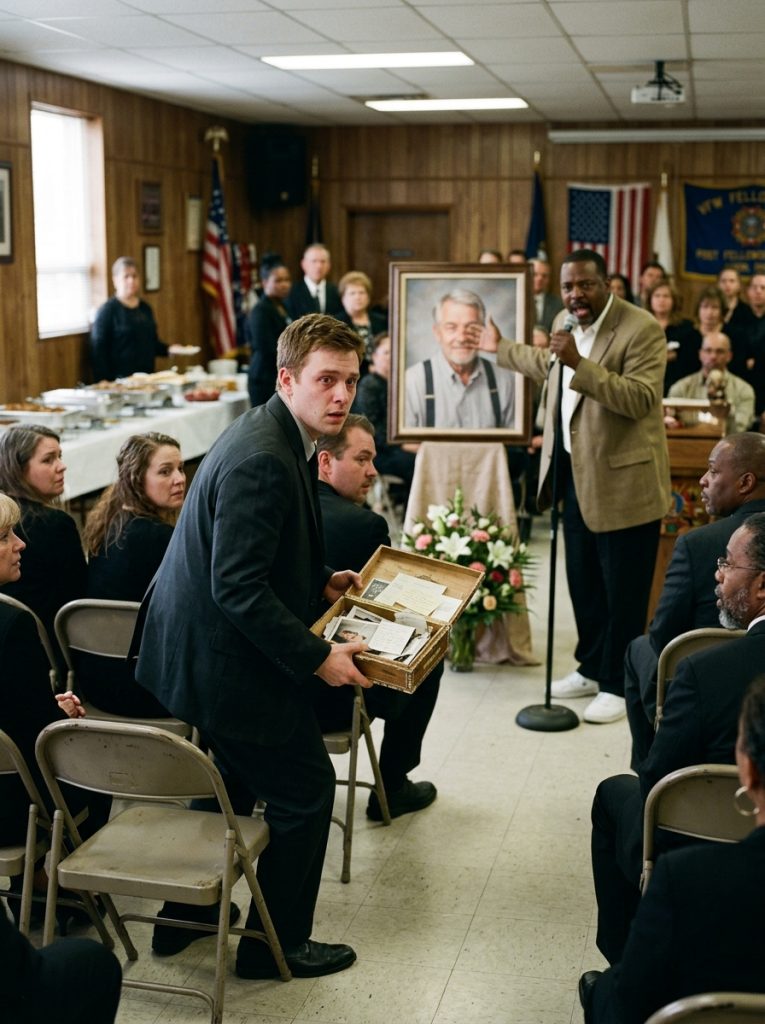
I stood up with the open box in my hands, and the whole hall turned to look at me instead of Dwayne.
I walked to the front. Past the folding chairs, past the casseroles, past Pop’s photograph smiling at me from the easel. I stopped beside the man at the microphone, my birth father, and I set the cigar box on the little table next to the flowers where everyone could see it.
“You want to correct the record,” I said. My voice came out steadier than I felt. “Okay. Let’s correct it. But we’re going to use Pop’s records, not your memory.”
I took out the first money order stub. Then the next. I laid them in a row on the white tablecloth.
“These are money orders,” I said, loud enough for the back row. “Carbon copies. Pop kept copies of everything; you all know that about him. Forty-three of them, over eleven years.”
Dwayne’s smile was still up, but it had started to set, like plaster.
“Every one of them,” I said, “is made out to the county. For child support. Arrears. The support that was legally owed for me.” I turned and looked at him. “By you.”
A murmur moved through the hall.
“Here’s the part I didn’t know until ten minutes ago.” My hands were shaking now, but I kept going. “Pop didn’t have to pay these. I lived with him. The support was supposed to flow the other way — from you, the absent father, to whoever was raising me. But you didn’t pay it. For years. And when a person doesn’t pay court-ordered support long enough, you know what happens?”
Nobody answered.
“They go to jail,” I said. “There was a warrant, Dwayne. I found the notice in the box. You were going to be arrested. And the man you just called ‘the babysitter’ quietly walked into that county office and paid your debt. Under your name. So that my father wouldn’t be a man in a cell. So that I could grow up with a dad out in the world to be angry at, instead of one behind bars.”
The hall was dead silent now. Dwayne reached for the microphone like he wanted to say something, and I moved it an inch out of his reach.
“There’s more,” I said. “There’s a rehab bill in here. Sixty-one days at a facility upstate, eight years ago. Paid in full. Pop’s bank, your name on the intake. I didn’t even know you’d gone to rehab. I thought you’d just disappeared again. You disappeared into a bed Pop paid for, trying to get clean, and he never told me, because he didn’t want me holding my breath waiting for a father who might not come back sober.”
A woman in the third row had her hand over her mouth. Pop’s old Army buddy was openly crying.
And then a memory hit me so hard I had to grip the edge of the table.
I was maybe ten. We were at the grocery store, and Pop spent twenty minutes at the little kiosk by the customer service desk filling out a form, frowning over it the way he frowned over a stuck bolt. I’d asked what he was doing. “Paying a bill for a fella who’s having a hard time,” he said. “Go pick us out a cereal.” I picked the sugary one. He let me, which he never did. I understood now what bill he’d been paying, and why he let me have the cereal that day. He’d just kept my father out of a jail cell, and I’d been annoyed we were taking so long.
There were a hundred of those mornings, I realized. A hundred small frownings-over of forms I’d never thought twice about.
And Dwayne — Dwayne sat down. Just folded into a folding chair, the fight going out of him, because there is no correcting a record that’s written in money orders and your own name.
At the bottom of the box, under all of it, there was an envelope. My name on the front, in Pop’s blocky capitals.
I almost didn’t open it there. But Pop had said I’d know when it was time, and standing in that hall with the truth finally laid out on a tablecloth, I knew.
I read it out loud, because he would have wanted the room to hear the one thing he never said while he was alive.
“Theo,” it said. “If you’re reading this, I’m gone, and you found the box. I’m sorry I never told you. I want to explain why, so you don’t think I was protecting him. I wasn’t.
I was protecting you.
A boy needs a father he can be mad at more than he needs the truth about why the father left. If you knew Dwayne was facing jail, you’d have felt responsible. If you knew about the using, you’d have spent your childhood scared. So I paid what needed paying and I kept my mouth shut and I let you be a kid who was just plain angry, because plain angry is survivable. The other thing isn’t.
You were never a burden, Theo. You were the best decision I ever made, and I didn’t make it because I had to. I made it because the first day you fell asleep on my chest, I was done. That was it for me. You were my boy from then on.
Don’t hate your father. Hating him will cost you more than it’ll ever cost him. Just know the truth now, and let that be enough.
Love, Pop.”
I folded the letter. I couldn’t see for the tears, and I didn’t try to hide them.
Then I did the thing Pop asked me to do in the last line, even though every cell in me wanted to do the opposite.
I walked over to Dwayne. He flinched like he expected to be hit. I held out my hand and helped him up out of the folding chair.
“He paid for you to get clean,” I said quietly, just to him. “Are you?”
He nodded. Eight years, he said. He’d stayed clean. He’d come today, he admitted, because he’d heard about the money and thought maybe there was something in it for him, and he’d dressed it up as fatherhood because that was the only role he had left to play.
“There’s nothing in it for you,” I told him. “There’s no money, Dwayne. Pop spent it on you twenty years ago. That’s where the inheritance went. You already got it.”
He started to cry. For the first time, I think, it wasn’t a performance.
I didn’t forgive him that day. I want to be honest about that. Forgiveness isn’t a light switch and Pop never said I had to flip it. But I left the door open, the way Pop always told me to. We talk now, a little. Carefully. He goes to a meeting on Thursdays and sometimes he calls me after.
I keep the cigar box on my mantel. The money orders are in a frame beside it, all forty-three of them, where anyone who visits can see exactly what kind of man raised me.
A few months after the memorial, I drove out to the county building myself. I wanted to see the office where Pop had stood at that counter, year after year, paying down a debt that wasn’t his. It’s just a gray room with bad carpet and a number you take from a dispenser. I sat in one of the plastic chairs for a while. An ordinary, ugly little room. That’s where the love happened. Not at a graduation, not at a ballgame — at a service counter, under fluorescent lights, with a man quietly choosing his kid’s peace over his own bank account, again and again, and telling no one.
I named my son after him last spring. Sal. He’s four months old. He falls asleep on my chest the way Pop’s letter said I once fell asleep on his, and the first time he did it, I finally understood the line that had confused me. “That was it for me.” I get it now. You don’t decide to love a kid like that. It just happens, and then you spend the rest of your life paying bills at gray counters and frowning over forms and never once calling it a sacrifice.
People ask why I’d frame a stack of old receipts.
I tell them they’re not receipts.
They’re the longest, quietest love letter a man ever wrote without using a single word — and he addressed every one of them to the name of the man who left, so that I’d never have to know how much it cost him to let me keep a father at all.
Pop was never the babysitter.
He was the whole house. He was just too humble to ever say so out loud.
So I say it for him now, every chance I get.