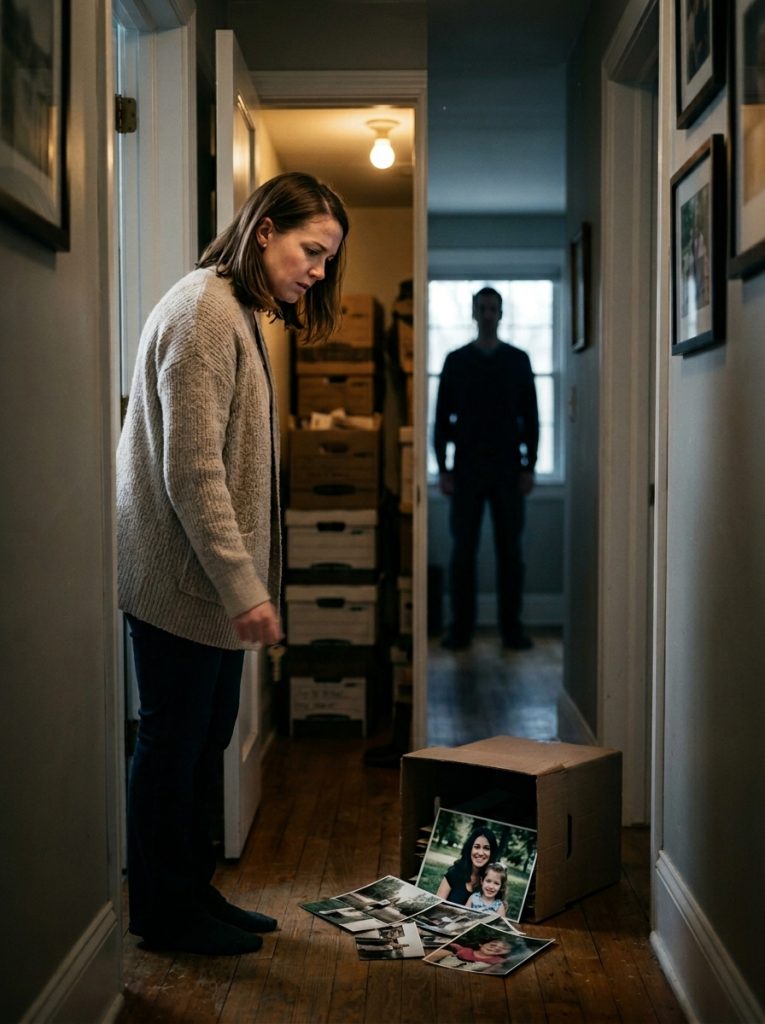
The drawing on the back of that little girl’s photo said: “Lily, age 4. My whole heart.”
In my handwriting. A daughter. Mine.
And in the second box, under the competency petition, I’d found her death certificate — and a folded newspaper clipping about the same highway crash that took my memory. Two cars. One driver killed. One child, age four, who did not survive.
I hadn’t lost only my past. I’d lost her. And Mark had decided I should never get her back, because a grieving mother is unpredictable, and an unpredictable wife is hard to declare incompetent on schedule.
I heard his car door slam outside.
I did not panic. Something colder than panic took over.
I put the photograph of Lily in my cardigan pocket, the way I’d kept the key. I left the boxes exactly as they were. I closed the storage room door, turned the lock, and was standing at the kitchen sink running water over a mug when Mark came in.
“You’re up,” he said, that careful warmth in his voice. “How are you feeling? Did you rest?”
“I had a headache,” I said. “I slept most of it off.”
He studied me the way he always did, checking my face like a gauge. I gave him nothing. Nineteen years of marriage, he’d told me. Apparently I’d learned something in those years about hiding from him, even if I couldn’t remember learning it.
“Good,” he said finally. “That’s good.”
That night I lay beside him in the dark and I made a plan with the only tools I had: a phone he monitored, a car he tracked, and a mind he’d spent eight months teaching me not to trust.
The first thing I did was the hardest. I started writing things down.
Not on my phone. On paper, in pencil, hidden inside the lining of a winter coat in the hall closet — a trick that felt strangely familiar, like my hands had done it before. Every day, the date, what was real, what I’d seen in that room. If he wiped me again, somehow, the paper would remember.
The second thing I did was test the name.
There had been a name in those documents. A woman who’d called and called: Renata Cole. My sister, the boxes said. The one Mark swore didn’t exist.
On Thursday, when Mark was at work, I walked twenty minutes to the public library and used a computer that wasn’t ours. I searched her. She was real. She lived ninety miles away. She had a public business page with a phone number.
My hands shook so hard I misdialed twice.
“Hello?”
“My name is Dana,” I said. “I think — I think I might be your—”
The sound she made. I will never forget the sound she made.
“Dana. Oh my God. Dana. They told me you didn’t want to see me. He told me you blamed me for Lily, that you said you never wanted to hear my voice again. I’ve called three hundred times. I’ve driven to that house and he wouldn’t open the door. I filed a welfare check and he told the police you were too fragile for visitors. Dana. Dana, are you safe?”
The whole architecture of the cage came clear in one breath.
He hadn’t just rewritten me to me. He’d rewritten me to everyone who loved me — told them I was hostile, unstable, that I’d cut them off. He’d used my missing memory as a wall and built it in both directions.
“I’m not safe,” I said. “But I’m not confused either. I need help. I need it to be careful.”
Ren was careful. That’s the thing about real family — they show up, and they don’t slam the door on the way out.
She didn’t come screeching to the house. She helped me do it right.
Over the next two weeks, while I smiled at Mark across the dinner table and said I felt foggy and tired, I photographed every document in that storage room on a cheap phone Ren mailed to a neighbor I trusted. The power of attorney he’d had drawn up. The competency petition, half-filed. A letter to a doctor I’d never met, coaching him on what to write about my “deterioration.” Bank transfers moving my accident settlement into a trust with Mark as sole signer.
He hadn’t erased my old life by accident. He’d been monetizing the erasure.
The day I left, I left like I’d planned it for years, because in a way I had.
Ren parked two streets over. A caseworker from a domestic protection agency met us there, because I’d called them too. I walked out the front door with the photo of Lily, the coat with the pencil notes in the lining, and the cheap phone full of evidence.
I did not leave a note. He’d taught me, after all, the power of an unexplained disappearance.
Mark called the police, of course. Reported me missing, endangered, “not in her right mind.” It nearly worked. It’s a good story, the fragile wife who wandered off.
It fell apart the moment my lawyer handed over the photographs of his own paperwork.
You cannot petition a court to declare your wife incompetent and also claim she’s too incompetent to have understood she was leaving you. The documents he’d built to trap me became the documents that freed me. Every careful lie had his fingerprints on it, in his hand, on his accounts.
The competency case evaporated. A different kind of case took its place — one with his name on the wrong side of it. Fraud. Coercion. The settlement money came back. The house, which it turned out had been mine before the crash, in my name from a life he’d hidden, came back too.
I saw him one last time, across a courtroom, the day his lawyer tried to argue I was too impaired to testify.
I testified anyway.
I described the storage room. The bare bulb. The boxes in my own handwriting. The key that opened the door he said led nowhere. I described it all in a flat, steady voice, and I watched the careful man who’d built a fragile woman out of nothing realize that she’d been taking notes the whole time.
His attorney asked, trying to rattle me, “Mrs. Whitlock, given your condition, how can the court trust anything you remember?”
“I don’t remember any of it,” I said. “I wrote it down as it happened, because I’d learned not to trust the man who controlled my memory. Everything I just told you is on paper, dated, in pencil, in the lining of a coat. You’re welcome to weigh it.”
Mark didn’t look at me after that. He looked at the table, the way men do when the floor they built finally gives.
There was also Biscuit.
The dog. The one who used to lean into me and growl whenever Mark crossed the room. It turned out Biscuit had been mine before the marriage too — Ren remembered him as a puppy. The animal had known something my erased mind couldn’t hold onto. When I left, I took him with me. He sleeps at the foot of my bed now and has never once growled in this house.
I don’t live in the old place. I couldn’t.
I live near Ren now. We are slowly, carefully rebuilding the years he stole — not my memory, that may never come back, but the record of who I actually was. She tells me stories. She shows me photos. She knew the real me, and she’s introducing us, one afternoon at a time.
Here is the thing I’ve learned about a mind wiped clean.
It doesn’t have memories. But the body keeps its own. My hands knew that recipe. They knew to hide notes in a coat lining. They knew, somehow, to keep one small brass key when a careful man told me it opened nothing.
Some part of me, before the crash, had been afraid of him. Had been getting ready. Had left herself a door.
I think about her a lot — the woman I was, the one who saw it coming and hid a key. I don’t remember her.
But I trusted her with my life, and she didn’t let me down.
On Lily’s birthday, Ren and I drove out to where she’s buried. I’d never been. Mark had told me visiting would “set me back.”
I sat in the grass by my daughter’s small stone, and I read her the note off the back of her photograph, the one in my own writing.
My whole heart.
I don’t remember her face from life. But I remember her now, on purpose, every single day.
That’s a choice he doesn’t get to take.