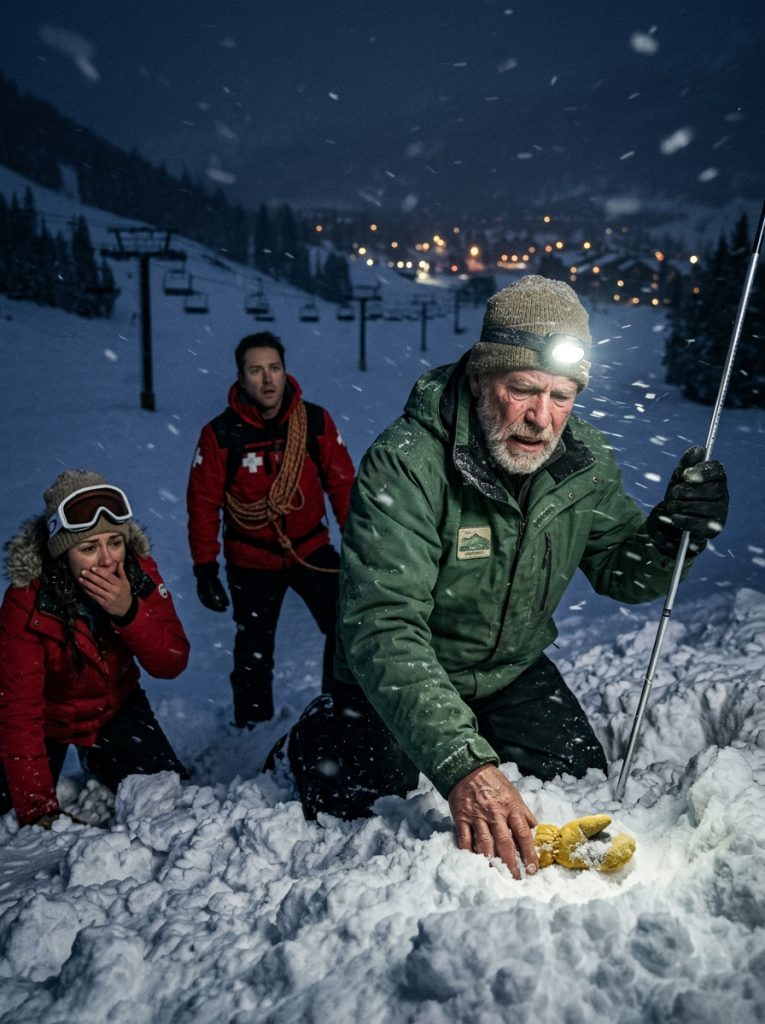
Walt dug like a man half his age.
I dropped beside him and dug too, both of us throwing snow with our bare hands, and the cold didn’t register, nothing registered except that splash of yellow getting bigger under our fingers.
“Slow,” Walt said suddenly, catching my wrist. “Slow now. If she’s in a pocket, we don’t want to collapse it on her. We go careful from here.”
I made myself slow down. It was the hardest thing I have ever done.
He cleared the snow from around the mitten like an archaeologist, scooping, packing the walls, talking the whole time in a low steady voice — not to me. To her.
“All right, sweetheart. We’re coming. You hold on. Walt’s coming.”
And then her hand. Then her arm in the teal sleeve. Then, in a hollow no bigger than a kitchen sink where the snow had banked against the tower base and frozen into a shell, my daughter’s face.
Gray. Lips blue. Eyes shut.
For one second the whole mountain stopped.
Then Posy coughed, and turned her head, and said in the smallest, most annoyed little voice, “It’s cold, Mommy.”
I have no words for the sound I made.
Walt already had his jacket off and around her. “Pocket of air against the tower,” he said, almost to himself, easing her free. “Knew it. The wind scours a void there every storm. Knew it.”
By then the headlamps had turned back around. Marcus and two patrollers came crashing across the debris, and what had been a recovery turned, in one heartbeat, into a rescue.
They had her in a thermal wrap and onto a sled in under two minutes. The dog handler radioed the clinic. Marcus kept saying my daughter’s name and a string of numbers, and I ran alongside the sled holding Posy’s one bare hand the whole way down, and Walt — Walt just stepped back into the dark and let them work.
She had hypothermia and a hairline fracture in her wrist. That was all. A girl pulled living out of an avalanche after the search was called, and “that was all.”
The clinic doctor told me later that the air pocket bought her the time. That without it, the cold math doesn’t work. That somebody knew exactly where that pocket would form.
So at two in the morning, while Posy slept under heated blankets with color back in her cheeks, I went looking for the lift operator.
I found him in the empty patrol room, drinking coffee he wasn’t really drinking, still in his snow-soaked clothes.
“You knew where she was,” I said. “You didn’t guess. You knew.”
Walt looked at his cup for a long moment.
“I used to forecast avalanches,” he said finally. “Twenty-six years. Bridger, Alta, a season in the Alps. I was good at it. Reading slopes is the only thing I was ever really good at.”
“Then why are you running a chairlift?”
He was quiet again. Then: “Because reading them right doesn’t always mean they listen. I called a slope once at a resort out west. Said close it, said don’t let anyone on it. The boss said I’d cost him a holiday weekend. Slope went. We lost a girl. Younger than yours.” He turned the cup in his hands. “After that I didn’t trust myself to make the call anymore. So I took a job where the worst thing I can do is stop the lift too early. Lower stakes. That was the idea.”
I sat down across from him because my legs wouldn’t hold me.
“Walt. That slope tonight. Did you know?”
And here is the part I will carry the rest of my life.
He reached into his jacket and took out a folded sheet of paper, soft and damp at the creases like he’d been carrying it for days.
It was a copy of an email. From Walt, to the resort operations manager. Dated nine days earlier.
It described the exact slope above the lift towers. Wind loading on a buried weak layer. A recommendation, underlined: close the upper traverse and run control work before the next storm cycle.
The reply, from management, was two lines. They thanked him for his “input.” They noted that he was “lift staff, not patrol,” and that terrain calls were “above his role.”
They never ran the control work. The slope let go on the first big storm, exactly where he said it would, exactly when.
“I knew where to dig,” Walt said quietly, “because I’d already drawn that slide in my head a week ago. I just prayed I was wrong.”
I didn’t sleep that night. I sat between my daughter’s hospital bed and a folded email, and by morning I knew I wasn’t going to let that piece of paper stay folded.
I gave it to the patrol director. Then, when the resort tried to call the whole thing a tragic act of nature, I gave it to a reporter.
The story moved fast, the way the truth does once it gets loose. A retired avalanche forecaster, demoted in everyone’s eyes to “just the lifty,” had warned management about the exact slope that buried four people — in writing, nine days early — and been told to stay in his lane. Then he’d ignored the call to abandon the search and pulled an eight-year-old out alive.
The resort’s first instinct was to manage it. Their second, once the email was public, was to grovel.
There was an investigation. The operations manager who wrote those two dismissive lines was gone within the month. The resort rewrote its avalanche protocol from the ground up, and the new policy had a name attached that the reporters loved: the Dolan Rule. Any staff member, any title, who reports a hazard in writing gets a documented review by patrol leadership. No more “above your role.” No more weak layers ignored because somebody had the wrong jacket.
Marcus Vance came and found Walt himself. I was there. The patrol director who’d called my daughter non-survivable stood in front of the lift operator he’d shouted at across the debris, and he took off his glove to shake Walt’s hand, and his voice broke when he said, “You were the only one still looking. I’ll never forget that. None of us will.”
They offered Walt a senior position. Snow safety consultant. Real authority, the kind he’d run from for years.
He turned it down at first. Said he’d lost his nerve for making the calls. Said he was happier on the lift.
It was Posy who changed his mind, in the way only a kid can.
She insisted on thanking him before we left the mountain. Marched up to this weathered old man in her wrist cast and her one yellow mitten and announced, very seriously, “You’re the best digger in the whole world. You should be in charge of all the snow.”
Walt crouched down to her level. “You think so, huh?”
“I know so,” she said. “I was there.”
He laughed — a real one, the kind that surprises a person — and something in his face let go.
He took the job.
Posy is fine. She tells the story constantly, and in her version she helped dig, which I allow, because she earned a little embellishment by surviving. She kept the yellow mitten. The other one’s still up there somewhere on that mountain, and she likes that. “So part of me lives at the resort,” she says.
We go back every winter now. First thing we do, every single time, is find Walt.
He’s easy to find. He’s the man at the top of the lift in the green jacket, the one the young patrollers now go quiet and listen to, reading the slopes like the only thing he was ever really good at.
He scans Posy’s pass, every year, like it’s the most important job on the mountain.
And every year he tells her the same thing, soft, just for the two of them: “Glad you held on, kid.”
She always answers the same way.
“Glad you kept looking.”