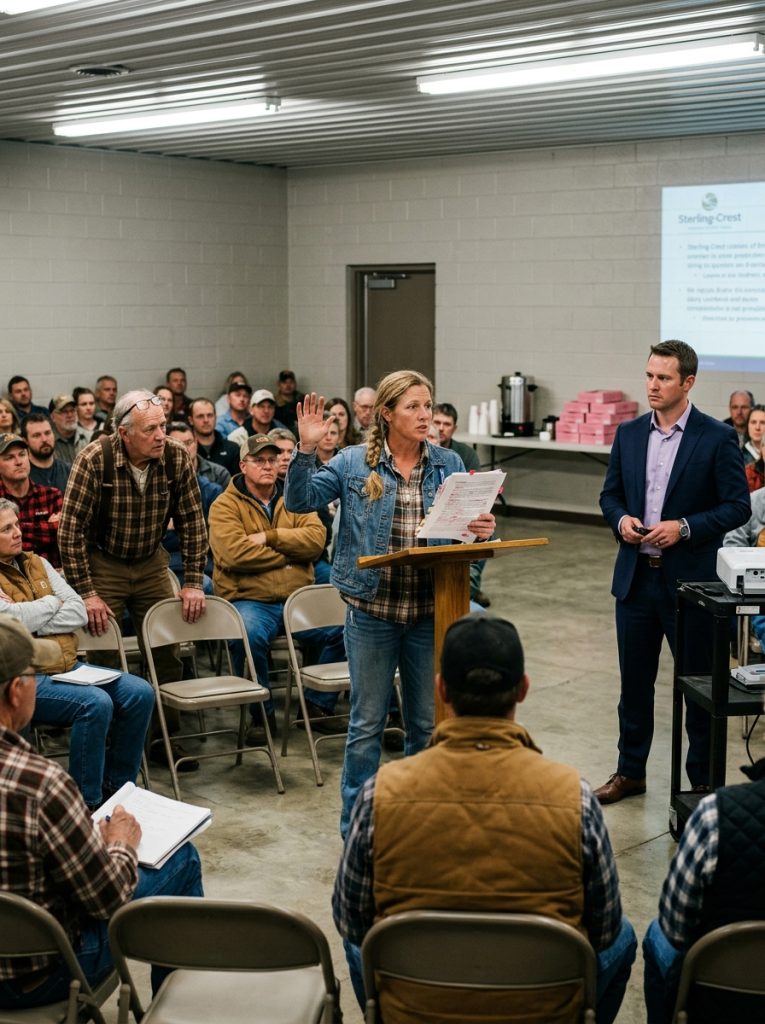
Pete walked to the front of the room with the slow steady gait of a man who has not been in any hurry since 1989.
He took off his half-frame reading glasses. He cleaned them with the tail of his thermal henley. He put them back on.
He said, “Folks. I’m Peter Inman. Thirty-one years at the law school over in Madison, ag-law department. Retired three years ago. Junie’s father and I were roommates. He was the smarter one.”
A few of the older farmers laughed.
“I read the contract on Junie’s coffee table on Sunday afternoon. Twice. I’m going to confirm what she just read out to you in plain English, in plain English. Clause 3(a) is a non-compete that survives the contract by ten years. Clause 7(c) is a unilateral price re-rate. Clause 11(d) reclassifies your hands. Clause 14(a) is a buyback at a dollar.”
He looked at Whit Maddox.
“Mr. Maddox. I do not need to ask you whether you have explained any of these clauses in plain English to anyone in this room before this evening, because I already know the answer.”
Maddox started to speak.
Pete held up one weathered hand.
“I’m not finished, son. Sit down.”
Maddox sat.
Pete said, “Folks. I’m not going to tell you whether to sign. I’m not your lawyer. I am going to tell you that the version of this deal that has been pitched to you tonight is not the version that is in the binder in your lap. If you sign this contract, you are not a partner. You are a supplier on a leash. If your kids want to milk in this part of Wisconsin in 2036, they will have to ask Sterling-Crest’s permission. That is what 3(a) does. I cannot tell you whether twenty-two million is worth that. I can tell you that no farmer in this room has ever signed a contract this aggressive in fifty years of records I have read for the state of Wisconsin.”
He took his glasses back off.
He said, “That’s all I came up here to say. Junie. The floor’s yours.”
He sat down.
The room sat in silence for a moment that felt longer than it was.
Then Marisol Ortiz, who has not raised her hand at a co-op meeting in nine years, raised her hand from the second row.
The chair, an old beet-faced dairyman named Stan Kowalik, said, “Marisol.”
She stood up.
She said, “I have worked in the Halverson barn since 1992. My father has worked in the Halverson barn since the year I was born. My son is in his second year at UW–River Falls. My daughter is at the local technical college learning to weld. We do not have a non-compete in our family because the dairy industry in this country has been generous enough not to write one over us. I do not know who reads me as a contractor and not as an employee in clause 11(d), but if any farm here signs that clause, I will take my family up to the Mears operation in Black Earth and I will not be alone. There are eighteen of us in this co-op who do this work, and most of us are in the lobby tonight. I just polled them. None of them are coming with you, Mr. Maddox. None of us. Not one.”
Marisol sat down.
Tom Veldkamp, whose son’s name Junie had said out loud, stood up next.
He said, “I want to know who in this room thinks I am going to sit at my Christmas table and tell my boy he cannot milk in his own state because I signed a piece of paper for a check.”
Stan Kowalik banged his pen on the lectern.
He said, “Folks. I am going to call a vote. Not on the deal. On whether to walk away from the deal as currently presented and direct the executive committee to find another path. All in favor.”
The hands went up like wheat.
Stan counted twice.
He said, “Thirty-one in favor.”
He said, “Opposed.”
Four hands. All four of them belonged to the four members who had been hardest hit by the spring price slump and were the most afraid.
I love those four men. I have known them my whole life. I do not blame them.
Stan said, “Motion carries thirty-one to four. Mr. Maddox. We thank you for your time. The co-op will be in touch about returning your bagels.”
He banged the pen one more time.
The room exhaled.
Maddox stood up. He attempted, briefly, a final version of the smile he had walked in with. He picked up his projector remote. He picked up his binder. He shook three hands on the way to the door — the men he had identified, correctly, as the most exposed — and he left.
He has not, to my knowledge, set foot in Dane County since.
Two weeks later the chair appointed me to a four-person task force to find an alternative regional distribution partner.
We worked through November.
In early December we signed a deal with Driftless Foods, a Madison-based grocery chain that runs forty-two stores across southern Wisconsin and northern Illinois. The deal pays less per hundredweight than Sterling-Crest had promised. It pays it directly to the member farms. There is no non-compete. There is no labor reclassification. There is no buy-back at a dollar.
The deal also funds a small endowment for any member’s child who wants to pursue a dairy-science or sustainable-agriculture degree at any UW System school. Pete drafted the endowment language himself, on a yellow legal pad, on his porch, with a coffee, in October.
He charged us nothing.
We made him an honorary member of the co-op anyway.
The co-op held its annual election on January 14. The chair stayed Stan. The vice-chair seat opened. Marisol Ortiz nominated me.
I tried to say no.
She said, “Junie. Don’t insult me.”
I won by acclamation.
The first thing I did as vice-chair was put a clause in our co-op’s standing bylaws that any member-facing contract over five million dollars now requires a mandatory thirty-day plain-English review by an independent counsel of the executive committee’s choosing, paid for out of the co-op’s general fund, before any vote.
We are calling it the Inman clause.
Pete, when I told him, made me write down on the back of a placemat at a diner in Mount Horeb that the clause is in fact the Halverson clause, and that he did not name it, and that I am not allowed to call it the Inman clause in any printed material on the co-op’s letterhead.
I am writing it as the Inman clause anyway.
The Halversons have always been stubborn. Pete will get over it.
My father’s union ballpoint pen sits in a small cup on my desk in the office above the milking parlor. I clip it to the front of every contract I read.
I have not had to read another twenty-two-million-dollar offer since.
I do not think I will, for a while. The dairy industry has a memory. Sterling-Crest’s offer collapsed in three other counties between November and February for reasons I am told, by a friend at a different co-op down in Lafayette, “had something to do with a video that ended up at the Wisconsin State Grange.”
I have not seen the video.
I do not need to.
The bagels at the next co-op meeting were homemade. Marisol’s mother brought them. Stan announced, very seriously, before the call-to-order, that the executive committee had authorized a rotating bagel duty roster.
I baked the next round.
They came out flat.
Pete laughed at me for an hour.
Advertisement
The barn lights still come on at 4:14 a.m. The herd still walks itself in the way it has walked itself in for forty-six years. My father’s old union ballpoint still clicks on the contract clipped to my clipboard every Sunday afternoon.
The dairy is still a Halverson dairy.
The kids in this room are still going to be allowed to milk in this state.
That is all I came to that fire-hall to do.
I drove home from the meeting at ten p.m. with the heater running and the windshield wipers off and the smell of October in the cab of my truck.
I clipped the marked-up contract to the visor.
I patted my dad’s pen with my thumb.
I said, out loud, the way I sometimes still talk to him on the back roads outside Stoughton, “We did it, Pop.”
The truck did not answer.
It did not need to.