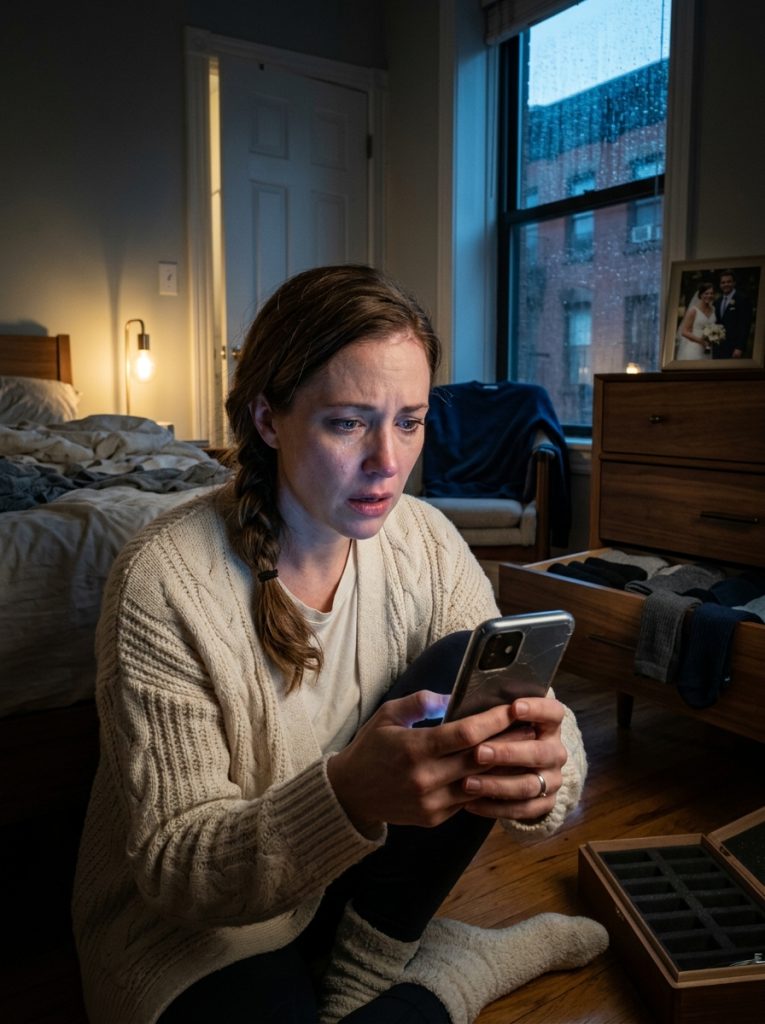
I did not turn off the phone.
I did not put it back in the drawer.
I did the only thing my body remembered how to do without my brain having to be in the room. I unlocked the bathroom across the hall, walked in, locked the door behind me, sat on the cold tile, and called the only number that had been keying my chest for an hour.
ICE — Sister, Roo.
She picked up on the half-ring.
She did not say hello.
She said, “Adele.”
The way you say the name of a person you have been waiting to hear from for nine months and are afraid to scare away.
I said, “Roo. I — I’m sorry. I don’t remember you. I’m sorry.”
She said, “Honey. Honey. You don’t have to be sorry. Are you safe right now?”
I said, “I don’t know.”
She said, “Okay. I am going to ask you three questions. You’re going to answer them yes or no. Are you in the brownstone in Park Slope?”
“Yes.”
“Is Conrad in the house?”
“Yes.”
“Are you on his side of the bed or yours?”
I had to think.
“His.”
“Okay. Listen carefully. I am twenty minutes away. I have been twenty minutes away since the day they discharged you. I want you to lock the bathroom door, run the shower, and sit on the floor. Don’t speak loudly. I’m putting you on speaker. I’m calling someone else on the other line. I’ll be on the front stoop in eighteen minutes. Do not buzz me up. Do not open the door. I have a key.”
I said, “Okay.”
She said, “Adele. Honey. The phone is real. The kitchen in the picture is real. The little girl is real. I am real. Your name is Halloran. Hold on.”
I sat on the bathroom tile with the shower running and an unlocked phone in my lap that had pictures on it of a child I did not remember calling me Mom.
Roo arrived.
She let herself into a brownstone Conrad had given her no key to, with a key Conrad did not know she had, because she had had it since 2017 from the actual address it went to, which is to say, a different brownstone, a different bedroom, a different husband I do not remember.
I will spare you the next two hours because I cannot tell them in order yet. I can only tell you what I learned over the next ten days from a domestic-violence attorney named Imani Soto, the rehab clinic’s social worker Patrice Goff, and a sister named Maureen Halloran who would not let go of my hand at any time we were in the same room.
My name is Adelaide Halloran.
I was born in Burlington, Vermont.
I was married, at twenty-six, to a man named Cole Halloran, an emergency-room nurse who died of a brainstem aneurysm in 2018 when our daughter Jules was seven months old.
I raised Jules on my own for five years. I worked as a botanical illustrator. I owned a farmhouse outside Stowe.
I met Conrad Gentry in late 2023 at a gallery in New York. He pursued me. He moved in. He moved Jules and me to Brooklyn last summer “for her schools.” I had been against the move. I had let him push.
A week before my “stair fall” in October, I had filed for separation on the advice of my sister, who had spent the year watching Conrad rewrite my budget, my friends, my schedule, and my bedtime. I had not yet served him. I had been waiting for the weekend, when Jules would be at Roo’s.
I had fallen down the brownstone’s interior staircase on a Friday afternoon.
I had been told, after I woke up, that I had been alone in the house at the time.
I had not been alone in the house at the time.
The investigators have not yet finished their work and I am not the prosecutor, so I will only say this: there is a security camera at a neighbor’s stoop across the street that recorded a 4:18 p.m. interaction at our front door on the day in question. A man matching Conrad’s description is visible entering the house. He is visible exiting the house at 4:31 with a phone in his hand. The 911 call from “an unknown male voice reporting a fall” was placed at 4:46 from a different phone entirely, from a sidewalk three blocks away.
That is what I am allowed to say.
Roo had been calling the rehab daily for eight months. She had been blocked, on every device I had access to, as my “ex-stepsister with mental-health issues who upsets the patient.” Patrice Goff had grown suspicious in month four when a colleague had quietly pulled my pre-injury file and noticed the original “next of kin” had not been Conrad at all. Patrice had been working the angle. She had been waiting until I was discharged. She had been waiting because, in her experience, the closer you press to a man like Conrad before discharge, the worse the discharge.
The night Roo came up the stoop, Patrice was on her other line.
The morning after, Patrice and Imani Soto and the precinct’s domestic-violence detective were in the kitchen of my own apartment in Park Slope at 9:14 a.m. taking down the parts of the story I could remember and the parts they had already verified.
Imani filed the protective order at noon.
Imani filed the petition to vacate the marriage at three.
Conrad had married me, it turned out, in a county courthouse in upstate New York while I was in a coma in October. He had used a power of attorney that had been notarized by a friend of his at a barbecue six months before the fall. The notary had been investigated. The marriage was annulled in March on the basis of fraud and incapacity.
I never have to call myself Adele Gentry again.
The Vermont farmhouse was in my name. He had been making mortgage payments, which he had then attempted to file as evidence of “marital contribution” to a property in any future settlement. The court did not buy that. The deed was clean. Imani filed a quitclaim. The house is mine.
Jules is mine.
Jules had been with my mother in Burlington for the last eight months because the family-court judge in October had granted Conrad’s emergency motion for “stable maternal care.” Imani filed a motion to terminate that arrangement on October 11. Custody was restored on November 4.
I drove with Roo up to my mother’s house on a Saturday in November.
I had been working, with a cognitive therapist, on a memory book of Jules. Photographs labeled with names. A timeline of her firsts. A page about her father.
I had been working, with the same therapist, on the day-by-day choice that re-meeting a six-year-old you do not remember would make on her, not on me.
I sat on the porch of my mother’s house. My mother held my hand. Roo stood at the bottom of the steps with her arms crossed and a look on her face I will never describe in public.
The door opened.
A small girl with soft brown curls in a yellow sundress stood in the doorway with a wooden spoon in her hand.
She did not run to me.
She looked at her grandmother. She looked at me. She walked down the porch steps, very deliberately, holding the wooden spoon, and she stopped in front of me, and she said, “Mama. Grandma made banana bread. I helped.”
I sat down on the bottom step.
She climbed onto my lap.
She handed me the wooden spoon.
She said, “I saved you the bowl.”
The fraud and coercive-control charges against Conrad are pending. There will be a trial. I will testify. I am told, by Imani, that the case is strong. Conrad has retained counsel and is, currently, telling a different story to the press than he is telling to his own lawyer.
I am thirty-eight years old. I have a brain that does not fully remember being twenty-six, or thirty, or thirty-five. I have a daughter who, mercifully, only remembers the months she had with me before the fall and the months she has had with my mother since. The years Conrad lived in our farmhouse, she remembers as a tall kind man who is no longer in the kitchen.
Advertisement
She has not asked about him.
I am told, by the cognitive therapist, that some memories may come back this year and some may not.
I have decided I do not need them to.
I have a phone now that I unlocked with my own thumb. It is on a new account. It is my number. It has the photographs Roo has been quietly archiving for me for eight months. It has Jules’s school-pickup line and my mother’s house phone and the contact for Imani Soto and the contact for Patrice Goff and a folder labeled “Jules — Year Seven” that I am building, photo by photo, in real time.
I am sleeping in the bedroom at the back of my mother’s house in Burlington. The window looks out at a sugar maple. The maple has started to drop its leaves.
I am no one’s Addy Gentry.
I am Jules’s mama.
I held the wooden spoon up to the morning light on the porch step and looked at the small bite marks in the curve of it where my daughter had been chewing on the handle.
I have not let go of it since.