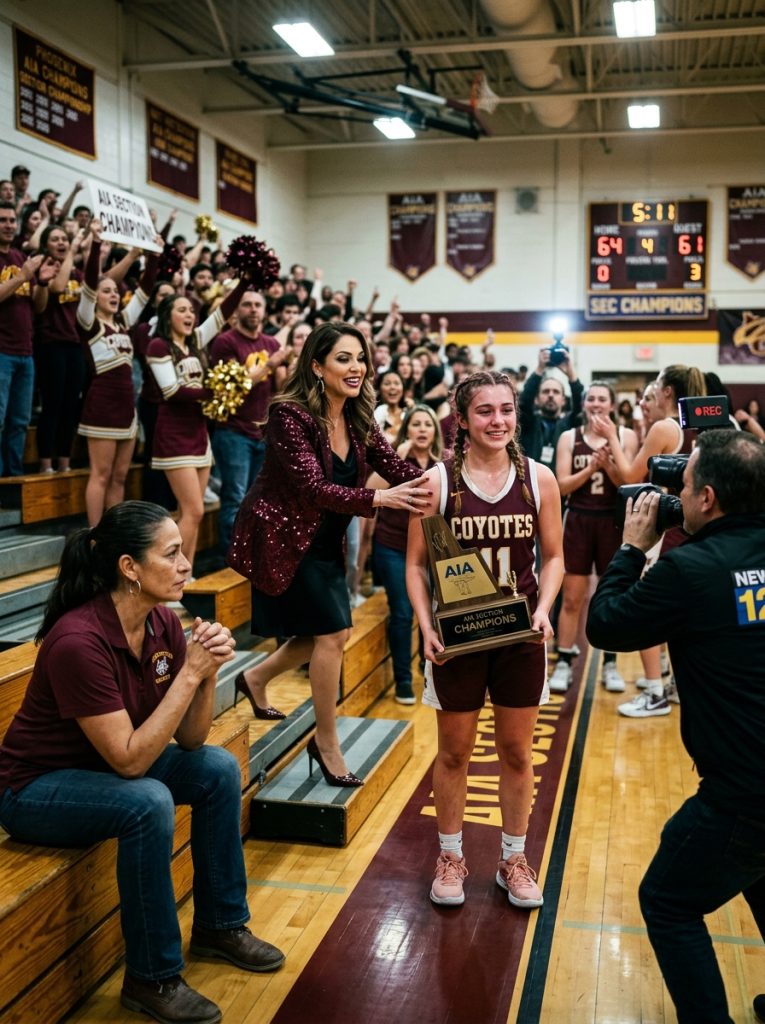
I do not remember standing up.
I remember Selena’s hand. I remember the calluses on her palm from the leather of a basketball. I remember the weight of her arm pulling me down out of the bleachers and onto the polished maple of a gym I have walked into for thirteen Friday nights a year.
The cameraman did not know what to do.
The principal did not know what to do.
Coach DeLeón did. She put two fingers in her mouth and whistled the way she whistles to start a fast break, and every member of that varsity team — fourteen girls in sweat-stained home whites — formed a circle around me and Selena and the gold trophy on the center line of the court.
The cameraman reframed.
The principal reframed.
The whole gym reframed.
Yolanda Vega stood alone halfway down the bleacher steps in stiletto heels and a wine-red blazer, with her smile freezing one degree at a time. She looked at her younger sister on the floor of an Arizona high-school gym in a faded team-mom polo with the coyote-head logo on it, and she did the thing she has always done when the spotlight does not move with her.
She started toward the camera.
Coach DeLeón stepped between Yolanda and the lens.
She did not raise her voice.
She said, “Ma’am. We are taking a team photo. I’m going to ask you to step back to the bleachers. We’ve got family up front.”
Yolanda looked past her at the principal.
The principal, to his credit, said, “Ma’am, please.”
She turned. She walked back up the bleacher steps. She did not sit down.
The flash went off.
I could not have told you what I did with my face. I could not have told you what my face was doing. I am told, by the assistant principal’s husband who saw the photo on the school’s social account that night, that I look “exactly like a woman who has been holding her breath for a decade.”
The team posted the photo as the official championship shot.
Selena dictated the caption.
It said: “Section champs. Tía. The whole reason. — #11.”
A local news affiliate picked it up the next morning.
By Saturday afternoon Yolanda’s TikTok had a five-minute video on it where she stood in her glittering blazer in a different gym in front of a different banner and explained, with rehearsed pauses, that her daughter had had a “moment” at the championship and that the woman in the photo was her younger sister, who had “stepped in to help raise” Selena while Yolanda had been “navigating personal challenges.”
The video had eighty thousand views by sundown.
I did not respond to it.
Selena did.
Selena wrote a letter that night. She typed it on the family laptop at our kitchen table. I sat across from her in the same maroon polo and watched her type, because I was not going to interfere and I was not going to leave her alone for it, either.
She read it out loud to me before she posted it.
She said, “Tía, tell me if any of this is wrong.”
I said, “Mija, you do not need my permission to tell the truth.”
She read.
The letter said: “My name is Selena Vega. I am seventeen. I am a senior point guard at Coyote High School. I won my section championship last Friday and I gave the trophy photo to my Tía because my Tía is the parent who showed up.
“I am writing this because my mother — my biological mother — Yolanda Vega, has spent the weekend telling people she ‘helped raise’ me and that my Tía ‘stepped in.’ I am writing to tell you that the version of those words that is true is not the version she is using.
“My Tía Marisol Vega did not step in. She raised me. She has been my parent since I was four years old. I have lived under her roof in Phoenix. I have eaten her food. I have worn the shoes she could not afford. She has driven me to thirteen years of basketball games in a 2003 Ford Ranger that has needed a new starter for nine of those years.
“My biological mother sent me a Christmas card every year that I lived with my Tía. Most years she also asked for money. The last time she saw me in person before Friday night was three years ago, at a quinceañera that did not belong to me, where she took two photographs and left after twenty minutes.
“I am not making this letter to humiliate her. I am making this letter to ask her, publicly, to stop putting my Tía’s life in her caption. My Tía does not need credit. I am giving her this credit because she will not take it for herself. Please respect both of them.
“My birthday is in six weeks. I will spend it the way I have spent it for thirteen years. With my Tía. Eating empanadas she will undercook because the oven runs hot. We will not be posting any pictures.”
She signed it.
She read it back to me a second time.
I cried at the empanadas line because the empanadas line was true and because she had written it with the precise comic affection of a kid who has eaten my undercooked food her whole life.
Selena posted the letter at 9:47 p.m. on a Saturday night.
By Sunday morning the school’s social account had reshared it. By Sunday afternoon two of Yolanda’s friends had quietly unfollowed her. By Monday her TikTok video was set to private.
She has not posted about Selena since.
That is the public part.
The private part is harder.
The Tuesday after the championship Yolanda showed up at our front door at 7:30 in the evening. She had taken off the wine-red blazer. She was in jeans and a denim jacket and the same makeup she had been wearing since the eighties.
She had been crying.
I let her in. I made her coffee. Selena was at practice. I knew it; Yolanda had timed it.
She sat at the kitchen table for forty minutes. She talked about herself. She talked about her own mother. She talked about the casino in Laughlin and the man she had been with for two years and the lupus diagnosis she had received in August and had not told anyone about because she did not “do well with sympathy.”
She did not apologize.
She came close. She got within three sentences of it. She did not cross.
I let her not cross.
I poured her another cup of coffee.
I said, “Yolanda. I am not going to ask you for anything. I am going to ask Selena what she wants. If she wants you back in her life, you and I will sit at this table again and figure it out. If she does not, you will respect that. Either way, the photo from Friday belongs to her. Not to either of us.”
She nodded.
She left.
I sat at the table by myself for a long time after the door closed. Pepper, the orange tabby my niece adopted from a shelter when she was twelve, jumped up on the chair across from me. He looked at me the way Pepper looks at me.
I looked at him.
I said, out loud, to a cat, the thing I had not let myself say to a sister: “I did this on purpose. I am not bitter. I am just tired.”
Pepper blinked.
Advertisement
Selena came home an hour later.
She walked in. She set her gym bag by the door. She said, “Was she here?”
I said, “Yes, mija.”
She nodded.
She sat down at the table in the seat Yolanda had been in, and she pulled the cup Yolanda had been drinking from across the table, and she said, “Tía. What do you need.”
I said, “Mija, I do not need anything.”
She said, “Okay. What do I need.”
She did not look at me when she said it. She looked at the empty cup.
She said, “I think I need her to mean it. And until she means it, I think I need you. Like I have always needed you. Without anybody else in the photo.”
I said, “Okay, mija.”
She said, “Empanadas?”
I said, “Yes, mija.”
I undercooked them. They were perfect.
The gold championship trophy is on the mantel in our living room. Selena’s name is on the plate. The team photo from Friday night is in a frame on the side cabinet — fourteen girls in sweat-stained home whites, a coach with two fingers in her mouth on the edge of the frame, a niece holding a trophy, and an aunt in a maroon polo with weathered hands clasped, finally, on the floor of the gym she has walked into for thirteen Fridays a year.
I am looking at it right now.
She is wearing the right number.
So am I.