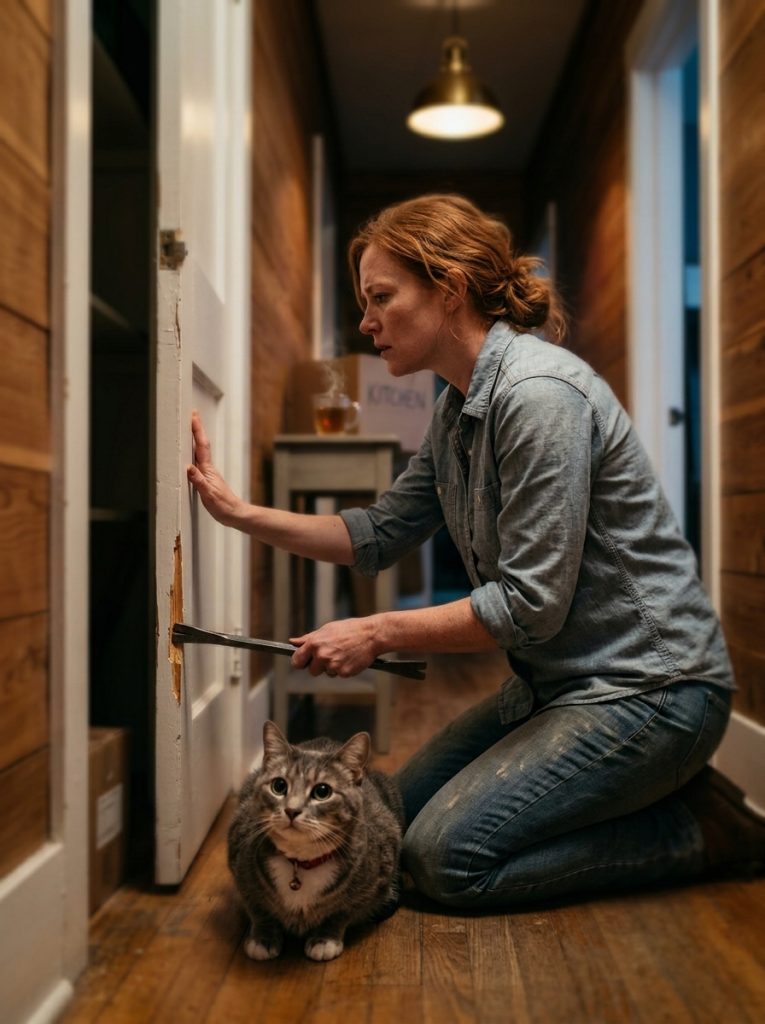
The last page of Marian Whitcomb’s letter was a wish.
The wish was: please find my daughter and tell her her mother was not crazy. Please tell her I knew Olive came back. Please tell her I forgave the man who took her, because he was tired and afraid, and because forgiveness was the last thing I had to give. Please tell her the cat will know, and the cat will be okay, because the cat already came home once.
I sat with that for a long time.
It was 1:17 a.m. and the rain on the roof had eased and a gray-and-cream tabby was asleep on a notarized letter on my kitchen floor.
I made coffee. I did not drink it.
I drove to the public library at 8:30 the next morning. I am an archivist. The library is where I think.
By eleven I had Marian Whitcomb’s obituary up on a screen. She had died on April 12, three weeks before my move-in. Hospice in the rental in the North End. She was survived by a daughter, Lainey Whitcomb-Reyes, of Spokane, Washington.
She was preceded in death by a husband, Roy.
There was no son-in-law named in the obituary.
I sat with that for another minute.
Then I went into the local-news archive and searched Roy and Marian Whitcomb. There was a small wedding announcement from 1974. There was a 2002 piece about Roy’s promotion at the railroad. There was a 2018 obituary for Roy.
The man Marian had spent her last eight months with, the man who had told her Olive was on a farm — was not Roy. Roy had been gone for years. Lainey’s husband was a different man. His name, in a recent Spokane charity photograph, was Ben Reyes.
I did not call Lainey from the library.
I went home. I made an actual lunch. I put on actual lipstick. I sat at my kitchen table at 2:30 in the afternoon and I dialed.
A woman answered on the second ring.
“Hello?”
“Mrs. Whitcomb-Reyes? My name is Renata Doyle. I — I think I’m renting the house your mother passed in. The one in the North End in Boise.”
There was a long silence.
She said, “Oh.”
I told her.
I told her I had moved in a week ago. I told her about Olive. I told her about the closet. I told her about the cabinet pry bar and the cardboard box and the photograph and the letter.
I read her the last page.
She started crying somewhere in the middle.
She did not stop until she had read the whole thing back to me, slowly, with her own breath in it.
She said, “Renny. Renny, I have to tell you something.”
She said her husband Ben had been the one taking care of her mother. That he had loved Marian. That he had grieved her hard. That when Marian had moved in for hospice, an old gray cat had appeared on the back porch on the second night and Ben had said, very quietly, in the kitchen, “Babe. We never sent her to a farm. I’m sorry. I’m sorry. I gave her to my brother in Pocatello and his wife couldn’t keep her and your mom kept asking and I — I didn’t know how to take it back.”
Lainey said, “I made him tell my mother.”
She said, “He stood at the foot of her bed in tears and apologized for thirty years of one lie. And my mother said, ‘Benny, you stupid, stupid man, hand me my cat.’ And he did. And she had Olive on her lap for the rest of that month.”
She said, “She knew, Renny. She knew. She had her cat. That part of the letter — the part where she says please tell her I knew Olive came back — she wrote that for me, didn’t she. So I’d hear it from a stranger. So I’d believe it.”
I said, “Yes, ma’am. I think she did.”
I asked her if she could come down. I asked her if she wanted Olive.
She was quiet for a long time.
She said, “I am very allergic, Renny. I have been very allergic my whole life. My mother always took the cat at family gatherings. I — I cannot keep her. I cannot.”
She started to cry again.
She said, “But I would like to come and meet her. If you’ll let me.”
I said, “Ma’am, I’ll wait.”
Lainey drove from Spokane on a Saturday two weeks later. She brought her husband Ben.
I made coffee in the kitchen of the house where Lainey’s mother had died. I left the front door cracked so they would know to come straight in.
Lainey walked through the rooms of her mother’s hospice house in silence.
She stopped at the closet.
She put her hand on the splintered jamb.
She did not cry that time.
She turned to Ben and she said, “You did the right thing in the end. I have not always told you that. I am telling you now.”
He nodded the way men nod when their face is about to do a thing they do not want it to do.
We sat in the kitchen for three hours. Olive sat on Lainey’s lap for two of them. Lainey sneezed every six minutes.
Ben said, almost in passing, “Marian wanted to leave Olive with the next tenant. The friend who came to clean the house — Mavis — Mavis told us she’d put a box in the closet for whoever came in. She said she didn’t trust the new tenant to keep her unless they understood. So she nailed the box up and shut the closet and we — we let her. We thought you could throw the box away if you didn’t want it.”
I said, “Olive made sure I didn’t.”
He laughed in a wet, sad way.
He said, “She would. She is her mother’s cat.”
When they left, Lainey sat in the passenger seat of their car for a minute before Ben backed it out of the drive. She rolled the window down. She said, “Renny. Send me a picture of her every month.”
I said, “Yes, ma’am.”
I have. I have sent eleven so far. Olive on the back porch in the morning sun. Olive on a stack of library books. Olive asleep on the letter, folded back into its envelope, in the cigar tin where I keep it now. Olive sitting on the windowsill at night looking out at the street.
Lainey writes back almost every month. The notes are short. She tells me what flowers her mother used to grow. She asks how Olive does in the rain. She tells me that on her last visit, Marian had asked, half-asleep, whether the cat ate the same brand. Lainey had said yes. Marian had said, “Good. Don’t ever change it. It’s the only thing she trusts about me.”
I have not changed it.
She also told me, in her fourth letter, that her mother had quietly asked Mavis to leave the box “where someone with a steady hand would find it.” Mavis had picked the closet because it had the only door in the house that locked.
I had bought a three-dollar pry bar. I had been steady-enough.
The cat will know, and the cat will be okay, because the cat already came home once.
Marian was right about that.
She was right about almost everything.
She was wrong about one thing.
Advertisement
She was wrong that the next tenant would need to be told her mother was not crazy. The next tenant heard it from a cat at a closet door at one in the morning, in a house full of cedar and rain and grief, and the tenant believed it before the letter was even read.
The bittersweet part is the part I have to say plainly so I do not start telling myself a tidier version.
Marian Whitcomb did not get to know that her cat would have a third home. Marian died before I ever rented this house. The pictures I send Lainey are pictures Marian will never see.
I keep the worn red collar from the box on my dresser, next to a small framed copy of the Polaroid of an eighty-two-year-old woman in a lavender housecoat on a porch swing in some kinder year, holding a cat she had been told was on a farm.
I will keep both of them as long as I am here.
Olive sleeps at the foot of my bed every night now.
She does not cry at the closet anymore.
The closet door is open all the time.