I made myself walk over to him before I lost the nerve.
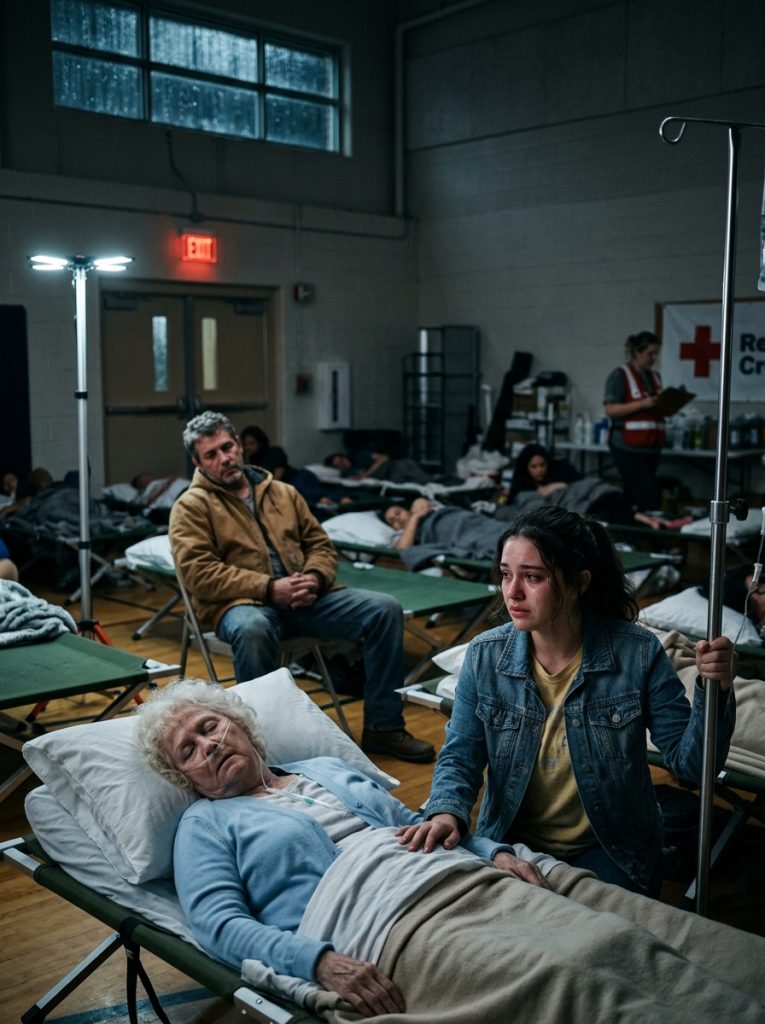
The community center was still half-set-up. Volunteers were unfolding cots in long rows along the gym wall. The Coastal Bend evacuation had been called only six hours earlier, and the wind outside was already starting to test the windows.
He had set his folding chair down by the double doors before any of us asked him to.
He saw me coming and straightened.
“Where do you need me, ma’am?” he said again.
I have learned how to keep my face professional. I do it every day. I did not do it that morning.
“I know you,” I said.
He smiled, polite, careful. “I don’t think we’ve met.”
“No, sir. We haven’t, exactly. You took my mother’s cot in 1999. Pasadena school gym. Hurricane Iris.”
His face did the slow careful thing of a man who has lived long enough to know not to claim anything. He looked at me for a long moment, the way you look at a face you are trying to remember through twenty years of weather.
He said, “Was your mother on a tank? Light blue cardigan?”
I did not have words for a second.
“Yes, sir.”
“That was a bad night,” he said.
He shook his head. He looked down at his hands, the same weather-burned hands that had steadied an IV pole for me when I was eighteen years old.
“I’m Cami,” I said. “I’m the social worker here today.”
“Marcus,” he said. “Marcus Beaumont.”
I had spent twenty years guessing at that name. I had ledgered checks “for the man in the folding chair” against six versions of it. Roofing accent. Beauchamp. Beaumonde. Beaumont.
He saw my face go.
He said, gently, “You okay, hon?”
I am forty-eight years old. I have run this work for a decade. I have walked families through three category-fours and an ICU and a county morgue. I had to sit down on a stack of folded blankets in front of him.
“My mother died nine years ago,” I said. “She kept your cot tag in her bedside drawer until the end.”
Marcus took his cap off and held it in both hands.
He said, “Aw, sweetheart.”
A volunteer came by with a clipboard and asked where to put the next pallet of water. I waved them past. Marcus pointed without looking. “Against the back wall, son. Off the floor.”
He had been a hurricane volunteer for forty-five years.
I learned that in pieces over the next hour, the way you learn anything from a man who does not like to talk about himself.
He had been a roofer. Forty years on commercial flat-roof crews up and down the Gulf. Galveston, Houston, Beaumont, Lake Charles, Mobile. The kind of work that puts a man on a tar bucket at four in the morning in August and on a ridge cap in February with a frozen nail gun.
He had retired in 2012.
He had not stopped going to shelters.
His wife had been a Red Cross volunteer in the seventies. She had died of pancreatic cancer in 1996. He had buried her on a Tuesday and shown up at a Beaumont shelter on a Friday because Hurricane Bertha was coming up the coast and “she would have wanted somebody from her side of the bed there.”
He had not missed a named storm since.
I did not know any of that when I was eighteen.
I asked him, at some point, when I could trust my voice, “Why didn’t you ever sign in that night?”
He shrugged. “I’d been on a roof in Texas City for sixteen hours. I drove east when the call came in. I didn’t know if I was a guest or a worker. By the time I’d figured it out, your mom was asleep.”
“You missed your cot for a stranger.”
“Hon, that wasn’t a cot. That was a chair.”
The next thing I want to tell you happened over the course of the night. The shelter filled. The wind came up. Volunteers worked. Marcus took the position by the doors he had taken twenty years ago without anybody asking him to. He steadied two more IV poles for two more strangers. He rocked a baby for ten minutes so a young mother could sleep. He moved like a man who had been doing this since before any of us were born.
At three a.m., between intake waves, I sat down next to him and told him about the foundation.
I told him my mother had kept his missing top button in a small ceramic dish on her dresser for twenty years. I told him it was sitting on my dresser now. I told him I had not known what to do with it except keep it.
I told him there was a small foundation registered under the name “The Folding Chair.” That every spring, before hurricane season, we bought folding cots for shelters along the Coastal Bend. That every check I had signed for twenty years had had a tiny pencil note in the memo line: for the man in the folding chair.
Marcus looked at me for a long time.
He said, “How many cots.”
I said, “Last year, three thousand four hundred.”
He sat with that.
He said, very quietly, “I built houses for forty years and the only thing I ever did that mattered was a chair.”
I said, “Sir. You’re wrong about that. But the chair did matter.”
He put his cap back on. He stood up. He went and steadied another IV pole for a man with COPD whose wife had brought him in on a walker.
That is the part of him I will keep.
In the morning the storm dropped a tree on the access road. We were stuck at the community center for another twelve hours. By the time the road cleared, Marcus had named every volunteer in the building and could tell you which family on which row was on which medication.
He stayed through breakfast. He folded his blanket the way he had folded it twenty years ago, set it on the seat of his folding chair, and shook my hand.
He said, “I’d like to help with the cots, if you’ll have me.”
I drove him into Corpus Christi the following Saturday. I introduced him to my board.
He had never been thanked, formally, by anyone, in forty-five years of volunteer work.
We sat him at the head of the table and let four people who had once been kids in his shelters say what they had been waiting their whole lives to say. One was a county judge now. One was a flight nurse. One ran a small ranch outside Beeville. One was me.
Marcus cried exactly once. Not at the praise. At the youngest one, the flight nurse, when she said her grandmother had passed two years before and had told her, every Christmas of her childhood, “There was a man in a coat at the shelter, baby. I never got his name. You make sure to be that man for somebody.”
He nodded the way he nods at IV poles.
He said, “Yes ma’am.”
He came on as a senior advisor. We renamed the program. The cots in our supply rooms now have a tag stitched into the canvas: “Folding Chair Foundation. Take care of each other.”
Marcus is seventy-three. His hands are slower. His eyes are not. Last spring he taught a Red Cross volunteer training in Galveston and made forty-two new people promise to choose the chair when the cot would do better for somebody else.
Advertisement
He still does not call himself a hero. He still calls it “a chair.” He still folds his blanket on the seat the way a man folds a coat at a job he has finished.
I have his missing top button in a small ceramic dish on my dresser.
I do not need it anymore. I know exactly where the man it came from is, every storm.
The night Hurricane Iris swallowed Galveston, my mother and I were the last two people through the doors of a Pasadena school gym, and the cots were already gone.
A stranger took the chair.
Twenty years later, I learned his name.
He had been there the whole time.