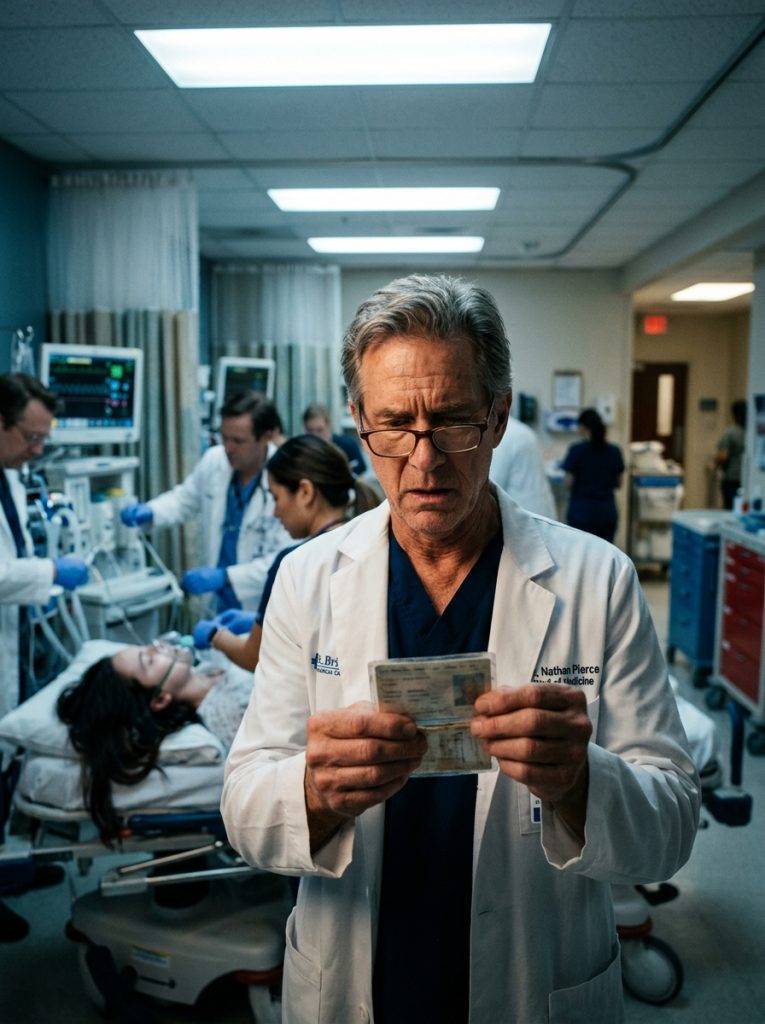
“Doctor. Her pressure.”
The nurse’s voice pulled me back into my own hands.
Here is the thing about being good in a crisis: it doesn’t ask your permission. I put the card down on the tray. I became, for the next forty minutes, only a physician, because the woman on that table was dying and her name and her secrets could wait but her heart could not.
Sustained arrhythmia. A collapse in a parking lot, a heart that had forgotten its own rhythm. We shocked her. We pushed the drugs. I ran the code I have run a thousand times, except that this time, somewhere underneath the doctor, a father was praying to a God he’d half stopped believing in.
Don’t take her. Not before he knows her. Not before I fix what I didn’t even know was broken.
We got her back.
By two in the morning she was stable, sedated, breathing on a vent in the cardiac ICU, alive. I stood at the glass and looked at her for a long time. Twenty-six years old. The missing half of my son’s whole face. The woman who, I’d been told for nine years, had wanted nothing to do with him.
I drove home as the sky was going gray. I sat on the edge of our bed and I woke Diane, and I told her everything, and my steady hands finally, finally shook themselves out in front of the one person who’s allowed to see it.
“She kept his name in her wallet, Diane,” I said. “For nine years. A woman who ‘made a clean break’ does not do that.”
Diane was quiet a long time in the dark.
“We need to find out what’s true,” she said. “We owe him that. We owe her that.” Then, softer: “And I’m scared, Nathan. I won’t pretend I’m not.”
“I know,” I said. “Me too.”
We pulled the file the next day. Nine years ago we’d used a private agency, and the caseworker — a smooth, reassuring woman named Coralee Banks — had handled everything. The paperwork was clean. Too clean. Every form said the same thing in the same careful language: birth mother declines all future contact.
It took two weeks and a lawyer to find the other half of the story.
The agency had folded years before; Coralee Banks had left the field under a cloud we weren’t the first to notice. And when Jo Keller finally woke up and was strong enough to talk, and I sat down beside her bed and told her, as gently as I have ever told anyone anything, who I was — the picture came clear, and it was uglier and simpler than I’d feared.
Jo was seventeen when she had him. Alone. Terrified. Her own mother had thrown her out. Coralee had been kind to her, at first — the only kind face in the worst months of a child’s life.
And Coralee had told Jo that the adoptive family insisted on a fully closed adoption. That they wanted no trace of her, ever. That the most loving thing a good girl could do was sign, and disappear, and never come looking, because showing up would only confuse the boy and prove she was selfish.
“She said if I really loved him,” Jo whispered, “I’d vanish. So I tried to be that kind of love. The kind that vanishes.”
Two mothers. One lie standing between them, told by a woman who found it easier to manage frightened people than honest ones.
But Jo couldn’t vanish. Not all the way.
She’d moved to Sacramento two years after the adoption — close, but never too close. She never approached us. She never tried to find our address. “I gave my word,” she said. “I just… I wanted to be in the same sky as him.” She worked. She saved. She opened an account in his name she could never give him, and she carried that card with his name on it everywhere she went, so that if anything ever happened to her, the little she had would somehow reach the boy she’d never stopped being a mother to.
“I wasn’t going to interfere,” she kept saying, her eyes wild with the old fear. “Please believe me. I never would have interfered. I know you’re his parents. I know that. Please don’t think I came here to—”
“Jo,” I said, and I took her hand the way I should have taken it the first night, when she couldn’t hear me. “You collapsed in a parking lot. You didn’t come here at all. You ended up in my hospital because the universe has a sense of humor I’m only now starting to appreciate.”
She cried then. I’m not ashamed to say I did too.
Here is what Diane and I decided, after the long talks, the hard ones, the ones where we sat at the kitchen table after Theo was asleep and said the scared things out loud.
We decided that love is not a fixed quantity to be guarded. We decided that a boy who has more people who love him is richer, not divided. We decided that the lie that kept Jo away had stolen nine years from all of us, and we would not let it steal one more.
We told Theo carefully, in the soft language you use for big truths and small hearts. That his birth mother had always loved him. That she’d been told to stay away and had believed she was supposed to. That she was kind, and brave, and not very far away, and that he could meet her when he was ready.
He was ready in about four seconds. He’s nine. They don’t carry our hesitations.
The weeks before that meeting were the hardest of our marriage, and the most honest. We mapped every fear out loud at that kitchen table. What if Theo loved her more. What if she didn’t stay in the lane she promised. What if we were carefully building our own heartbreak.
Diane finally said the thing that settled it.
“We don’t protect him by keeping a door shut that he’ll only grow up to resent us for locking,” she said. “The lie already took nine years from this family. I refuse to be the next person who hands this boy a comfortable story instead of the true one.”
They met in a park, because parks are neutral and full of escape routes for everyone’s nerves. Diane and I sat on a bench and watched our son walk up to the woman whose face he wears, and we held hands so tight it hurt.
Theo studied her. Then he said, “You have my exact ears.”
And Jo Keller, who had spent nine years vanishing, laughed and cried at the same time and said, “No, baby. You have mine.”
It’s not a fairy tale. I won’t sell you one.
It’s careful, and it’s ongoing, and there are tangled feelings under it that all four of us are still learning to name. Diane will always be his mom — the one who held him through fevers, who he runs to. I will always be his dad. That isn’t in question, and Jo has never once tried to put it in question.
But there’s a third place set at our table on Sundays now. Theo has a birth mother who shows up to his recitals and knows how he likes his pancakes. He has more, not less. We all do.
I am still the chief of medicine at St. Bride’s. I am still good in a crisis. But I read the wallets differently now — every card, every folded directive, every emergency contact scrawled in a stranger’s hand. Because I know now that the smallest piece of paper in a dying person’s pocket can hold the truest thing about them.
Jo’s card said a child’s name. Everyone, including me, read it and assumed they understood what it meant.
We were wrong.
It didn’t mean a woman who walked away.
It meant a woman who, even with nothing left, with her heart literally stopping in a parking lot, had made sure the last thing she carried was him.