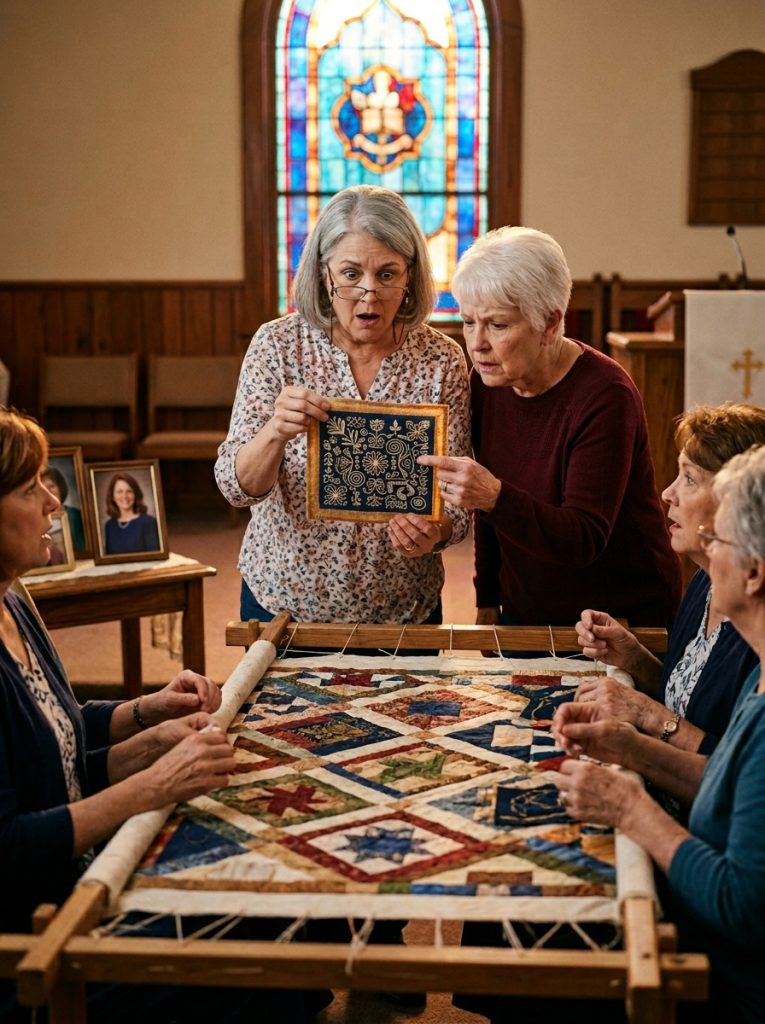
Meg read the square the way Ruth had taught her to read fabric, thread by thread, and she told us where it pointed.
The counted knots — three, nine, fifteen — weren’t a date at all. They were a hymn. Number three hundred ninety-something in the old green hymnal didn’t exist, but Meg understood it differently. Page from the back. The founders’ wall in the church office, third frame from the window.
The half-verse stitched into the border, the words rearranged just so, finished the sentence: Behind what they hung to be admired.
We went to the church that evening. All five of us, in a knot, the way you walk into deep water together.
The office was Glen’s domain. He kept it locked, but the building chair had a key, and the building chair was Meg’s brother-in-law, and in Halford that is the same as having a key yourself.
The founders’ wall was a row of framed photographs of dead men in high collars. Third frame from the window was the founding pastor, stern as a winter. I lifted it off its nail.
My hands were not steady. The church was dark except for the one lamp we’d dared to turn on, and every creak of that old building sounded like a key turning in the front door. Meg kept watch at the window. Sixty-some years I’d worshipped under that roof, and I had never once been afraid in it until that night.
Behind the frame, taped to the wall, was a flat tin. The kind that holds butter cookies at Christmas.
Inside the tin was a ledger and a letter.
The ledger was in Ruth’s hand. Two columns. On the left, what the congregation had given — the roof fund, the mission fund, the money we’d raised for the food pantry with bake sales and quilt raffles for three years running. On the right, where it had actually gone. Account numbers. Transfers. A second account none of the elders had ever seen, in Glen’s name alone.
The roof never got fixed because the roof money was never going to fix the roof.
The letter was longer.
I won’t share all of it. Some of it was Ruth’s, and Ruth’s alone, and she’d kept it hidden for a reason. But she gave us permission, later, to tell the parts that cleared her name, because she said the only thing worse than what happened to her would be letting it happen quietly to the next minister’s wife.
She wrote that for years, she hadn’t been allowed her own money. Not a dollar without asking. She wrote that her phone was checked, that her friendships were “pruned” one by one until the quilting circle was the last green thing left, and then that was taken too. She wrote that when she’d gone quiet at the market and looked away fast, it wasn’t coldness. It was that she’d been told, gently, in that warm-honey voice, exactly what she was and wasn’t permitted to say.
She wrote about the loneliest part of all.
That the kinder the town was to him, the more trapped she became. Every casserole carried to “that poor, patient man.” Every elder who clapped him on the shoulder after service. Each kindness was another brick in a wall that only she could see.
How do you ask for help, she wrote, from people who already adore your jailer?
She wrote that the day she found the second account, everything changed. That she understood, finally, that the man who controlled her also stood every Sunday and asked us to trust him with our roof and our poor.
And she wrote the line that I will carry to my own grave.
I could not say it out loud. He had taken my voice years ago. So I said it the only way I had left — in thread, where he would never think to look, to the only people who ever taught me I had a voice at all. If you are reading this, then the women found it. Of course you did. You always could read my hands.
She didn’t abandon us.
She left a map.
And she waited a whole year, wherever she was, to find out whether the women of Halford were still paying enough attention to follow it.
What happened next happened fast, the way a dam goes — slow for years, then all at once.
We did not take the tin to Glen. We took it to the regional elders and, on the lawyer’s advice, to the county. The second account was real. The transfers were real. There is a plain word for moving the congregation’s roof money into your own name, and it is not a word that warm honey can sweeten.
Glen Ackerman was placed on leave within the week and removed within the month. The denomination opened a formal review. The district attorney opened another. Restitution is a long road and we are still walking it, but the food pantry has its money back, and the roof, after all these years, is finally getting fixed.
The harder reckoning was ours.
We had pitied him. We had prayed for “poor Glen.” We had let a quiet woman become the villain of a story she never got to narrate, because the man telling it had a good voice and we liked the way it made us feel. I think about that more than I’d like to. How easy it was. How little it cost us to believe the worst of the one who couldn’t answer back.
We found Ruth through her sister, three states away, in a small apartment with a deadbolt and a job at a library and a phone number that was finally, only, her own.
Meg called her. Put it on speaker. The whole circle crowded around the phone in my fabric shop like teenagers.
“Ruth, honey,” Meg said. “We read it. We read all of it. We’re so sorry. We’re so sorry it took us a year.”
There was a long silence on the line. Then Ruth Ackerman laughed — a wet, broken, astonished laugh — and said the first free words I’d heard from her in longer than I could remember.
“You read my stitches,” she said. “I knew you would. I knew somebody would finally look at my work and see that it wasn’t a mistake.”
Ruth came home that spring.
Not to the parsonage — that chapter is closed, and good riddance. She rents the little house behind the library now, and she came back to Halford with her head up, because the town that had whispered her out owed her a welcome, and for once we paid what we owed.
She rejoined the quilting circle. Of course she did. She’s still the finest hand any of us ever saw.
There was a Sunday, not long after, when the interim minister asked Ruth if she’d say a few words.
She stood at the front of the church that had pitied her, in front of the very people who’d whispered her out of town, and she didn’t accuse a soul. She just talked about thread. About how a single square can hold a whole truth, if someone takes the time to read it right.
There wasn’t a dry eye in the building.
Including, I’ll admit, mine.
We finished the anniversary quilt together, all the squares laid out and joined, a hundred years of births and weddings and survivals stitched into one piece.
We put Ruth’s square in the center.
It hangs in the fellowship hall now, where the light from the stained glass falls on it in the late afternoon. Visitors think it’s just a pretty quilt. Sometimes one of them points to the center square and says the stitching there looks a little different, a little odd, almost like a pattern.
And one of us will smile and say yes.
Yes, it does.
That one was stitched by a woman who couldn’t speak — until she found a way to be heard by the people who knew how to listen with their eyes.