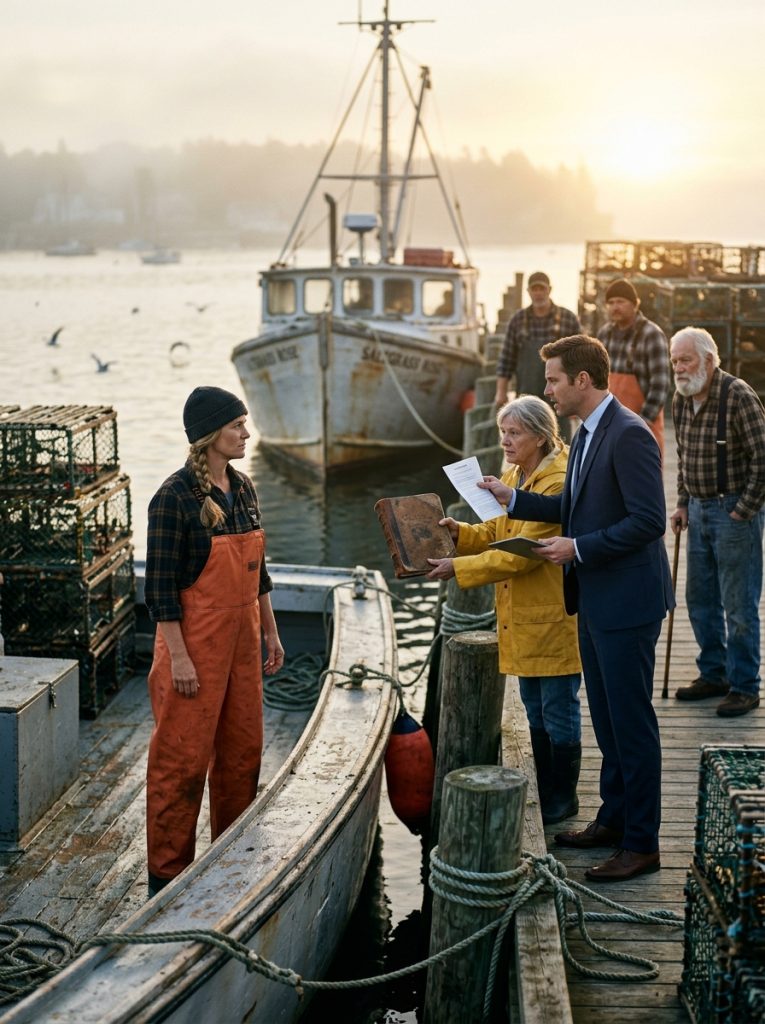
Gus Pell set the logbook down on a lobster crate and opened it with hands that shook a little, the way old hands do.
The page was dated September 1961.
The ink had gone brown. The handwriting was a harbor master’s careful block print, the kind of penmanship they don’t teach anymore.
“Read it out loud, Gus,” Commissioner Nash said. “Loud enough for Mr. Lyle to hear.”
Gus cleared his throat.
“‘Be it recorded this day,'” he read, “‘that the Foss family, in exchange for the deeding of their shoreline parcel to the Town of Wickham for the construction of the public pier, is granted in perpetuity a working berth at the inner slip, free of fee, transferable to heirs, so long as a working vessel is moored there and the family fishes these waters.'”
The dock had gone very quiet. Even the gulls seemed to be listening.
“My grandfather gave the town the land for that pier,” Lena said slowly. The pier Meridian’s clients now strolled along with their lattes. The pier with the brass cleats and the NO COMMERCIAL TRAFFIC signs. “He gave it to them. For free.”
“He gave it to them for this,” Nash said, and tapped the page. “A right your family forgot it had, because for sixty years nobody ever needed to look it up. You don’t go hunting for a key when no one’s tried to lock the door.”
Curtis Lyle had recovered enough to start talking again. It is the great gift and the great curse of men like Curtis Lyle that they can always start talking again.
“That document is sixty years old,” he said. “It predates our acquisition. It predates the harbor authority’s master plan. Commissioner, with respect, a handwritten note in a fisherman’s diary is not a recorded deed—”
“It’s recorded,” Gus said.
Lyle stopped.
“Town clerk’s office,” Gus went on, mild as milk. “Volume nine, page two hundred and twelve. I filed a certified copy myself in 1978, when the last developer tried this same tired thing. Figured somebody’d try it again someday.” He looked at Lyle over his glasses. “Wasn’t wrong.”
Beatrice Nash closed the logbook.
“Mr. Lyle,” she said. “Three weeks ago, my office received complaints that a private developer was pressuring the last working boats out of a public harbor. So I came to see for myself. Quietly. The way I always do, because people show you who they are when they don’t think anyone who matters is watching.”
She unzipped her yellow slicker and folded it over her arm, and underneath she was wearing the plain navy blazer of a woman who signs things for a living.
“I watched your company tell the Pelletiers their slip rights were ‘expired’ when they weren’t. I watched you tell the co-op they’d be fined for repairs the marina was contractually obligated to make. I watched you tell this woman, in front of her own father, that she was squatting on water her grandfather gave this town.”
“That’s a negotiation,” Lyle said. “That’s how—”
“And in three weeks,” Nash continued, “do you know who offered me a hot cup of coffee on a cold morning, without knowing or caring who I was? Who handed me a fillet off her catch because she thought I looked hungry and lived alone?” She nodded at Lena. “Her. The woman you called a squatter. Not one person from your company so much as said good morning to the old lady sketching on the dock. You only see people you think can help you.”
A murmur ran down the dock.
The fishermen who’d gathered — people who’d known the Foss family their whole lives, some who’d already sold their own slips under the same pressure — shifted closer.
“She gave me bait on credit all last winter,” somebody called out. “Never once asked when I’d settle up.”
“Towed my boat in for free when my engine quit off the point,” said another. “In a January gale.”
“That’s your squatter, mister.”
Curtis Lyle looked around at the faces closing in, and for the first time the polish cracked. Underneath it was just a man in an expensive suit holding a folder full of paper that didn’t mean anything anymore.
Big Tom Foss had made his way down the pier on his cane. He stood beside his daughter now, and his eyes were wet, and he wasn’t looking at the suit or the commissioner. He was looking at the boat. The Saltgrass Rose. His father’s keel.
“Lena,” he said quietly. “I told you to take the buyout. I’m sorry. I got tired.”
“You held on long enough for the right morning, Dad,” she said, and put her arm around him. “That’s all any of us can do.”
It came apart fast for Meridian Coastal Group after that.
Commissioner Nash didn’t just enforce one berth right. She froze the entire marina conversion pending a state review of how the company had acquired the other slips — and the review found exactly what she’d watched happen with her own eyes. Pressure. Misrepresentation. Fees that didn’t exist on paper. The Pelletiers got a letter saying their sale was being investigated for fraud. So did the co-op.
Curtis Lyle was named in the report. Within two months he was no longer with the company, and the company itself, drowning in legal exposure and bad press, sold the whole development at a loss to a nonprofit harbor trust that had been quietly waiting in the wings.
The trust’s first act was to repaint the signs.
The new ones don’t say NO COMMERCIAL TRAFFIC. They say WICKHAM WORKING HARBOR — EST. 1961, and under that, in smaller letters, a line Beatrice Nash insisted on: A place that remembers the people who built it.
The brass cleats stayed. The fancy floating docks stayed too. Turns out there’s room in a harbor for a pleasure boat and a fishing boat, as long as nobody’s trying to push the other one out.
The town threw a supper that fall in the new harbor pavilion. They put Big Tom at the head of the table and made him tell the story — his father, the shoreline parcel, the handshake that saved his granddaughter sixty years later. He told it three times. Each time it got a little bigger. Nobody minded.
Lena still hauls before dawn. The Saltgrass Rose still smells like work. But now the morning yoga class on the new pier waves to her when she comes in heavy with the catch, and the café sells her fish, and tourists pay actual money to watch a real captain unload a real day’s labor.
Gus Pell got a plaque. He pretends he hates it. He visits it twice a week.
And Birdie — Commissioner Beatrice Nash — still comes to Wickham now and then, on no official business at all. She sits on a crate in a yellow slicker and sketches the boats.
Lena always brings her a coffee.
“You didn’t have to keep doing that,” Nash told her once. “You know who I am now. The test’s over.”
Lena handed her the cup anyway and looked out at the water going gold.
“It was never a test to me,” she said. “It’s just how you treat people. Turns out that’s the same thing my grandfather thought, sixty years ago, when he gave away a beach and asked for nothing but the right to keep fishing.”
Nash smiled and took the coffee.
Out on the inner slip, free of fee, transferable to heirs, the Saltgrass Rose rocked gently at the berth that would always, now, be hers.